
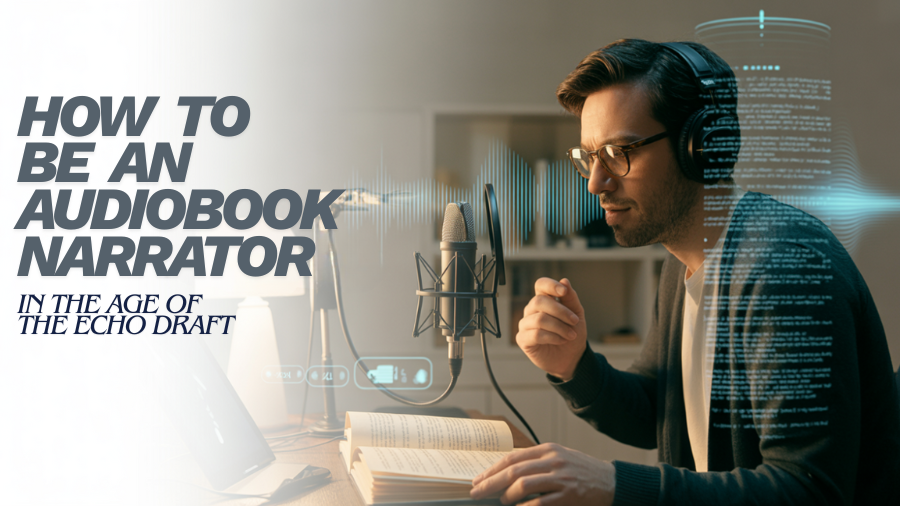
The job often starts in the dark. A blanket hung over the door. A lamp turned low. A glow from a screen filled with more words than anyone’s throat should speak in a day. Outside the room: traffic, kids, the buzz of a phone. Inside: one person, one mic, and a long, slow breath that turns a silent book into a living voice.
Most listeners never see that small room. They tap “play” on a commute, or while they wash dishes, and a calm voice fills the space where their own thoughts used to be.
In the last decade, as print sales wobble and screens multiply, more people “read” with their ears. The old question of how to be an audiobook narrator has moved from the edges of the acting world into the center of how stories now travel. Learning this job is not only about making money. It is about how books survive in a noisy age.
This article looks at the real work behind that warm, steady sound. It sets out the basic audiobook narrator requirements that sit under the surface charm. It examines audiobook narrator training in a time of gig work and home studios. And it introduces a simple new writing technique that helps both narrators and authors shape prose for the ear as much as for the eye. The aim is not to sell a dream. It is to show, with clear eyes, what this life is, how to start audiobook narration, and how the practice of speaking books aloud may change the way we write them.
How to Be an Audiobook Narrator When Books Live in Your Ears
The first surprise in learning how to be an audiobook narrator is that the work is less about sounding “dramatic” and more about sounding true. A strong narrator does not yell like a stage actor or slide into cartoon voices. They sit almost inside the listener’s head. The performance is close, gentle, and oddly private.
To reach that place, the narrator has to learn a new kind of reading. On the page, a line of text looks flat. But when spoken, it acts like music. Commas become rests. Paragraph breaks feel like small scene changes. Italics pull the pitch up. A full stop drops it down. The narrator starts to see each page not as a wall of words but as a simple score. Their job is to find that score and follow it without fuss.
Soon, another truth appears. Some prose loves to be read aloud. It rolls in the mouth and lands with ease. Other prose fights back. Long, tangled sentences that seem elegant in print can choke the breath. Stacks of abstract nouns (“situation,” “conversation,” “realization”) turn to clouds in the air. The body has to push hard just to get them out.
That is where the craft bends toward a new kind of writing. As narrators learn how to be an audiobook narrator in practice, they begin to feel which lines sing and which lines sag. They feel this in their lungs and tongue, not in a workshop. The Echo Draft method grows from that feeling. It treats the body as the first editor and the voice as a guide for revision.
Audiobook Narrator Requirements: More Than a Nice Voice
On paper, the list of audiobook narrator requirements looks simple: a clear voice, the ability to read smoothly, a decent mic, and a quiet room. In practice, the demands reach much deeper.
There is stamina. A single finished hour of audio can take two or three hours to record, sometimes more if the text is dense or tricky. The narrator must sit still, hold a steady tone, and keep the story in mind, line after line. The body gets tired in strange ways: a tight jaw, a sore back, a low ache around the eyes from reading ahead.
There is an emotional range. Audiobooks live in a narrow band of volume. Shouting or whispering can break the recording. Yet the story still asks for grief, joy, anger, desire, boredom, fear, and wonder.
All of that has to fit between “too loud” and “too soft.” The narrator learns to shift feeling with small moves: a shorter breath, a slight delay before a hard word, a smile that can be heard but not seen.
There is memory. A book may carry dozens of characters. Each has a voice, an age, a weight, a pace. The narrator must track all of them across ten or fifteen or even thirty hours, circling back weeks later to pick up a single side character in a final scene. Notes help. So does a light character map. But in the end, the mind has to hold the world of the book as a living thing.
Finally, there is a twist of ego and humility. The narrator has to care enough to carry the book. They must believe that their choices matter: where to pause, where to lean in, where to let a line go dry. At the same time, they must not take the book hostage. The author’s voice sets the rules. The narrator bends their own style to serve it, not the other way around.
Audiobook Narrator Training: Learning to Think in Sound
“Audiobook narrator training” may sound like a neat package, like a few online classes and a certificate at the end. There are such classes, and some are helpful. But most real training happens in slow, private hours with no one watching and no credits to show.
Actors who come from the stage have to unlearn some habits. In a theater, big choices carry across the room. In a booth, those same choices feel fake. A lifted eyebrow that seems tiny on stage becomes huge in the mic. Stage actors learn to cut the gesture in half, then in half again, until the feeling fits in a breath.
Radio hosts bring other habits: speed, polish, a smooth “host voice” that works fine for news but can flatten a scene in a novel. They learn to slow down, to let small flaws stay, to sound less like a station and more like a friend.
True audiobook narrator training happens in loops of listening. Narrators study the masters in their field the way young writers study great sentences. They listen to how someone moves through a long paragraph without rushing. They notice where a skilled voice pauses before a joke or softens before a hard fact. They rewind a small scene to hear how the narrator enters a flashback or shifts tense without jarring the ear.
Simple drills help:
- The one-page test. Read one page out loud at a normal pace. Record it on a phone. Play it back while following the text with your finger. Every stumble, breath gasp, or odd stress jumps out. Mark each spot on the page.
- The bland to vivid test. Take a flat paragraph from a manual or news story. Read it once in a neutral tone. Then, without changing the words, read it again as if it were the most important thing your listener will hear today. See how small shifts in timing and energy change the feel.
Over time, this audiobook narrator training teaches a new way to see text. The narrator no longer treats a book as a silent object. They see it as something that will move through time, second by second, inside a stranger’s head. That shift sets the stage for a deeper audiobook narration guide, the Echo Draft.
Audiobook Narration Guide: The Echo Draft Method
Most guides explain mic distance, room tone, and mouth clicks. The Echo Draft is different. It is an audiobook narration guide and a writing technique in one. It treats the way words feel in the mouth as equal to how they look on the page.
The method is simple and can be used by narrators, authors, or both together. It works best on scenes that carry emotional weight or key information. Here is how it works in four passes.
Pass One: The Raw Read
Take one scene, a page or two. Read it out loud at a natural pace. Do not try to “act.” Just talk. Use a pencil (on paper) or simple marks (on a tablet) and note the places where:
- You run out of breath.
- You trip over a phrase.
- You lose track of who is speaking.
- Your mind drifts for a moment.
Those marks show where the text and the breath are not yet in sync. The problem may not be you. It may be the line.
Pass Two: Scoring the Page
Now go back and lightly “score” the text, as if it were music:
- Draw a slash ( / ) where you felt a natural pause.
- Underline words that you stressed without planning to.
- Circle long chains of commas or clauses.
- Put a small wave over sentences that rose in tone and a downward tick over those that fell.
This turns the flat text into a simple sound map. You can now see where the voice wanted space, where it wanted speed, where it stalled.
Pass Three: The Echo Draft Rewrite
Pick one marked paragraph. Keep the meaning, but rewrite it for the ear. You might:
- Break one long sentence into two or three shorter ones.
- Move key facts closer to the start of a line.
- Swap abstract words for concrete ones (“tree” instead of “vegetation”).
- Cut repeated words or dull filler.
Read the new version out loud. Listen to how it feels. This “Echo Draft” is the scene speaking back to you. It is the sound of your own text answering your breath.
Pass Four: Pattern and Spread
Look for patterns in your marks. Maybe you always trip over three-clause sentences. Maybe you always rush past parenthetical phrases and get lost. Those patterns show where your style and your voice push against each other.
Once you see the pattern, you can fix it before you step into the booth. Authors who work with narrators can use the Echo Draft on drafts. Narrators who cannot change the text can still use the marks to plan breaths and stress, turning a rough passage into a smoother performance.
In a world where many people will never see the printed page, this kind of audiobook narration guide is not a bonus. It is a way to respect the fact that prose now lives, more and more, in the air.
Audiobook Jobs for Beginners: The Hidden Slush Pile
The Echo Draft may make the pages easier to read. Does it not answer the next hard question: how to find audiobook jobs for beginners when you have no credits and no studio?
The biggest publishers usually work with studios and long-time voices. Their jobs rarely land on public job boards. The entry points for new narrators sit lower in the stack:
- Independent authors who release their own work.
- Small presses with thin budgets but real passion.
- Educational and training projects that need clear, plain narration.
- Volunteer outfits that record books for people who cannot see the page.
The work here is mixed. Some scripts are polished. Others arrive as loose word files full of typos, tense shifts, and missing commas. Some clients know exactly what they want. Others are vague or change their minds halfway through. The pay can range from small flat fees to no pay at all.
For audiobook jobs for beginners, the first goal is not to land the “perfect” book. The goal is to build proof: proof that you can carry a story, keep the sound steady, meet a deadline, and take notes without flinching. A ten-minute sample of a public domain story can show this. So, can a short nonfiction piece be done for a local group?
In this early stage, the narrator also learns a quieter skill: the art of not taking silence as a verdict. Many auditions go into a void. No reply does not always mean dislike. It often means chaos on the other end.
A publisher may receive hundreds of samples for one book. A steady practice is to send work out, mark the date, then move on to the next page, the next book, the next small step in audiobook narrator training.
How to Start Audiobook Narration When No One Knows Your Name
The question of how to start audiobook narration can feel like a riddle. You need credits to get work; you need work to get credits. Breaking that loop means building a small, self-made path.
It often begins with a home practice routine:
- Daily reading. Fifteen to thirty minutes reading out loud from varied texts novels, essays, manuals, children’s books. The aim is not perfection. It is comfort.
- Weekly recording. Once a week, record a ten-minute story or essay. Edit only the major mistakes. Listen back a day later with fresh ears. Make a list of what you like and what you do not.
- Genre testing. Try romance, crime, fantasy, literary fiction and nonfiction. Notice what feels natural. Some voices sit well in light, chatty books. Others shine in dry humor or serious work. These notes will guide which audiobook jobs for beginners to chase.
Next comes the demo, the first real public step. A demo does not need to be fancy. It needs to be clear and honest. Three short samples, one fiction scene, one dialogue-heavy passage, one nonfiction bit are often enough. Agents and producers do not want a collage of tricks. They want to know whether you can carry a straight line from start to finish.
Then there is the question of where to send that demo. Narrators may:
- List on platforms that match voices with independent authors.
- Email small presses with a short, respectful note and a link.
- Join online groups where engineers, directors, and narrators share leads.
At this stage, learning how to be an audiobook narrator means learning to endure not-knowing. Will this audition land? Will this email be read? The only solid answer is the work itself: the time in the chair, the pages read, the slow improvement that only you can hear at first.
Audiobook Home Studio Setup: Building a Quiet Box
Sooner or later, anyone serious about the work reaches a hard limit: the room. You can only make so much progress if your “studio” is a kitchen table near a loud fridge. A careful audiobook home studio setup does not have to look like a space station. It just has to sound like a quiet box.
The core idea is to build “a room inside a room.” Many narrators start in closets. Clothes hanging on rods act as thick, soft sound absorbers.
Blankets and duvets draped over doors cut down on reflections. A rug helps. So do soft panels on hard walls. The goal is not total silence that is almost impossible in a home but a consistent, non-echoey sound.
Noise is the main enemy.
Fridges, fans, air conditioners, street traffic, pipes in the wall, and kids running above. The narrator learns the patterns of the building. When does the garbage truck arrive? When does the neighbor’s dog bark? Recording times shift around those peaks.
Inside this small space, comfort becomes a major part of the audiobook home studio setup:
- A chair that does not squeak and supports the back.
- A stand that puts the script at eye level, so the neck stays neutral.
- A small lamp that does not buzz or hum.
- A way to keep water close without risk to the gear.
The booth is both a tool and a trap. It keeps sound out, but it can hold stress in. Long sessions in a cramped space can strain the body.
To handle this, many narrators build small rituals: stretches between chapters, a quick step outside between takes, a short walk after a long day. These are not luxuries. They are part of the invisible structure that lets the voice stay clear.
Audiobook Narrator Equipment: Tools, Not Toys
Once the room exists, the next question is gear. The list of audiobook narrator equipment can read like marketing copy: microphones, headphones, interfaces, preamps, and software. The real rule is simple: good tools are the ones that get out of the way.
A decent microphone is the heart of the setup. It does not have to be the most expensive model. It has to match the voice and the room. A bright, sharp mic in a hard space can sound harsh and thin. A slightly warmer mic in a soft booth can sound close and human. Many narrators test a few options by recording the same short passage and listening back with eyes closed. The right mic is the one that makes them sound like themselves on their best day.
Closed-back headphones do two jobs at once. They keep room noise out, and they let the narrator hear mouth clicks, plosives, and tiny hums from the gear. The point is not to obsess over every sound. It is to catch the bigger issues before recording a full chapter.
An audio interface sits between the mic and the computer. It turns the analog voice into clean digital data. Simple, sturdy models work well. Fewer knobs mean fewer chances to bump a setting mid-book and end up with mismatched chapters.
Recording software can be plain. Many narrators use basic, free programs that let them record, cut, and save in standard formats. Fancy effects are rarely needed. Most audiobook work only asks for a clean, even sound with a bit of gentle noise control.
The rest of the audiobook narrator equipment list is practical:
- A pop filter to soften hard “p” and “b” sounds.
- A stable mic stand.
- A backup drive for finished files.
- A second power strip, because gear grows.
The temptation, especially for beginners, is to keep buying new gear in search of a magic fix. Often, the real fix is cheaper: move the mic, hang another blanket, drink more water, slow down. Tools matter. But the voice, the text, and the room shape most of what the listener hears.
Audiobook Narrator Salary: What a Voice Is Worth
Talk about the job long enough, and someone will ask about money. The answer to “What is a fair audiobook narrator salary?” is both simple and hard: it depends, and that “depends” hides a lot.
Most work is paid by the “finished hour.” This means a set fee for each hour of final, edited audio. A short book might run four finished hours. A long epic might run twenty or more. Rates range widely. Union jobs through large book publishers tend to pay more and provide protections. Non-union jobs can sit anywhere from modest to worryingly low.
But “per finished hour” is only part of the story. To find your real audiobook narrator’s salary, you have to count the time a book takes. For each hour of finished audio, a narrator may spend:
- One hour of reading and marking the text before recording.
- Two to three hours of recording, with breaks and retakes.
- One to two hours editing, cleaning noise, and fixing mistakes.
A rough rule is that each finished hour hides four to six working hours. When narrators divide the fee by those hours, the hourly rate can look far less glamorous.
This does not mean the work is not worth doing. It means the math has to be clear. Narrators who track their time learn which kinds of projects fit their lives.
A complex fantasy with many voices and strange names may need higher pay than a simple essay collection. Long, urgent deadlines may carry a cost in voice strain that the fee should reflect.
Money also ties back to the Echo Draft. Text that has been shaped with the ear in mind is faster to record. Clean sentences, clear attributions, and well-placed breaks mean fewer mistakes and less editing. In quiet ways, good writing supports a better audiobook narrator’s salary by cutting hidden labor.
In a gig economy, where many creative workers drift from job to job, learning how to be an audiobook narrator includes learning to say, “This is what my time and voice are worth.” Those words are not easy to speak. But they are part of the craft.
Audiobook Narration Tips for Beginners: Living With the Mic
Beginner narrators often look for one secret rule. There isn’t one. Instead, there are dozens of small habits that, taken together, let a voice survive book after book.
Here are some audiobook narration tips for beginners that grow directly from life in the booth and from the Echo Draft idea.
Treat water as gear.
Hydration is not an afterthought. Drink water steadily through the day, not just in sips between chapters. Many narrators keep a simple rule: one glass before, one glass during, one glass after a session. Tea can help. Dairy and very sugary drinks tend to add mouth noise.
Warm up like an athlete.
Five minutes of gentle lip trills, tongue stretches, and light humming can save you from strain. It feels silly at first. Do it anyway. The voice is a set of muscles. Muscles work better when warm.
Build a “trouble word” list.
Every book has names, places, and terms that can trap the tongue. Look them up in advance. Write a simple note on how they sound. Keep that list in the booth. The few minutes you spend here can save an hour of pickups later.
Use the Echo Draft on yourself.
Once or twice a week, record a small piece, then mark where you rushed, dragged, or sounded flat. Rewrite one paragraph for the ear using the Echo Draft steps. Even if you cannot change the client’s text, you are training your brain to feel better paths through language.
Remember, the listener is one person.
It helps to picture someone in a small room: on a bus, walking a dog, doing the dishes. Not a crowd. Not “the market.” One real person who chose your book out of all the noise. Speak to that person. Ask, often in your own head: “If we were alone in a room, how would I tell this?”
Rest on purpose.
Voice strain can creep in slowly. A tight throat may not show up as pain. It may show up as a dull, flat tone. Build breaks into your day before the voice gets tired. Stand up. Look far away to relax your eyes. Step out of the booth for real air. These pauses are part of audiobook narrator training, not signs of weakness.
Over time, these audiobook narration tips for beginners become habits. The mic stops feeling like a test. It starts to feel like a tool you live with, as familiar as a pen in the hand of a writer.
How to Be an Audiobook Narrator Tomorrow: The Future Voice of the Page
The dark booth at the start of this story is not likely to vanish. If anything, there will be more such rooms in more homes: closets turned into studios, corners turned into padded forts, basements threaded with cables and blankets.
As more books find their first audience through headphones instead of hardcovers, the question of how to be an audiobook narrator will pull in actors who want steady work, writers who want to voice their own books, and people with day jobs who like the quiet company of text at night.
The Echo Draft method is a small answer to a larger change. As more stories are spoken, the line between writing and performance grows thin.
Narrators learn to think like editors. Authors learn to think like narrators. Editors start to ask not only, “Does this sentence look right?” but also, “How will this sound when it is the only voice in someone’s ear on a hard day?”
There are risks in this new landscape. If every book is written only for the ear, some of the wildness of the page—its long loops, its dense thickets—may fade.
But the Echo Draft does not ask writers to flatten their style. It asks them to test the path their sentences must walk. If a line is meant to be hard, let it be hard on purpose. If a thought is meant to be complex, give the listener a rope to hold.
In the end, audiobook work comes back to a small, steady act: one person, alone, reading words that someone else arranged, for a stranger they will never meet. The narrator does not know where that stranger is or what kind of day they have had. They know only that, for a little while, their voice will be the shape that story takes.
For some authors and small presses, of course, learning every step of narration may not be possible or even desirable. Their strengths live on the page.
In that case, handing the mic to specialists can make sense. Independent outfits and focused publishers, among them Arkham House Publishers, who offer full audio narration services at reasonable and affordable pricing, now help writers bring their books into the spoken world without forcing them into the booth.
It is one more sign that the work of giving stories a voice can be shared: between writer and narrator, between page and sound, between the quiet room where a book is born and the many quiet rooms where, years later, someone will press “play” and let that book live again in the ear.