
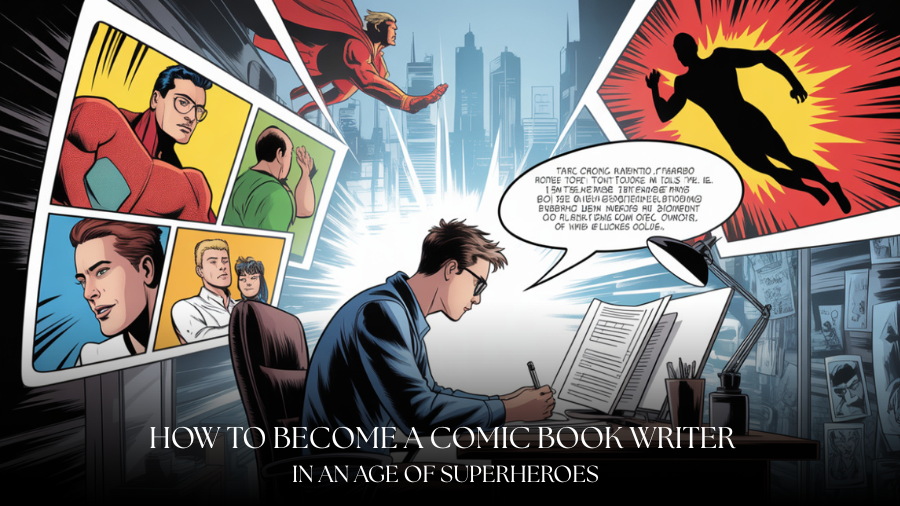
On a winter subway ride, a teenager in a worn hoodie is reading the same page again and again. The car shudders. Lights flicker. Doors chime. He does not look up.
A single splash page holds him still: a hero mid-fall, city lights burning below, a caption hanging in the air like a held breath.
Most people on that train will never know the name of the person who wrote that page. They may remember the artist, the costume, the logo on the cover. But somewhere, long before this book hit the shelf, a writer sat alone at a desk and tried to describe a feeling so sharply that a stranger on a rattling train would forget the world for a moment.
This is the quiet, strange comic book writer job at the heart of comics. To become a comic book writer is to build images with sentences that no one will ever see, so that an artist can draw the pictures everyone remembers. It is a career full of myths: overnight success, big checks, a golden mail from Marvel, and full of hard, patient work that almost no one talks about.
This article makes that work visible. It asks a simple question: how does someone actually become a comic book writer today? and answers it in panels rather than in dreams.
It lays out a new, practical writing technique built for comics, offers a comic book writing guide for both beginners and stubborn veterans, and follows the real path from first script to possible career.
In a time when superhero movies rule box offices and webcomics quietly gather millions of reads, learning this craft is not just a niche hobby; it is a way to speak in one of the dominant languages of popular culture.
Along the way, there is a tricky fact to face.
No one can promise that you will be hired by Marvel, or that your creator-owned series will sell out at midnight. But there is something more honest on offer: a way to build the skill set that every working comic writer, from indie zine makers to big-company veterans, relies on every day.
How to Write a Comic Book: Thinking in Panels, Not Paragraphs
Most people who want to become a comic book writer start with the wrong question. They ask, “What is my big idea?”
A better first question is, “What happens in one panel?”
Comics do not move the way prose does. Prose flows in sentences and paragraphs; comics jump from moment to moment. Each panel is a frozen slice of time.
The reader’s mind fills in the motion between the frames.
So the core skill in how to write a comic book is not fancy language.
It is the ability to pick which moments to show and which to leave in the gaps.
Here is the new technique, simple enough to sketch on the back of a receipt: the Panel Grid Method.
The Panel Grid Method asks the writer to stop thinking like a novelist and start thinking like an editor in a small film studio.
Before writing any dialogue, the writer draws a nine-panel grid on a page, three panels across, three down.
Each square stands for one beat in a scene. In each square, instead of writing full lines, the writer notes three things:
- What the reader sees.
- What has just changed.
- What emotion should land.
One square might read: “Close on hero’s face / realises he was lied to / hurt anger.”
Another might say: “Wide shot of ruined street/silence after blast / numb shock.”
The writer fills all nine squares like this, quickly and without polish.
No dialogue. No captions. Just visible changes and feelings.
This sounds almost too simple, but it trains one of the rarest habits in comic writing: the habit of cutting.
Many new writers try to pack three or four actions into one box.
On the page, that becomes impossible for the artist to draw and hard for the reader to follow. The Panel Grid Method forces each panel to carry one clear action and one clear feeling. It is a limit that makes the story stronger.
Only once the grid feels right does the writer move on to script pages.
By now, the scene already has shape. The hard choices of where to start, what to skip, and when to land the emotion have been made.
The result is a scene that is clean, visual, and easier for an artist to translate.
Steps to Write a Comic Book: From Daydream to Script
The fantasy version of this path is fast: a spark of an idea, a night of inspired typing, and then a glowing file called Issue One Script.
The real steps to write a comic book are slower and loop back on themselves, but they are teachable.
Step 1: Start with a one-sentence promise
Before character sheets, before long backstory, there is a single sentence that explains what the reader is really being offered.
This is not marketing copy. It is a private compass.
“Iron-willed teen tries to save his family business by entering an illegal mech-fighting league.”
“An aging witch runs a small-town diner where the daily specials fix the customers’ deepest regrets.”
If that sentence feels dull or vague, the book will too. Rewrite it until it carries a clear, strange hook. This is the seed of every panel that follows.
Step 2: Break the story into issues and pages
A standard comic issue is around twenty pages. Each page holds three to six panels. That means a single issue may have eighty to one hundred small beats of action. Thinking at that scale can be dizzying.
A simple frame helps: three acts across twenty pages.
- Act One: Pages 1–6. Set up the world, the main character, and the first clear problem.
- Act Two: Pages 7–15. Make that problem harder, stranger, or more costly.
- Act Three: Pages 16–20. Force a choice that changes something real; end with a new question.
This is not a rule; it is a rhythm. It is also where the Panel Grid Method comes in. The writer can sketch the key beats for each act in a few nine-panel grids, then shuffle them until the build feels right.
Step 3: Use the Panel Grid Method on every key scene
Not every moment in an issue needs a grid. But the major scenes, such as the opening, closing, and any emotional turning point, should get one. The writer draws the nine squares, fills in what the reader sees, notes the change and the feeling, and only then writes the script.
Over time, this becomes almost like muscle memory. Seasoned writers do the grid in their head; beginners benefit from doing it on paper. It turns a vague “cool idea” into a sequence of concrete, drawable moments.
Step 4: Draft the script, panel by panel
With the grids in place, the writer moves into comic book script writing. Each page is broken into panels. Each panel gets a brief description and any dialogue or captions.
A page might read:
Page 4 (5 panels)
Panel 1
Wide shot. Street outside the mech arena, early dawn. Rain on metal signs. No people yet.
CAPTION (HERO): “There is still time to turn back.”
Panel 2
Closer on HERO, hood up, counting cash. His hands shake.
HERO (thought): “But debts don’t.”
And so on.
The goal is not to impress with fancy language. It is to be clear, visual, and kind to the artist. The writer tells the artist what must be seen and leaves room for how it will be drawn.
Step 5: Revise with the artist in mind
Many new writers assume revision means punching up dialogue. In comics, revision often means cutting words. If a facial expression shows the emotion, the caption can go.
If the grid has three panels that do the job in two, remove one.
The clearest way to become a comic book writer who keeps getting hired is not to write the flashiest lines. It is to be the writer whose scripts make the artist’s job easier and the reader’s experience smoother. Editors remember that. If you are stuck on where to start or how to write, you can take the assistance of professional Arkham Book Publishers comic experts.
Comic Book Writing Guide: Story, Structure, and the Art of Leaving Things Out
Most how-to guides promise tricks. Comics are less about tricks and more about restraint.
A comic book writing guide that respects the medium starts with three questions:
- What is the reader supposed to feel on this page?
- What is the one thing that must change between the first panel and the last?
- What can be left silent?
Silence is the secret muscle of comics. A wordless panel can hit harder than a paragraph of explanation. The Panel Grid Method makes silence part of the plan. If a moment should be quiet, it gets its own square, its own panel. The writer can mark “no dialogue” in the grid so that the hush is not an accident but a choice.
Structure matters too. The last panel on each page is a hinge.
The reader sees it while turning the page, so it carries the promise of what comes next.
A good hinge panel raises a clear question: Will she tell the truth now? What is behind that door?
The Panel Grid Method helps here as well; one of the nine squares may be devoted to that hinge moment, so the writer does not bury it in the middle of a page.
Comic Book Script Writing: The Hybrid Language of Words and Pictures
Comic book script writing is a hybrid form. It is not a film script, though it borrows some of that logic. It is not a prose story, though it needs character and voice. It is a private document meant for a small team, artist, letterer, editor who will turn it into something public.
There is no single standard format. Some scripts are sparse: short panel descriptions, minimal direction. Others are dense, with camera angles, lighting notes, and long side comments. The best approach is the one that gives the artist enough to work with and no more.
The Panel Grid Method fits into any format. It lives earlier, in the outline stage. By the time the writer is typing “Panel 3,” the important choices have already been made in the grid.
This frees the script to be clean and calm.
A typical panel entry might include:
- Panel number and size, if needed (“Panel 1 large, top third of the page”).
- Brief visual description.
- Dialogue and captions, each tagged with the speaker.
- Any important sound effects.
Writers who want to become comic book writers in a competitive field often worry about format above all else.
Editors, though, tend to care more about clarity and timing.
If the script is easy to read and the page turns land well, minor formatting quirks can be fixed.
How to Write a Comic Script: A Small Scene, Slowly
Theory is useful. A scene is better.
Take a simple scenario: two siblings on a rooftop, one about to leave town. In prose, this could run for pages. In a comic, it might take only two.
Using the Panel Grid Method, the writer first sketches nine beats:
- Rooftop wide shot; night city. / Calm before talk/quiet.
- Sister kicks feet over the ledge. / Brother enters. / mild awkward.
- Close on brother’s worried face. / He tries to joke. / forced lightness.
- Close on sister’s hands gripping the edge. / She avoids eye contact. / tension.
- Medium two-shot. / She blurts, “I got in.” / shock.
- Close on brother’s silence. / He processes. / hurt pride.
- Wide shot. / He hugs her, still upset. / mixed love.
- Close on sister’s tearful smile. / Relief. / hope.
- Rooftop is wide again. / They sit together, city below. / bittersweet peace.
Then the writer turns those beats into panels.
Not every beat must be one panel; some can merge.
But the heart of the moment is laid out.
When the script is drafted, the dialogue is spare because the grid has already done the emotional work.
In this way, learning how to write a comic script becomes less about sudden inspiration and more about careful sequencing.
This is the part of the craft that can be taught and practiced, page after page.
Tips for Writing Better Comic Dialogue: When Fewer Words Hit Harder
Bad dialogue is easy to spot. Characters speak in full, polished sentences. They say exactly what they feel. They sound like the writer, but with capes.
The best tips for writing better comic dialogue start with listening.
Read the balloons out loud. If a line feels long in the mouth, it will feel cramped in a small oval on the page. If it sounds like a speech, ask if the character would really say this while dangling from a bridge.
Three simple tests help:
- The Breath Test: Can each balloon be read in one breath? If not, cut.
- The Overlap Test: Do two characters say the same thing in different words? Merge or remove one.
- The Silent Panel Test: Can this line be cut and replaced with a silent look, gesture, or background detail? Try it and see.
The Panel Grid Method supports all three. Because the emotional beats are laid out in advance, the dialogue does not need to do all the work. It can do less and land harder.
New writers often fear that short lines will make their book feel thin. In practice, tight dialogue makes room for the art to breathe. It respects the reader’s ability to infer. Over time, this kind of restraint is one of the marks of a writer ready for bigger, riskier stories.
Comic Writing for Beginners: Building a Real Practice
There is a quiet heartbreak hidden in the phrase “comic writing for beginners.”
It suggests a short phase, like learning to ride a bike, after which the training wheels come off, and success rolls in. In reality, almost everyone in comics is, in some area, still a beginner.
The first job is not to land paid work. It is to build a practice that can last long enough for paid work to be possible.
That means:
- Writing small stories, not just dreaming of long sagas.
- Finishing short scripts, even when they feel clumsy.
- Sharing work with trusted readers or artists and listening more than defending.
- Learning to revise without drama.
The Panel Grid Method fits this stage well because it shrinks the task. A beginner does not have to “write a 120-page graphic novel.” They have to fill nine boxes, then another nine. One small scene becomes a short story; a few short stories begin to look like a body of work.
Many working writers began with self-published mini comics, online strips, or short collaborations. They did not wait for permission. They learned in public, issue by issue.
Comic Book Writer Career: What Comic Book Writer Jobs Really Look Like
It is tempting to imagine a comic book writer’s career as a straight, glamorous path: pitch, contract, instant fan base.
The reality is more jagged.
Most writers patch together several streams of work:
- Creator-owned books that they write and often help fund.
- Work-for-hire stories in shared universes.
- Related jobs, scripting games, story consulting, teaching.
- Sometimes an entirely separate day job.
The best preparation is not only craft but also rhythm. A comic script is a deadline machine. Issues must ship on schedule.
Artists, letterers, colorists, printers, and shops depend on the writer turning in pages on time.
Here again, the Panel Grid Method is less about art and more about workflow.
Because it breaks scenes into units, it allows a writer to work in small, steady chunks. One evening might be a grid for a scene. The next evening, the script for that scene. Over weeks, an issue grows.
Writers who manage their energy this way are the ones editors tend to hire again. They can do any comic book writer jobs without burning out or vanishing.
They can become a comic book writer not only on paper but in the calendar.
Comic Book Writer Jobs: Where the Work Actually Is
Search for comic book writer jobs, and the listings look thin.
This can feel like proof that the dream is closed to outsiders.
In truth, many jobs in comics are not advertised in a normal way.
They move along three quiet paths:
- Pitches and submissions: Some publishers open windows for new series pitches or short stories. Writers send scripts or proposals, often with art samples.
- Anthologies and contests: Short comics printed in themed collections. These can be a first credit and a way to meet editors.
- Personal networks: Artists recommending writers they like. Editors are calling back people who turned in good work on time.
The Panel Grid Method cannot open doors by itself.
But it can help create samples that show clear storytelling.
A tight eight-page story with strong panel choices stands out in a stack of scripts, even if the writer’s name is unknown.
It is also worth noting that “jobs” now extend beyond print.
Webtoon platforms, crowdfunding, and digital-first publishers all need scripts. Some pay modestly; some offer more. The field is uneven and sometimes unfair. But the core demand for people who can turn ideas into panels that keep a reader on that subway train — remains.
How to Become a Writer for Marvel Comics: The Long, Honest Path
The question hangs in every convention hall at least once an hour: how to become a writer for Marvel comics?
The short answer is that there is no form to fill out, no simple test to pass.
The long answer is that Marvel, like any large publisher, tends to hire writers who have already proven they can handle the demands of monthly comics.
That usually means:
- Having finished, published work elsewhere — indie books, other publishers, webcomics.
- Showing skill with character voices and long-running plots.
- Demonstrating reliability under a deadline.
Editors read widely. They notice small books that do something interesting with form or fictional characters. A writer who has become known for crisp panel work and emotionally precise scenes, the kind that the Panel Grid Method is built to create is more likely to be invited to pitch.
This is both sobering and freeing. To become a comic book writer for a big brand, the most direct path is often to stop chasing the brand and start building work where you are. Small, smart comics can be tiny calling cards passed from hand to hand until they reach the right desk.
Comic Book Publishing Process: What Happens After “The End”
Finishing a script feels like the end. It is not. It is the start of the comic book publishing process, a long relay race in which the writer is only the first runner.
The process often follows a chain like this:
- Script: The writer delivers the issue to the editor or to a collaborator.
- Layouts and pencils: The artist breaks down pages, sometimes pushing back on panel counts or angles.
- Inks: The lines are tightened and prepared for color.
- Colors: Mood and focus are set; time of day, texture, and emotion deepen.
- Letters: Word balloons and captions are placed and sometimes trimmed when space runs out.
- Edits: The team checks for clarity, consistency, and errors.
- Print and digital release: The book leaves the small cluster of makers and enters the noisy, distracted world.
At each stage, the original script is changed. Lines are cut. Panels morph. This can be a shock for new writers who thought of scripts as sacred.
The ones who last learn to see the script as a plan, not a monument. If the final book moves the reader, the plan has done its job. The Panel Grid Method has one last quiet benefit here. Because it leads to leaner scripts, it leaves a little more space in each panel. Letterers have more room. Artists do not have to squeeze background detail behind thick slabs of text. The whole relay runs a bit smoother.
Why Becoming a Comic Book Writer Matters Now
It might seem strange to argue for the importance of learning to become a comic book writer in a world already flooded with stories.
But look again at that teenager on the train, locked into a falling hero on a single page.
Comics slip past defenses that prose or film sometimes hit.
They invite the reader to do part of the work — to fill in the motion between frames, to hear the voices in their own head, to sit a beat longer with a silent panel. In a culture of constant scroll, that small act of attention is rare.
Moreover, comics have become a shared language across borders and screens. A sharp sequence in a webcomic can be read in Manila, Lagos, São Paulo, and Milwaukee on the same morning.
A short, well-structured story can jump from print to animation to live-action and back again.
The work is not easy. The odds of fame are slim.
But the act itself — of choosing nine small moments, of lining them up, of finding the one line of dialogue that needs to stay — is a way of thinking that sharpens everything it touches.
In that sense, the Panel Grid Method is not just a tool for comics.
It is a way to look at life in beats: what is really changing here, what do I want someone to feel, what can I leave unsaid?
Final Words
So the path is not glamorous, but it is clear. To become a comic book writer, one must learn to think in panels, practice the Panel Grid Method until it becomes second nature, write small stories, finish them, share them, repeat. One must accept the strange mix of artistry and logistics that defines the field: the beauty of a perfect silent panel, the grind of deadlines, the long, looping road to any kind of steady career.
Yet there is one more piece that modern writers cannot ignore: finding readers once the book exists. In a crowded, fast-moving market, even the sharpest story can vanish without a trace if no one hears about it.
This is where smart, ethical promotion becomes part of the craft, not a shameful add-on.
For writers who do not want to spend their days learning every new social platform, working with a partner can help. A company like Arkham House Publishers, which offers services for authors for comic book writing and publishing at reasonable and affordable pricing.
Whether you’re sketching your first four-page story or polishing a full series pitch, Arkham House Publishers can step in where you need it most: script feedback, production support, or guidance through the comic book publishing process, all at reasonable, transparent pricing.
If you’re ready for your pages to live somewhere other than your hard drive, reach out to Arkham House Publishers and let’s get your next comic off the grid and into readers’ hands.