
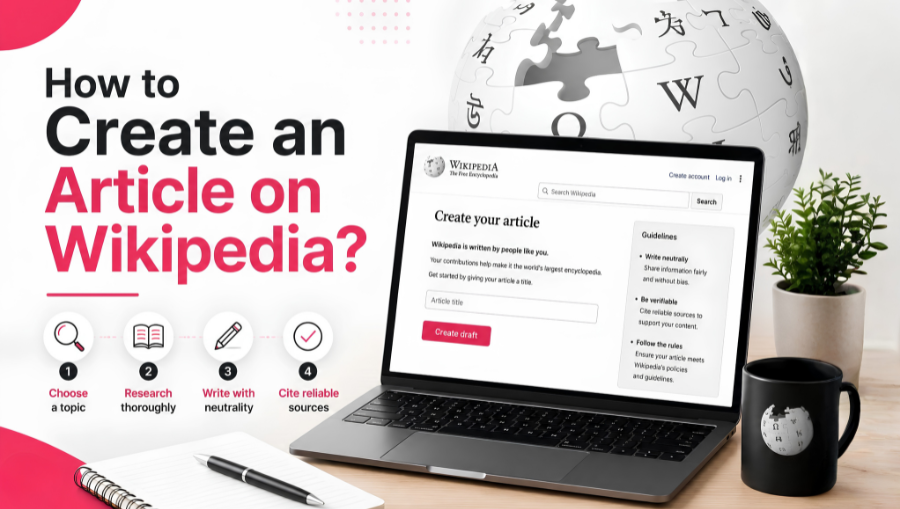
Creating a new Wikipedia article sounds easy and simple. But it is not. Your every statement needs to be backed by evidence and fact. The language needs to be highly objective and neutral without any hint of bias.
If you’re wondering, creating a new Wikipedia article is all about stating some facts, adding some links, and clicking on the publish, then think again. Wikipedia doesn’t work like a personal blog site. For authors, this can be confusing. You may have written a book. You may have a website, social media pages, interviews, book reviews, and readers. Still, that does not always mean Wikipedia will accept an article about you or your book.
Creating a new Wikipedia article takes planning. You must understand Wikipedia notability, follow Wikipedia citation requirements, and write in a clear, neutral tone. If you skip these steps, your Wikipedia draft may be declined. This guide explains how authors can create a strong Wikipedia article the right way.
What Creating a New Wikipedia Article Really Means
Creating a new Wikipedia article means that you’re adding new information to the Wikipedia encyclopedia. The topic could be about anything from a biography to an event occurrence.
Also, a Wikipedia article is a non-biases account of the event or a person. Hence, it could never be about the person who creates it. In addition, once you’ve submitted the article on Wikipedia, it is subjected to changes, inquiry, removal or improvement.
This is why creating a new Wikipedia article is very different from creating a website page. On your own website, you can say what you want. On Wikipedia, you must follow the rules.
A good Wikipedia article should:
- Use neutral language
- Include reliable sources
- Avoid promotion
- Share facts, not opinions
- Follow Wikipedia citation requirements
- Show that the topic meets Wikipedia’s notability
If the article sounds like an ad, it will likely be rejected.
What Qualifies for a Wikipedia Article?
Not every person, book, or business can have a Wikipedia article. A topic must meet Wikipedia’s notability guidelines.
Wikipedia notability means the topic has been covered by reliable and independent sources.
In other words, what you are writing about must be in the news or a publication in detail.
A source is usually stronger when it is:
Independent
Reliable
Published by a trusted outlet
Written with editorial review
Focused on the topic in detail
A source is usually weaker when it comes from:
The author’s own website
A publisher’s sales page
Amazon
Goodreads
Social media
A press release
A paid promotional article
A personal blog
Wikipedia wants proof that the topic matters beyond the person or company talking about itself.
A Topic Usually Has a Better Chance If It Has
A topic usually has a better chance of becoming a Wikipedia article if it has strong proof of public attention.
For an author, this may include detailed interviews, book reviews, news articles, awards, academic mentions, or profiles in trusted publications.
A book may have a better chance if it has been reviewed by respected media, won a known award, been studied by scholars, or received deep coverage from independent sources.
A company may have a better chance if major business publications or news outlets have written about it in detail.
The keyword is “detail.”
A small mention is usually not enough. A strong source should explain who the subject is, why it matters, and what makes it worth covering.
Furthermore, you have to ensure that the small mention or a passing remarks do not make the topic notable. Either a prime coverage has been given to the topic, or a strong source needs to be present. These details must include all about the topic: who, why, what, when, and how.
A Topic Usually Has a Weak Chance If It Only Has
A topic usually has a slight chance if it only has promotional sources.
For example, an author may have a website, Amazon page, book launch article, social media page, and publisher bio. These are useful for readers, but they are not always enough for Wikipedia.
A topic also has a slight chance if all sources repeat the same press release. If many websites publish the same announcement, Wikipedia may still treat it as one promotional source.
An author may also have a weak chance if the only proof of success is social media followers, book sales claims, or personal statements.
Wikipedia does not accept a page just because someone is popular online. It looks for strong, independent coverage.
Can I Make a Wikipedia Article About Myself?
Many authors ask this question: Can I make a Wikipedia article about myself?
The answer is yes, you can try. But it is not recommended.
Wikipedia has rules about conflicts of interest. A conflict of interest happens when someone writes about themselves, their business, their book, their client, or someone they are connected to.
The problem is simple. It is hard to be neutral about your own life and work.
Even if you are honest, your writing may sound like a professional bio. You may use words that feel normal in marketing, such as “inspiring,” “powerful,” “award-winning,” “renowned,” or “well-loved.” On Wikipedia, these words can make the article sound promotional.
If you are an author and want an article about yourself, the safest path is to focus on sources first. Gather reliable, independent sources. Use draft space. Be clear about your connection if you edit. Keep the writing plain and factual.
Wikipedia does not want your personal story told in your own words. It wants verified facts based on trusted sources.
The Real Difference Between a Wikipedia Article and a Promotional Page
A promotional page tries to sell. A Wikipedia article tries to inform.
That is the biggest difference.
A promotional page may say:
“Sarah Adams is a gifted and inspiring author whose powerful stories have touched readers around the world.”
A Wikipedia article would say:
“Sarah Adams is an American author known for writing historical fiction.”
The second sentence is simple. It does not praise the author. It does not try to make readers buy a book. It only gives a fact.
That is how Wikipedia writing should sound.
For authors, this can feel too plain. But plain writing is often better on Wikipedia. Editors want facts they can check. They do not want emotional claims or sales language.
A promotional page may include:
Praise
Book purchase links
Personal claims
Emotional language
Brand statements
Calls to action
A Wikipedia article should include:
Verified facts
Neutral wording
Independent sources
Clear dates
Simple structure
Balanced information
Step-by-Step: How to Create a Successful Article as a Beginner
Creating a new Wikipedia article is easier when you follow a clear process. Do not start by writing the page. Start by checking whether the topic is ready for Wikipedia.
Step 1: Search Wikipedia First
Before creating a page, search Wikipedia.
You can use highly relevant keywords and search the existing page. You can search it through the author’s name, pen name, organization, etc. The reason is to rule out any chance of having the Wikipedia page on the topic. If the page already exists, you can either update the Wikipedia information or improve the existing one.
Step 2: Build a Source List Before Writing
Before you write the article, make a source list.
This is one of the most important steps.
Collect all sources that mention the subject. Then sort them into strong and weak sources.
Strong sources may include newspapers, magazines, literary journals, trusted book review sites, academic books, or respected industry publications.
Weak sources may include press releases, author websites, Amazon pages, Goodreads pages, social media posts, paid articles, and publisher sales pages.
For authors, strong sources are often:
If you cannot find enough strong sources, the article may not be ready yet.
Step 3: Check Notability Before Drafting
After making your source list, check Wikipedia notability. Ask this question: Do these sources prove that the topic has received serious, independent attention?
If you’ve answered yes, it is very likely you have a solid topic.
If you’ve answered no, then wait before creating the topic.
Many beginners make the mistake of thinking any source is enough. That is not true. A page with many weak sources can still be declined.
For example, five press releases do not prove notability. Ten social media links do not prove notability. A personal website does not prove notability.
Therefore, it is always best to work with a few strong sources, rather than adding many weak sources.
Step 4: Write a Neutral First Sentence
Your first sentence must be an opening statement with a neutral tone. Do not start with praise. Do not start with a sales line. Do not use dramatic words.
A weak first sentence may look like this:
“John Miller is an awe-inspiring author who is known to change many lives across the globe.”
A Wikipedia-worthy sentence would be:
“John Miller is an American author of mystery novels.”
This sentence is neutral, clear, and simple. If you are referring to a book, then you could write:
“The Last Train Home is a 2023 mystery novel by American author John Miller.”
This gives the reader basic information without promotion.
Step 5: Use a Simple Article Structure
A Wikipedia article should be easy to follow.
Do not make the article too long. Do not add sections that are not needed. Let the sources guide the structure.
For an author article, you may use sections like:
Early life
Education
Career
Books
Reception
Awards
References
For a book article, you may use sections like:
Background
Publication
Plot summary
Themes
Reception
References
Only include sections that you can support with reliable sources.
If you do not have strong sources about the author’s early life, do not add a long early life section. If you do not have reviews, do not create a reception section full of personal opinions.
Step 6: Cite as You Write
Wikipedia citation requirements are very important.
Every key fact should have a source. This includes dates, book titles, awards, education, career history, reviews, and public claims.
Do not write the whole article first and add sources later. That can lead to weak or unsupported claims.
A better method is simple:
Write one fact. Add one citation. Then continue. Good citations help reviewers trust the article.
Step 7: Avoid Original Research
If you’re working on Wikipedia, then you must avoid original research at all costs. By original, we mean research that voices your own opinions or thoughts.
For authors, this often happens when writing about books. Wikipedia does not want your personal analysis. It wants published information from trusted sources.
Step 8: Use Draft Space or the Article Wizard
Beginners should use draft space or the Wikipedia Article Wizard.
Draft space lets you create the article before it becomes a live Wikipedia page. This gives reviewers a chance to check it.
Using draft space is safer than publishing directly. The draft may get declined if it has problems, and you can always update it. Decline simply means the draft needs work. For authors who are working with Wikipedia for the first time, they may begin with a draft space.
Step 9: Submit Through Articles for Creation
Submit your drafts with Articles for Creation in Wikipedia. This allows a volunteer to review your draft and assess its notability, tone, structure, and sources. Your draft may be accepted. It may also be declined.
A Wikipedia draft declined message can feel disappointing, but it is common. Many drafts are declined the first time.
The most important thing is to follow the feedback thoroughly. Understand it first to implement it later.
If the reviewers have flagged the sources as weak, then you must find strong supporting evidence and sources. If the reviewer has pointed out the tone, then work on its style. If your Wikipedia article is falling short on notability, then add stronger coverage sites.
Do not resubmit the same draft without fixing the problem.
Step 10: Fix Feedback Without Arguing
If your Wikipedia draft is declined, do not argue first.
Reviewers are not rejecting you as a person. They are reviewing the article based on Wikipedia rules.
Read the feedback. Find the main issue. Then revise the draft.
If the article sounds promotional, remove praise.
If the article has weak citations, replace them.
If the article lacks notability, add stronger independent sources.
If the article includes personal opinions, remove them.
A calm revision gives the draft a better chance.
Beginner Example: Why One Draft Fails and Another Works
Here is a simple example.
A weak draft may begin like this:
“Emma Brooks is a beloved and inspiring author whose moving books have touched thousands of readers. Her latest novel is a must-read story of hope, courage, and healing.”
This sounds like a promotion. It uses praise. It makes big claims. It does not cite sources. It sounds like something from an author’s website or book ad.
A stronger draft may begin like this:
Emma Brooks is a British author of historical fiction. Her 2021 novel The Winter Path was reviewed by The Bookseller and shortlisted for the Northbridge Fiction Prize.”
This version is better because it gives facts. It names the type of work. It includes details that can be checked.
The stronger draft does not try to sell the author. It simply explains who the author is and why the topic may be notable.
That is the goal of Wikipedia writing.
Special Care for Biographies of Living People
Wikipedia has strict rules for biographies of living people.
This includes authors, speakers, publishers, business owners, public figures, and private people who are still alive.
The rule is simple: be very careful.
Do not add personal details unless they are important and supported by reliable sources. Do not add claims about family, health, religion, politics, personal problems, or private life unless they are clearly relevant and strongly sourced.
Even positive claims need sources.
For example, do not write:
“She is one of the most respected authors of her generation.”
That is too broad and promotional.
A better sentence would be:
“In a 2022 review, The Literary Journal called her novel a careful study of family loss.”
This sentence is better because it gives credit to the source.
For living people, unsourced claims can be removed quickly. Poor sourcing can also damage the article’s chance of approval.
Should You Pay Someone to Create a Wikipedia Article?
You can pay someone to help with a Wikipedia article, but you must be careful.
Wikipedia has paid editing rules. Paid editors must disclose that they are being paid. This keeps the process honest.
Be careful with anyone who promises a guaranteed Wikipedia page. No one can honestly promise that. Wikipedia pages can be reviewed, changed, declined, deleted, or merged.
Some services create pages that sound like ads. These pages often get declined or removed.
A good Wikipedia professional should first review your sources. They should tell you honestly whether the topic is ready. They should understand Wikipedia notability, Wikipedia citation requirements, and conflict-of-interest rules.
For authors, this matters a lot. If you pay someone before checking your sources, you may waste money on a page that cannot pass review.
A good editor will not just ask, “What do you want the page to say?”
A good editor will ask, “What independent sources prove this topic belongs on Wikipedia?”
Common Mistakes That Get Wikipedia Articles Rejected
Many Wikipedia drafts are rejected for the same reasons. If you understand these mistakes, you can avoid them.
Writing Like a Marketer
Marketing language is one of the biggest problems.
Wikipedia does not want words like:
Inspiring
Powerful
Amazing
Groundbreaking
Best-selling without proof
World-renowned
Must-read
Life-changing
These words may work in book promotion, but they do not work well on Wikipedia.
Instead, use simple facts.
Do not say the author is “famous” unless strong sources prove it. Do not say a book is “powerful” unless a reliable reviewer says that, and even then, attribute it to the reviewer.
Depending on Press Releases
Press releases are weak sources for Wikipedia.
A press release is usually written to promote something. It may announce a book launch, an award, an event, a partnership, or a business update. But it is not independent coverage.
Many authors have press releases online. These can help with basic facts, but they usually do not prove Wikipedia notability.
If several websites publish the same press release, that still does not count as several strong sources. It is the same message repeated.
Wikipedia prefers independent reporting, reviews, profiles, and analysis.
Creating a Page Too Early
Sometimes the topic is real, but it is too early for Wikipedia.
An author may have just released their first book. A company may have just launched. A book may be new and not yet reviewed by major sources.
Creating a page too early can lead to rejection.
It may be better to wait until there is stronger public coverage. For authors, this may mean waiting for book reviews, interviews, awards, media features, or academic mentions.
A strong page created later is better than a weak page created too soon.
Using AI-Written Text Without Review
AI can help organize ideas, but AI-written text should not be copied into Wikipedia without review.
AI text may sound too promotional. It may include vague claims. It may repeat ideas. It may also create facts that are not supported by sources.
Wikipedia needs careful human editing.
Every claim should be checked. Every citation should be real. Every sentence should be neutral.
For authors, this is important because book and author content can easily sound like marketing. Human review helps remove that tone.
Confusing Popularity With Notability
Popularity is not the same as Wikipedia notability.
An author may have many followers. A book may have many online reviews. A business may have many customers. But Wikipedia still asks for reliable, independent sources.
Social media numbers do not prove notability by themselves. Amazon rankings do not prove notability by themselves. Personal success claims do not prove notability by themselves.
Wikipedia wants trusted sources that discuss the topic in detail.
That is the difference.
Quick Checklist Before You Submit
Before submitting your draft, review it carefully.
Ask yourself:
- Does the topic have reliable, independent sources?
- Do the sources discuss the topic in detail?
- Does the article meet Wikipedia’s notability standards?
- Does the article follow Wikipedia citation requirements?
- Is the tone neutral?
- Did I remove promotional words?
- Are all major claims cited?
- Did I avoid original research?
- Did I use draft space or the Article Wizard?
- Did I disclose any conflict of interest?
- Would this article still sound fair if a stranger wrote it?
If you answer no to several questions, improve the draft before submitting it.
Final Takeaway
Creating a new Wikipedia article is not about writing the most impressive version of a person, book, or company. It is about writing the most verifiable version.
For authors, that means the article should not sound like a book promotion or personal bio. It should be based on reliable sources, written in a neutral tone, and supported by clear citations.
If your topic has strong independent coverage, you may have a real chance. If the sources are weak, the best step is to build public coverage first and return when the topic is ready.
A good Wikipedia article does not beg for attention. It earns its place through facts.
If you are an author planning on creating a new Wikipedia article, start with a source review before writing. Check your independent coverage, remove promotional language, and build your draft around facts that trusted sources can prove.