
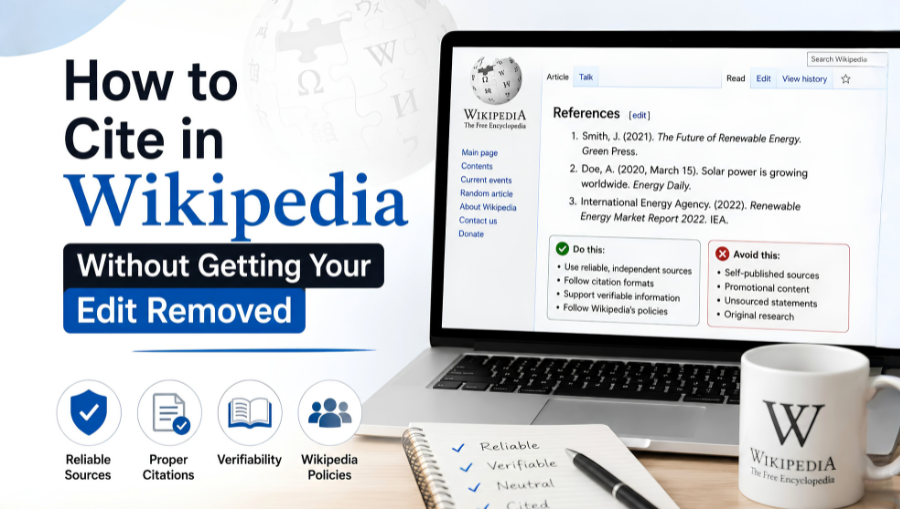
Learning how to cite in Wikipedia can feel hard at first. Wikipedia has rules. Editors check new edits. If you have mentioned a source that is weak, deceitful, or misplaced then your edit will be removed more likely.
How to Cite in Wikipedia: A Practical Guide to Adding Sources and Using Wikipedia in APA 7
Now, the good news for you is that you don’t have to be a technical expert to work with citations. You don’t have to spends weeks in learning how to cite in Wikipedia: a practical guide to adding sources and using Wikipedia in APA 7. You just need to use a good source, place it near the claim, and format it in a way Wikipedia can read.
This Wikipedia citation guide will show you how to add a citation on Wikipedia, how to use the Wikipedia source editor, how to cite a website from Wikipedia, and how to cite Wikipedia in APA 7 for school or research.
Quick Answer: How Do You Cite in Wikipedia?
Open a VisualEditor or a Source Editor to cite in Wikipedia, and then mention your reliable source in the sentence you want to support. In VisualEditor, click where the citation should go, choose Cite, paste the link or fill in the source details, and save your edit with a clear edit note. These citation practices are also essential during the Wikipedia page creation process, as properly sourced content is more likely to meet Wikipedia’s editorial standards. A good citation should be close to the claim. It should come from a source that readers can trust.
What “Cite in Wikipedia” Really Means?
When people say cite in Wikipedia, they may mean two different things.
First, they may mean adding a source inside a Wikipedia article. This helps prove that a claim is true.
Second, they may mean using Wikipedia as a source in a school paper, blog, article, or report. That is a different task. In that case, you need a style like APA 7 Wikipedia citation.
So there are two main uses:
- You add a source to Wikipedia.
- You cite Wikipedia in your own work.
Both need care. Wikipedia is open to public edits, so its pages can change. That is why citing the right version matters when you use Wikipedia in APA 7.
Why Citations Matter on Wikipedia?
Citations matter because Wikipedia is built on trust. Anyone can edit it, but not every edit stays. The facts that can be checked and verified are the reliable sources. Hence, when a reader accesses the source, they can instantly know the direct information source. It also helps distinguish a fact from an opinion.
Good citations help Wikipedia in three ways:
- They make facts easier to check.
- They protect edits from being removed.
- They help readers learn more from the original source.
Strong citations also support a page’s eligibility under Wikipedia’s notability requirements by showing that the topic has received meaningful coverage from reliable, independent sources.
Wikipedia does not ask editors to prove what they know from memory. It asks editors to show what trusted sources say.
That means your edit should not sound like “I know this is true.” It should show, “This source says this.”
When Should You Add a Citation on Wikipedia?
You should add a citation when a claim needs proof. A claim is any statement that says something is true.
A simple fact may not always need a source. But if the fact is specific, new, debated, or important, you should cite it.
A good rule is this:
If someone may ask, “How do you know?” add a citation.
You should add citations for:
- Dates
- Numbers
- Quotes
- Awards
- Book titles
- Medical claims
- Legal claims
- Public statements
- Claims about living people
- Claims about sales, rankings, or success
Claims about living people need extra care. Wikipedia is very strict about this. If a claim about a living person is not well sourced, it can be removed quickly.
Claims That Usually Need Citations
These claims often need citations:
- “The singer won two awards.”
- “The study found a link between diet and sleep.”
- “The mayor announced a new plan.”
- “The author was born in Chicago.”
- “The school has more than 2,000 students.”
- “Critics praised the novel.”
- “The law changed in 2023.”
Each sentence gives a fact. That fact should come from a source reader can check.
You do not need to cite every word. But you do need to cite facts that matter.
What Counts as a Reliable Source on Wikipedia?
A reliable source is a source reader can trust. It should have some form of checking, editing, review, or public record.
Wikipedia usually prefers sources that are:
- Independent
- Published
- Fact-checked
- Written by experts or reporters
- Clear about authorship
- Clear about dates
- Strong enough for the claim
A source does not need to be famous to be useful. A local newspaper can be strong for a local event. A court record can be strong for a legal fact. A publisher page can be useful for a book release date.
But the source must match the claim.
This is the main idea behind Wikipedia reliable sources.
Strong Sources for Wikipedia
Strong sources may include:
- Books from known publishers
- Academic journals
- Government websites
- Court records
- University pages
- Major newspapers
- Trusted magazines
- Museum websites
- Library records
- Expert reports
- Official public records
For instance, if you’re covering a medical topic, your cite source should be a health agency, medical journal, or a hospital directory instead of a personal blog.
Or if you are writing about a public award, the official award website may be a strong source.
Weak or Risky Sources
Some sources are weak on Wikipedia. Although they could be used, but they can later create problems. Some of the weak sources could include:
- Personal blogs
- Fan pages
- Social media posts
- Sales pages
- Press releases
- Self-published websites
- Sites with no author
- Sites with no date
- AI-written pages with no proof
- Pages that copy from Wikipedia
- Promotional company pages
A company website can support basic facts about that company. For example, it may support the company’s address or product list. But it is not a strong source for praise.
This is weak:
The company is a leading name in publishing.
A company’s own website should not be used to prove that. You would need an independent source.
How to Add a Citation on Wikipedia Using VisualEditor?
VisualEditor is the easiest way to add a citation on Wikipedia. It lets you edit the article without using much code.
Step-by-Step Process
To cite Wikipedia with VisualEditor, follow these simple steps:
- Open the Wikipedia article.
- Click Edit at the top of the page.
- Find the sentence that needs a source.
- Put your cursor right after the sentence.
- Click Cite in the toolbar.
- Paste the source link or add the source details.
- Let Wikipedia create the citation.
- Check the title, author, date, website name, and URL.
- Click Insert.
- Read the sentence again to make sure the source fits.
- Click Publish changes.
- Add a short edit summary.
- Publish your edit.
A good edit summary may be:
Added source for publication date.
Or:
Added citation for award claim. Make sure to keep your edit summary concise and honest.
The source needs to always support the publishing claim. If your book says it is published in 2023, then it should not claim in 2024.
How to Add a Citation on Wikipedia Using Source Editor?
The Wikipedia source editor uses wikitext. Wikipedia pages are built with Wikitext code. It may look difficult in the beginning, especially if you’re doing it for the first time. However, the basic citation format is actually simple and easy to follow.
A citation is placed inside <ref> tags.
Example:
The museum opened in 1921.<ref>Source information goes here.</ref>
Most Wikipedia pages use citation templates. These templates make the source look clean.
A website citation may look like this:
The museum opened in 1921.<ref>{{cite web |title=About the Museum |url=https://example.com/about |website=Example Museum |access-date=25 May 2026}}</ref>
A book citation may look like this:
The event is described in a later history of the city.<ref>{{cite book |last=Smith |first=John |title=A History of the City |publisher=Example Press |year=2020 |page=45}}</ref>
A news citation may look like this:
The festival returned in 2022.<ref>{{cite news |last=Brown |first=Maria |title=Festival Returns After Two Years |work=Example Times |date=12 June 2022 |url=https://example.com/festival}}</ref>
The source editor is useful when you want more control. But be careful. A missing bracket or tag can break the citation.
Common Wikipedia Citation Templates
Wikipedia uses templates to keep sources neat. These templates are part of the Wikipedia reference format.
You do not need to know every template. But these are the most common.
Cite Web
Use cite web for websites.
<ref>{{cite web |title=Page Title |url=https://example.com |website=Website Name |date=2024 |access-date=25 May 2026}}</ref>
Use this for website pages, reports, official pages, and online articles that are not news stories.
Cite News
Use cite news for news articles.
<ref>{{cite news |last=Lee |first=Sara |title=Article Title |work=News Site |date=10 May 2024 |url=https://example.com/article}}</ref>
This is useful for newspapers, magazines, and trusted news websites.
Cite Book
Use cite book for books.
<ref>{{cite book |last=Green |first=David |title=Book Title |publisher=Publisher Name |year=2020 |page=88}}</ref>
Add a page number when the fact comes from a certain page.
Cite Journal
Use cite journal for academic journal articles.
<ref>{{cite journal |last=Khan |first=Aisha |title=Study Title |journal=Journal Name |year=2021 |volume=12 |issue=3 |pages=44–50 |doi=10.xxxx/example}}</ref>
This is often used for science, medicine, history, and research topics.
Where Should the Citation Go?
The citation should go right after the claim it supports.
Good example:
The bridge opened in 1932.<ref>{{cite web |title=Bridge History |url=https://example.com |website=City Archives |access-date=25 May 2026}}</ref>
This is clear. The citation supports the opening date.
Weak example:
The bridge opened in 1932 and became a famous landmark with many visitors each year.<ref>Source here</ref>
This is less clear. Does the source support the date, the landmark claim, the visitor claim, or all of them?
Place the source as close as possible to the fact. This helps other editors check your work faster.
If one source supports a whole paragraph, you may still need more than one citation. Long paragraphs with many claims can be hard to verify.
How to Create the References Section?
Most Wikipedia articles already have a references section. It is usually near the bottom of the page.
It may look like this:
== References ==
{{reflist}}
The {{reflist}} template shows all the inline citations used in the article.
If an article does not have a references section, you can add one near the bottom. Place it before sections like “External links” or “Further reading.”
Use this format:
== References ==
{{reflist}}
Do not create a plain list of links unless the article style calls for it. Wikipedia usually uses inline citations and a references section.
How to Cite a Website from Wikipedia?
To cite a website from Wikipedia, use the VisualEditor cite tool or the cite web template.
A good website citation should include:
- Page title
- URL
- Website name
- Author, if shown
- Date, if shown
- Publisher, if different from the website
- Access date
Example:
<ref>{{cite web |title=About the Author |url=https://example.com/about |website=Author Website |access-date=25 May 2026}}</ref>
If the website has a date, include it:
<ref>{{cite web |title=Annual Report 2024 |url=https://example.com/report |website=Example Company |date=2024 |access-date=25 May 2026}}</ref>
The access date matters because websites can change.
Before you use a website, ask yourself:
- Who wrote this?
- Is the site trusted?
- Does the source prove the exact sentence?
- Is the page current?
- Is the source independent?
If the answer is no, find a better source.
Can You Cite Wikipedia as a Source?
Yes, you can cite Wikipedia as a source in some cases. But you should be careful.
Many teachers and editors do not accept Wikipedia as a final academic source. This is because Wikipedia can be edited by many people. Some pages are excellent. Others may be incomplete, old, or wrong.
For school, Wikipedia is best used as a starting point. You can read the page to understand the topic. Then check the references at the bottom. Those sources are often better for your paper.
This approach is especially important when researching topics such as how to build a personal Wikipedia presence or create a page about yourself, where reliable third-party sources carry more weight than Wikipedia itself.
Inside Wikipedia, you should usually not cite one Wikipedia article as a source for another Wikipedia article. Wikipedia is not considered a reliable source for itself.
A better method is to find the original source listed in the Wikipedia article and cite that source directly.
How to Cite Wikipedia in APA 7?
An APA 7 Wikipedia citation is used when you cite a Wikipedia page in a paper or report.
APA 7 treats Wikipedia in a special way because pages can change. That is why you should cite the archived version of the page when possible.
APA 7 Reference Format
Use this format:
Article title. (Year, Month Day). In Wikipedia. Archived Month Day, Year, from URL
The article title goes where the author would normally go. This is because Wikipedia pages do not have one named author.
A full reference may look like this:
Artificial intelligence. (2026, May 20). In Wikipedia. Archived May 25, 2026, from https://en.wikipedia.org/w/index.php?title=Artificial_intelligence&oldid=123456789
Use the real archived URL from Wikipedia. Do not copy this example unless it matches your exact page.
APA 7 Example
Here is another example:
Climate change. (2026, May 18). In Wikipedia. Archived May 25, 2026, from https://en.wikipedia.org/w/index.php?title=Climate_change&oldid=123456789
The oldid number is important. It points to one fixed version of the page.
That means your reader can see the same page you used.
How to Cite Wikipedia In-Text in APA?
A Wikipedia in-text citation is the short citation inside your writing. It points readers to the full entry in your reference list.
For APA 7, use the article title and year.
Parenthetical Citation
A parenthetical citation appears at the end of the sentence.
Example:
Artificial intelligence is used in many fields (“Artificial intelligence,” 2026).
Put the article title in quotation marks. Use the year from the archived version you cited.
Narrative Citation
A narrative citation uses the article title as part of the sentence.
Example:
According to “Artificial intelligence” (2026), the field includes many types of computer systems.
This style works when you want to name the source in the sentence.
Still, check your teacher’s rules. Some teachers do not allow Wikipedia as a cited source.
How to Find the Archived Wikipedia Version for APA 7?
To cite Wikipedia in APA 7, use the archived version of the page you read.
Here is how to find it:
- Open the Wikipedia article.
- Click View history near the top.
- Find the version from the date you used the page.
- Click that version.
- Copy the URL.
- Use that URL in your APA 7 reference.
The archived URL often includes oldid=.
That number matters because it locks the page version. Wikipedia pages can change every day. The archived link helps your reader see what you saw.
This is one of the most important parts of citing Wikipedia in APA 7.
APA 7: Wikipedia vs. Normal Website Citation
Wikipedia is not cited the same way as a normal website.
A normal website may have one author, one publish date, and one stable page. Wikipedia is different because many people can edit it.
Here is a simple comparison:
| Source Type | How It Works in APA 7 |
| Normal website | Use author, date, page title, site name, and URL |
| Wikipedia | Use article title, date, “In Wikipedia,” archived date, and archived URL |
For a normal website, the author may be a person or group.
For Wikipedia, the article title comes first because there is no single author.
Also, APA 7 prefers the archived Wikipedia page, not just the live page.
Real-World Scenario: Student Using Wikipedia for Research
Imagine you are a student writing about the history of printing.
You search online and find a Wikipedia page. The page gives you a quick overview. It explains key dates, names, machines, and places.
That is useful.
But should you cite Wikipedia in your final paper?
Maybe. It depends on your teacher’s rules.
A stronger method is to use Wikipedia as a map. Read the page. Then scroll to the references. Look for books, journal articles, museum pages, and trusted history sites. Use those sources in your paper.
This helps you build a stronger paper.
Wikipedia can help you learn the topic. But the sources behind Wikipedia often carry more weight.
Real-World Scenario: Editor Adding a Citation to Wikipedia
Imagine you are editing a Wikipedia page about an author.
You want to add this sentence:
Her first novel was published in 2024.
You need a source. A publisher page may work well for a basic book fact. A library listing may also help. A review in a trusted magazine may be even better.
A safe citation may look like this:
Her first novel was published in 2024.<ref>{{cite web |title=Book Title |url=https://publisher.com/book-title |website=Publisher Name |date=2024 |access-date=25 May 2026}}</ref>
Now imagine you want to add this sentence:
Her first novel became one of the most important books of the year.
That is a stronger claim. You need a strong independent source. A publisher page is not enough. You may need a major review, award list, or trusted publication.
This is why source strength matters.
Common Mistakes When Adding Citations on Wikipedia
Many Wikipedia edits are removed because of simple mistakes.
Here are the most common ones:
- Using a weak source
- Using a source that does not prove the claim
- Adding praise or sales language
- Citing a blog for a serious claim
- Using Wikipedia as a source inside Wikipedia
- Placing the citation too far from the claim
- Adding a bare link instead of a full citation
- Forgetting the references section
- Using old sources for current facts
- Citing social media as the only proof
- Adding claims about living people without strong sources
The biggest mistake is thinking any link is enough.
It is not.
A citation is only useful if the source is trusted and clearly supports the sentence.
Advanced Tip: Match the Strength of the Source to the Strength of the Claim
A simple claim may need a simple source. A strong claim needs a strong source.
For example:
The book was published in 2024.
A publisher page may support this.
But this claim is stronger:
The book became a major literary success.
That needs independent coverage. It may need a review, award source, sales report, or respected article.
Here is another example:
The medicine was approved in 2023.
This should use an official medical agency, government record, or trusted medical source.
And this claim:
The medicine is safer than other treatments.
That needs very strong medical evidence. A company website is not enough.
The stronger the claim, the stronger the source must be.
This one rule can save many Wikipedia edits from removal.
Research Insight: Why Wikipedia Citations Affect More Than Wikipedia
Wikipedia citations matter beyond one page.
Many readers use Wikipedia first. Students use it. Writers use it. Journalists use it. Search engines also show Wikipedia pages often.
When Wikipedia has strong sources, readers can follow those sources and learn more. When it has weak sources, readers may be led to poor information.
A good citation helps build a path from a simple summary to deeper research.
That is why adding a source to Wikipedia is not a small task. It helps readers check facts for themselves.
A good citation can lead someone to a book, study, court record, report, or expert article. A bad citation can lead them to weak or false information.
So when you cite in Wikipedia, you help protect the quality of public knowledge.
To cite in Wikipedia, place a reliable source right after the claim it supports. Use VisualEditor by clicking Edit, then Cite, and adding the source details. Or use Source Editor with <ref> tags and templates like {{cite web}}, {{cite book}}, or {{cite news}}. Use strong sources, avoid promotional claims, and make sure the source proves the exact sentence.
Final Takeaway
Learning how to cite in Wikipedia is not about adding more links. It is about adding the right proof in the right place. Use reliable sources, place citations close to the claims, and avoid wording that sounds like praise or promotion. If you use Wikipedia in school work, cite the archived version in APA 7 so your reader can see the same page you used.
If you need clear, well-sourced, and reader-friendly content, Arkham House Publishers can help. With 30+ years of brand management experience, Arkham House Publishers supports authors, businessess, and professionals with writing, editing, publishing, and content services. Reach out today to make your content stronger, cleaner, and ready for readers.