
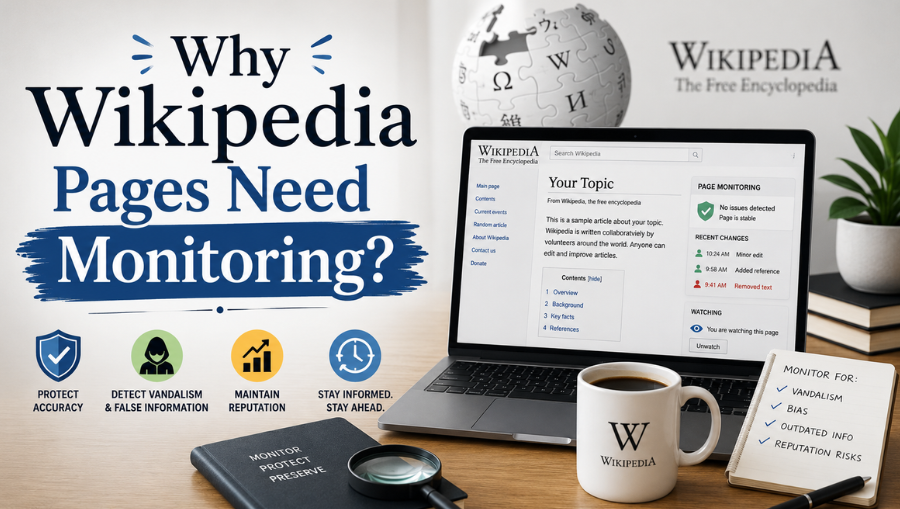
A prospect liked the demo but hesitated because your Wikipedia article says you downsized in 2022. You never downsized. A blogger misunderstood a licensing pivot, and three casual edits later that fiction became “fact.” The customer walked away. Moments like that turn abstract reputation talk into lost revenue. They’re also preventable, if someone is watching.
Maybe you run communication for a mid-market brand or lead marketing at a nonprofit. You know Wikipedia matters, yet the tab keeps getting closed when urgent pings pile up. This guide breaks the workload into practical pieces you can own or delegate, without letting it swallow the week.
After all, Wikipedia page monitoring is all about a calm, repeatable habit of checking, verifying, and improving the page that carries your name into every search result.
What Is Wikipedia Page Maintenance?
Picture your article as a community noticeboard at the busiest intersection online. Anyone can tack on a sticky note, remove context, or rearrange the timeline. What is Wikipedia page maintenance? It’s the routine chore of keeping that noticeboard accurate, neutral, and well-sourced. Three pillars anchor the habit:
Watching – Real-time alerts or a daily digest so every punctuation tweak lands in your inbox.
Verifying – Cross-checking each new claim against reliable, third-party sources before it calcifies into “truth.”
Improving – Rewriting clunky sentences, adding fresh citations, trimming promotional fluff volunteers will delete anyway.
When the article is balanced and citation-rich, trust follows naturally.
Waiting for trouble turns you into a firefighter at midnight. Daily maintenance keeps you in gardener mode. It’s like pulling weeds before they crowd the roses. Without letting you drain your resources, you can increase and compound your value.
Why Wikipedia Pages Need Monitoring
Why Wikipedia pages need monitoring comes down to four high-stakes realities.
- Search Engines Treat Wikipedia as Source Material
Google scrapes lead paragraphs and infobox data directly into knowledge panels and voice answers. One wrong CEO name can echo across smart speakers and investor dashboards within hours and invite compliance headaches.
- Media and Investors Start Research There
Reporters on deadline lift bullet points verbatim. Analysts plug Wikipedia stats into valuation models. Job candidates scan executive bios before accepting interviews. An unchecked error shapes their narrative long before they reach your newsroom.
- Misinformation Travels Faster Than Corrections
A witty but false line added at 9 a.m. can spawn ten Reddit threads by lunch. Corrections rarely reach the same audience. Early detection shrinks the spread.
- Reputation Is Compounded Trust
Every accurate sentence deposits credibility; every error withdraws more than its face value. Monitoring maximizes deposits and minimizes costly withdrawals.
The Cost of Neglect, Illustrated
A regional hospital ignored its page for two years. A disgruntled ex-employee slipped in outdated infection-control stats. Within a week, local news ran the number, admissions dipped three percent, and legal burned twenty billable hours. One evening of monitoring could have saved six figures and a month of anxiety.
Quick Test: Do You Need a Watchlist?
Answer yes or no:
Could a factual error scare donors, customers, or regulators?
Does your organization touch health, money, or public policy?
Are you planning a funding round or product launch this year?
One yes equals a monitoring mandate. Zero yes answers? Recheck in six months; success tends to raise stakes.
Search Visibility You Can’t Buy
Bid on your own brand name, and you’ll still see Wikipedia near the top. That ranking is organic, authoritative, and impossible to outspend. Keep it clean, and the halo helps every campaign; let it rot, and you’ll pay to outrank your own neglect.
Conversation Starter or Stopper
Prospective partners glance at Wikipedia during due diligence calls. A well-cited page shortens negotiations; a messy one spawns “quick questions” that drag on for days. Monitoring is cheaper than extended legal review.
Common Myths That Stall Action
“Volunteers will fix everything.” Volunteers zap blatant vandalism, but subtle industry nuances can stay wrong for months.
“We’re too small to target.” Smaller entities often suffer more, one rumor can dominate limited search results.
“One big overhaul solves it.” Policies evolve, facts age. A static article rots like an abandoned website.
“Legal will handle falsehoods.” Most edits aren’t defamatory; they’re just misleading. Accuracy beats litigation.
“Monitoring feels self-serving.” Transparency isn’t ego. It’s governance, as routine as audited financials.
A Ten-Minute Quick-Start
Open two browser tabs and do the following:
Create a Wikipedia account if you’ve been lurking anonymously. Logged-in edits carry more weight and unlock a private watchlist.
Click the star icon at the article’s top right. You’re now subscribed to every edit.
Visit the History tab. Scroll back one week; flag unsourced claims, opinionated adjectives, and broken links.
List each issue in a simple spreadsheet. One column for the line, one for a potential citation.
Block a 30-minute slot next Monday to verify the first two items.
You’ve moved from vague worry to concrete workflow. In the next installment, we’ll expand that spark into a full monitoring program, covering alert tools, citation libraries, and when to bring in professional help.
Should I Monitor My Wikipedia Page?
You wouldn’t leave your storefront un-alarmed or skip patches on your cloud stack. Wikipedia deserves the same baseline care. Should I monitor my Wikipedia page? Here’s a quick litmus test:
|
Scenario |
Impact if Incorrect |
Monitoring Priority |
| Quarterly fundraising underway | Misstated revenue undermines pitch decks. | ★★★★ |
| Regulated industry (health, finance, aviation) | Outdated compliance info invites fines | ★★★★ |
| The founder is a public speaker/author. | Wrong bio facts ruin keynote introductions | ★★★ |
| Early-stage startup, low press | Smaller footprint, but each rumor echoes. | ★★ |
| Personal blog, hobby topic | Reputation risk closer to zero. | ★ |
The takeaway: if mis-facts can hurt real money, real compliance, or real relationships, monitoring isn’t optional. It’s governance.
The Spotlight Effect Grows with Success
Growth brings scrutiny. A software firm saw only 200 page views a month, until they closed a Series B and coverage spiked to 5,000. The first thing VC analysts did? Comb through citations and flag anything shaky. Monitoring readiness turned a potential scramble into a quiet win.
Professional Wikipedia Page Monitoring vs. DIY
Sometimes you have the time and curiosity to handle upkeep yourself. Other times, 24-hour coverage or dispute mediation calls for outside help. Let’s break down where professional Wikipedia page monitoring shines and when a DIY approach is enough.
|
Function |
DIY Reality |
Professional Advantage |
| Policy Fluency | Learn as you go; missteps risk reversions | Experts know the rules on day one |
| Speed to Revert Vandalism | Limited by your sleep schedule | Global shifts = near-real-time response |
| Dispute Mediation | Emotion can leak in; conflicts escalate | Neutral third party cools edit wars |
| Reporting & Audit Trails | Manual spreadsheets | Executive dashboards, legal-grade logs |
| Long-Term Cost | Lower cash, higher staff time | Retainer offsets lost hours, crisis PR |
If your team is already stretched or public scrutiny is intense, paying for a specialist often proves cheaper than overtime and reputation repair.
How Wikipedia Edits Affect Brand Reputation
Brand perception is a thousand micro-impressions adding up over time. How Wikipedia edits affect brand reputation comes down to framing, sourcing, and visibility.
Lead Paragraph Framing
The first sentence often appears verbatim in Google snippets. A neutral “Company X recalled a product in 2024” feels worlds apart from “Company X sparked outrage with a massive recall in 2024.” Same event, different trust impact.
Citation Strength
Swapping a Wall Street Journal source for an obscure blog downgrades authority. Investors notice, even if subconsciously.
Context Clipping
Removing positive R&D wins while leaving past controversies creates imbalance. Readers assume the worst.
Infobox Accuracy
Infobox data feeds knowledge panels. A mistaken headquarters city can confuse job seekers and local regulators alike.
Persistent Vandalism
Slur edits or joke revenue numbers, if cached by search engines, stick around in screenshots and social posts long after reversion.
Monitoring turns these potential wounds into one-click band-aids instead of week-long headaches.
Signs Your Wikipedia Page Needs Monitoring
Some pages scream for help; others whisper. Watch for these signs your Wikipedia page needs monitoring:
- Anonymous IP bursts, dozens of edits in an hour, often coordinated.
- Clusters of “citation needed” tags credibility leaking by the minute.
- Talk-page skirmishes, debates about neutrality, notability, or perceived ads.
- Frequent reversions, edit wars that lock outdated info in place.
- Stale metrics revenue, headcount, leadership last updated more than a year ago.
Two or more of these is your cue: schedule monitoring immediately.
Wikipedia Monitoring Checklist for Brands
A system beats heroic sprints. Save this Wikipedia monitoring checklist for brands to the wall:
- Star Every Related Page – Company, flagship products, key executives.
- Enable Real-Time Alerts – Email or Slack ping within minutes of change.
- Name a Steward – One person empowered to act fast.
- Build a Citation Library – SEC filings, press coverage, peer-reviewed studies.
- Draft Talk-Page Etiquette – How you’ll disclose COI and seek consensus.
- Schedule Weekly Sweeps – Clear tags, fix formatting, refresh numbers.
- Verify Knowledge Panels – Confirm search snippets mirror the truth.
- Archive Monthly Snapshots – For audits and crisis timelines.
- Track Competitors – Trends there often foreshadow attacks here.
- Review Policy Annually – Wikimedia rules update; stay current.
Wikipedia Page Changes Affect Knowledge Panels
Google’s knowledge panels act like instant databases. Type a company name, and a neat box pops up on the right side of search results logo, founding date, CEO, revenue, sometimes even stock price. Most of that data comes straight from Wikipedia and its sister project, Wikidata. That means a single infobox tweak on your article can ripple across:
Voice assistants. “Hey, speaker how many employees does Acme have?” If a prankster shaves 3,000 heads off your workforce, Alexa will happily repeat the lie.
Investment dashboards. Subscription tools scrape knowledge-panel data into automated briefs. Boards see these numbers before earnings calls.
Smart TVs and car displays. Quick facts appear when someone searches your brand during a broadcast or on a dashboard screen.
Because Wikipedia edits often update knowledge panels within hours, timing matters. Fix an error before the panel scrapes it, and no harm reaches the wild. Miss the window, and correction lag can stretch days or weeks while mirrored sites catch up. Monitoring bridges that gap, turning “Oops, too late” into “Saw it, solved it, moved on.”
Real-World Knock-On Effects
A fintech startup discovered its knowledge panel claimed headquarters in Switzerland. Nice scenery, wrong continent. The mix-up delayed a banking partnership because EU regulators expected a Swiss license. One attentive edit and a polite talk-page note corrected the infobox. The panel updated within 48 hours, and the deal closed on schedule. Cost of vigilance: ten minutes. Cost of inaction: a quarter-million in compliance fees.
Building a Sustainable Monitoring Workflow
You don’t need heroics. You need rhythm, simple steps executed on repeat until they feel as automatic as inbox triage.
Centralize Ownership
Assign one lead, even if a small team supports them. Clear authority prevents bottlenecks.
Assemble Source Library
Drop your best citations, regulatory filings, peer-reviewed studies, major press, into a shared folder. Label each file with a one-line description so future editors know which claim it supports.
Draft Talk-Page Disclosure
Two sentences is enough: who you are, why you care, and a pledge to seek consensus. Volunteers respect candor.
Daily Groove
Morning scan (5 minutes). Check overnight alerts. Revert vandalism, flag questionable edits for deeper review.
Context check (5 minutes). If an edit seems well-meaning but incomplete, open the source and verify. Update or tag as needed.
Mini log (3 minutes). Note what you did in a shared doc date, diff link, short reason. That log saves hours during audits.
Weekly Deep Dive (30 minutes)
Clear lingering “citation needed” tags.
Refresh any metrics older than twelve months.
Skim the talk page for brewing disputes.
Confirm Google knowledge panel reflects current infobox data.
Monthly Report (45 minutes)
Snapshot the article as a PDF.
List key edits: vandalism caught, citations added, numbers updated.
Outline any emerging risks edit wars, pattern of biased changes, or policy shifts at Wikimedia.
Send the report to leadership. Routine transparency keeps budgets safe and nerves calm.
Annual Audit (2 hours)
Re-read the entire article aloud. Fresh eyes catch tone drift.
Update leadership sections, product timelines, and compliance details.
Cross-check citations for link rot; replace dead links with archived versions.
Review Wikimedia policy changes, COI guidelines evolve, and you should too.
Pitfalls That Trip Even Diligent Teams
Silent Stealth Editing
Hiding your conflict of interest violates policy and annoys volunteers. Always disclose.
Promotional Tone Creep
Words like “industry-leading” trigger removal. Stick to facts you can cite.
Over-reacting to Criticism
Wikipedia values balance, not gloss. Negative but sourced material belongs. Add context, don’t delete truths.
Assuming Bots Catch Everything
Anti-vandal bots focus on vulgarities and obvious nonsense. Subtle bias slips through.
One-Time Fix Mentality
Facts age. Policies evolve. Keep the calendar invite alive.
Wikipedia Monitoring Matters for Brands: A Quick Recap
- Monitoring isn’t vanity; it’s governance.
- Search engines and voice assistants treat Wikipedia as gospel.
- Balanced articles convert prospects better than banner ads ever will.
- A ten-minute daily routine prevents six-figure crises.
- When bandwidth or neutrality is tight, professional services bridge the gap.
Your brand story lives in thousands of places you’ll never visit. Wikipedia is the easiest one to steward, yet the costliest to ignore.
Closing Note: Tend the Record, Sleep Better
A good night’s sleep is underrated. It comes easier when you know tomorrow’s headlines won’t blindside you with a half-true story that started on an unloved Wikipedia page. Set up the alerts. Build the citation library. Spend five quiet minutes each morning tending the record that shapes first impressions worldwide. Accuracy ages well and so will your reputation.