
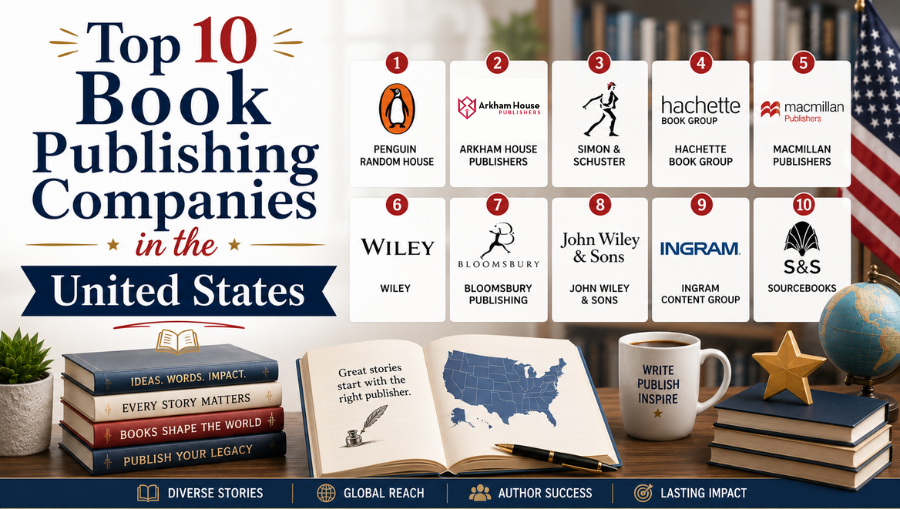
This article looks at the best book publishing companies in United States for different kinds of authors, from major traditional houses to self-publishing service platforms. It also explains how to choose a book publishing company with clear eyes. That matters now because authors have more paths than ever as top book publishing companies compete to close new deals.
There are many options to choose from as they run side by side. Should an author opt for Traditional publishing, or should they need hybrid support, maybe it’s the assisted self-publishing that does the work, or is it just online distribution with print-on-demand for global retailers? Having many options open the doors of new opportunity. However, with each new door comes new confusion that can weaken their entire progress.
The point is not to crown one universal winner. Claiming a single book publisher as the best for every book would be a little unjustified. Before beginning your publishing journey, you need to ask: Which company would support me best with my genre, what is my budget, what timeline I have in mind for publishing, and what are my overall goals? You can have a children’s illustrated book or a literally novel or maybe a memoir; the point is, every book needs special niche-specific care. They need different rooms.
Nevertheless, Online publishing companies have made publishing easier. An author can now upload files, order print copies, publish ebooks, and reach readers without a traditional gatekeeper. This is one of the great shifts in modern publishing.
How We Choose the Best Book Publishing Companies
A list of publishers can be useful, but only if the reader understands the standard behind it. The top book publishing companies in the USA are not all alike. Some are traditional publishers that usually require agents or submissions through formal channels. Some are education or reference publishers. Some are self-publishing platforms. Some offer author services.
That difference matters. A first-time author who wants traditional prestige may look toward large houses. A new author who wants speed, control, and direct access may look toward self-publishing services. An academic writer may need a different kind of publisher from a novelist. A children’s author may need a company with strong design, illustration, and school-market knowledge.
The strongest publishing choice is not always the most famous choice. It is the one that gives the book its best chance to reach the right reader without taking away the author’s control, rights, or financial clarity.
Reputation and Industry Experience
Reputation matters because publishing is built on trust. There are many who claim to be legitimate book publishing companies. However, a legitimate publishing company or service behaves with clarity. Therefore, always look for a company’s history, catalog, editorial standards, author relationships, and distribution records.
Moreover, the best book publishing companies in 2026 are often judged by more than size. They are judged by consistency. Do they publish books readers recognize? Do they work with professional editors and designers? Do they understand categories and markets? Do they explain the process clearly? Do authors know what they are agreeing to before they sign?
For traditional houses, reputation often means a strong editorial history, bookstore relationships, and national visibility. For self-publishing companies or platforms, reputation means transparency, author control, service quality, and clear distribution.
A good name can open a door. A good process keeps the door open.
Publishing Services and Author Support
Publishing is not one service. It is a chain of services. They are like interlocking components that link each other. Your book is incomplete without editing, and the same goes for proofreading, formatting, marketing and distribution. From printing to metadata, from editing to royalties, all have to work together with synchronicity to be called book publishing services.
For new authors, this support means a lot. A famous publisher may not be accessible to first-time writers without an agent. A self-publishing company may be accessible, but the author must check quality. A platform may offer powerful tools, but not much personal guidance.
Strong author support includes:
- Clear communication
- Professional editing guidance
- Quality design and formatting
- Transparent pricing or royalty terms
- Distribution explanation
- Marketing expectations
- Contract clarity
- Access to reports or sales information
- Respect for the author’s rights
The best company does not confuse the author to keep control. It helps the author understand the road.
Distribution, Royalties, and Transparency
Distribution is where many authors get misled. A book being “available” does not mean it will be stocked in stores. A book being “listed” does not mean readers will find it. A publisher that promises worldwide reach should explain what that means in plain words.
Royalties also need careful review.
- If you’re working with traditional publishers, you know they pay you in advance and set a royalty contract.
- Self-publishing platforms often pay based on sales after printing or retailer costs.
- Service companies may charge upfront while allowing authors to keep more control.
Each model can be valid, but the author must know which model they are entering. Transparency is the test. A legitimate company should be able to explain:
- Who owns the rights
- Who owns the ISBN
- Where the book will be sold
- How royalties are calculated
- When the author is paid
- What services are included
- What costs extra
- What the company can and cannot promise
A company that avoids these questions may not be the right home for the book.
Top Book Publishing Companies in the United States of America
The top book publishing companies below represent different parts of the U.S. publishing landscape. Some are large traditional houses. Some are specialized publishers. Some are platforms or author-service options. They do not all serve the same kind of author, and that is the point.
A serious author should not only ask, “Who is famous?” They should ask, “Who is right for this book?”
Penguin Random House
Penguin Random House is one of the largest and most recognized traditional publishing groups in the world. If someone has worked on fiction, non-fiction, memoir, history, politics, and literary work, they know how much this publishing house contributed to the industry.
It’s a dream come true for authors who want to walk on the traditional publishing path. It’s massive scale distribution, expert teams, and large-scale bookstore presence make all the difference. The entry point is really narrow; there’s intense competition among the literary agents, and the books are submitted through agents.
This publishing platform is the right fit for the authors who’re working with agents. They have the manuscripts ready for clear marketing positioning. On the other hand, it’s not a suitable option for authors who want a quick entry point with a fast publication route with full control.
For new writers asking which book publishing company is best for first-time authors, Penguin Random House may be aspirational, but not always practical as a first step unless the author has representation and a polished proposal or manuscript.
Arkham House Publishers
Arkham House is a historically known name in American speculative publishing, especially linked with weird fiction, horror, fantasy, and literary dark fiction traditions. Its identity is more specialized than that of the largest corporate houses, which can make it interesting for authors studying niche publishing history and genre identity.
For authors, the lesson of Arkham House is not only about size. It is about fit. Some books belong in large commercial channels. Others belong with publishers that understand a specific mood, readership, or tradition.
A specialized publisher can be valuable when it knows the language of the genre. The challenge is access. For writers of darker fiction, speculative work, or literary horror, a publisher with genre identity may feel more natural than a broad company. But fit must be checked with current guidelines and professional caution.
HarperCollins
HarperCollins is another major traditional publisher with a large global presence and many imprints across fiction, nonfiction, children’s books, Christian publishing, business, lifestyle, and more. It is one of the most established names in trade publishing.
For authors, HarperCollins offers the strength of scale. A book accepted by the right imprint may receive editorial development, professional design, strong sales support, and broad distribution. Like other large houses, however, it is highly selective. Most of the authors may need an agent to work with HarperCollins, which can make the process slow.
HarperCollins fits well with authors with commercial appeal. However, if you want immediate publication and full creative control, this may not be the best option for you.
There’s no denying the power of traditional publishing. However, it is always best to know that the author gives up control, their schedule, pricing budget, cover directions, and even the title direction with the traditional approach. The tradeoff is access to a deep publishing machine.
Simon & Schuster
One of the U.S’ major publishers is Simon & Schuster. It offers publishing services in a wide range of fiction, non-fiction, memoir, politics, history, culture and children’s books. It has a strong, long-standing imprint in the industry with a strong bookstore presence.
For authors, the company represents another strong traditional route. It can bring editorial expertise, national distribution, media connections, and brand recognition. Nevertheless, like other traditional publishing platforms, the access point is selective and most of the time agent-led.
If you have broad market potential, then Simon & Schuster is the publishing platform you should go for. Likewise, if you are ready to wait for enduring the traditional manuscript submission process and willing to wait for responses, revision and a lengthy production timeline, then it’s the best investment for your book.
For first-time authors, the challenge is access. The author may need to build a strong proposal, platform, agent relationship, or manuscript before this path becomes realistic.
Macmillan Publishers
Macmillan Publishers is a major traditional publishing group with respected imprints across literary fiction, commercial fiction, nonfiction, education-related titles, children’s books, and academic areas. The editorial reputation and the broad publishing reach are the biggest strengths of Macmillan Publishers.
If your work suits one of its imprints and you’re aiming for traditional publishing, it may be a good fit for you.
Another strength of Macmillan lies in professional publishing infrastructure. The limitation, for many new authors, is that it is not designed as an open self-publishing service. It is selective. Authors often need literary representation.
As a writer, if you dream of working with Macmillan, then you should consider your manuscript quality, category selection, and long-term career positioning.
Hachette Book Group
Hachette Book Group can be considered one of the large trade publishers in the United States. It publishes different genres across many categories like commercial fiction, lifestyle, children’s books, and literary works.
For authors, Hachette offers traditional publishing scale: editorial teams, sales channels, bookstore connections, and professional production. It is a strong name for authors pursuing the traditional path.
Like the other major houses, Hachette is selective. The author usually needs an agent or a clear submission route through an imprint that accepts certain kinds of work. It is important to know that, as a new author, Hachette is not a paid publishing service or direct upload platform like Amazon.
This platform is the strongest fit for authors who have strong proposals, market-ready ideas, and a refined manuscript. Again, like traditional publishers, it’s not a quick fit for authors looking for a fast publishing route with guaranteed acceptance and creative control.
John Wiley & Sons
John Wiley & Sons, often called Wiley, is a major name in academic, professional, education, business, technical, and reference publishing. It is not the same kind of publisher as a broad fiction house. Its strength is knowledge publishing.
Wiley may be relevant for authors with expertise in business, science, technology, education, finance, leadership, or professional fields. A book suited to Wiley usually needs authority, clear value, and a defined audience.
For new authors, Wiley is not usually the place for a novel or personal poetry collection. It is better understood as a publisher for ideas, instruction, professional guidance, and educational value.
This is an important reminder: the best book publishing companies in the USA are not interchangeable. A publisher that is excellent for business nonfiction may be wrong for fantasy. A house that publishes children’s books may not be right for a technical manual. Fit matters more than fame.
Merriam-Webster
Merriam-Webster is not a publishing platform for novels, memoir, or general nonfiction books. Its place on a publishing list is different. It represents the reference side of the industry, where accuracy, authority, and language expertise carry special weight.
Authors should study Merriam-Webster as an example of specialization. Not every publisher exists to publish every kind of book. Some are built around a narrow and powerful field.
For writers working in language, education, reference, or learning tools, specialized publishers may be more relevant than broad trade houses. For general authors, it is a reminder to look closely at what each company actually publishes.
Scholastic
Scholastic is one of the most important names in children’s publishing and education-related books in the United States. It is widely associated with school book fairs, classroom reading, children’s series, educational materials, and books for young readers.
For children’s authors, Scholastic is a major name. Its reach into schools and young reader communities gives it a distinct place in the industry. It understands how children discover books, how schools use books, and how age-appropriate publishing works.
That said, Scholastic is not simply a place where any children’s manuscript can be sent and accepted. Submission rules vary, and many authors still need agents or formal pathways. The children’s literary landscape is highly competitive, with rigorous quality demands and checks.
For writers asking about publishing companies for new authors, Scholastic may be highly desirable, but new authors should understand the need for polished writing, age-level awareness, strong concept, and the right submission path.
Pearson
Pearson is a major education publisher known for textbooks, learning systems, assessments, and educational content. It serves schools, colleges, professionals, and learners across many fields.
Pearson is not usually the right fit for a novelist, memoirist, or general self-published author. It is better suited to educational publishing, curriculum-aligned content, academic material, and learning products.
The lesson here is again about fit. An author with a textbook, teaching system, academic background, or learning program may find education publishers relevant. An author with a romance novel or memoir should look elsewhere.
Pearson belongs in a broad understanding of the U.S. publishing industry because education publishing is a major part of the field. But it is not a general author-service company.
IngramSpark
IngramSpark is not a traditional publisher in the same way Penguin Random House or HarperCollins is. It is a self-publishing platform connected to Ingram’s distribution network. For independent authors, it can be a powerful tool for print-on-demand publishing and wider distribution.
IngramSpark is often important for authors who want bookstore and library ordering potential. Through Ingram’s network, a self-published book can become available to retailers and institutions that use Ingram systems. That does not mean automatic shelf placement. It means access.
For independent authors, IngramSpark can be useful when paired with professional editing, design, formatting, and marketing. It may be more technical than simpler upload platforms, but it offers serious distribution value.
Authors comparing online book publishing companies should understand that IngramSpark provides tools and distribution, not a full editorial publishing team unless the author brings or hires that support separately.
BookBaby
BookBaby is an author-services company and self-publishing platform that offers support such as editing, design, formatting, printing, ebook conversion, distribution, and marketing-related services. It is often considered by independent authors who want help managing the publishing process without going through a traditional publisher.
For new authors, BookBaby may be attractive because it gathers several services in one place. This can reduce confusion. Instead of hiring separate freelancers for every step, the author can work through a service provider.
The key question is whether the package fits the author’s needs and budget. Authors should review service details, sample work, rights terms, distribution options, pricing, and royalty structure before buying.
BookBaby belongs in this conversation because many authors searching for legitimate book publishing companies are really looking for guided self-publishing support, not traditional acceptance.
How to Choose the Right Book Publishing Company
Choosing a publisher is not only a search. It is an act of self-knowledge. The author has to know what kind of book they have, what kind of career they want, and how much control they are willing to trade for support, reach, or prestige. Before you work with online book publishing companies or any traditional book publishing company, follow this checklist.
Know Your Publishing Goals
The first question is not “Who is the biggest publisher?” The first question is “What does this book need?”
An author should ask:
Do I want traditional publishing or self-publishing?
Do I want a publisher to pay me, or am I paying for services?
Do I need an agent?
Do I want bookstore distribution?
Do I want control over price and cover?
Do I need editing, design, and formatting help?
Do I want a fast release or a long traditional timeline?
Do I want to keep all rights?
There is no shame in any path when it is chosen honestly.
Compare Services and Pricing
Traditional publishers do not charge authors to publish. They invest in books they acquire, though the author earns royalties under contract. Self-publishing service companies charge for services. Platforms may be free to upload but charge through printing costs, distribution fees, or sales percentages.
Authors should never confuse these models.
If a company asks for money, ask what the payment covers. Editing? Cover design? Formatting? ISBN? Distribution? Marketing? Author copies? Website? Ads? Publicity?
If a company does not charge upfront but offers a contract, ask what rights are granted, how royalties work, and what the publisher will do for the book. Clear pricing and clear contracts are signs of respect.
Review Distribution and Marketing Support
Distribution and marketing are often used as selling points, but they are not the same.
Distribution means the book can be made available through certain channels. Marketing means work is done to create reader interest and sales. A book can have distribution and still be invisible. A book can have marketing buzz but weak distribution.
Good distribution support should explain:
Where the book will be available
Whether bookstores can order it
Whether libraries can order it
Which retailers will list it?
Who controls pricing
How reports are shared
Good marketing support should explain:
What assets are created
What outreach is done
Whether ads are included
How long promotion lasts
What results are realistic
What the author must do
The author should beware of any company that promises sales without explaining the work.
Read Contracts Carefully
The contract is where the truth sits. Friendly emails matter less than the signed document.
Authors should read for:
Rights granted
Rights retained
Royalty rate
Payment schedule
Term length
Termination rules
Ownership of cover and files
ISBN ownership
Distribution rights
Marketing obligations
Author copy costs
Revision costs
Noncompete or restriction clauses
If the author does not understand the contract, they should seek professional advice before signing. A good company will not punish an author for reading carefully.
Traditional Publishing vs Self-Publishing: A Clear View
A traditional publisher selects a book, pays the author through an advance or royalty structure, and manages editing, design, production, distribution, and often marketing. The author does not pay to be published. The tradeoff is that the publisher controls many decisions and the process can take time.
Self-publishing gives the author more control. The author may hire editors, designers, formatters, marketers, or publishing services. The author keeps more control over rights, pricing, schedule, and creative direction. The tradeoff is that the author usually pays for production and takes more responsibility for quality and sales.
The best path is the one that matches the author’s goals and resources.
Also check: Self-Publishing vs. Traditional Publishing: Which Is Better in 2026?
Publishing Companies for New Authors: What First-Time Writers Should Know
First-time authors often enter publishing with two emotions at once: hope and urgency. Hope is good. Urgency can be dangerous.
New authors should slow down long enough to understand the difference between:
A traditional publisher
A hybrid publisher
An assisted self-publishing company
A distribution platform
A printer
A marketing service
A vanity press
Some companies provide real value. Others make money by selling hope to authors who do not yet know the industry. This is why research matters.
The safest first step is to build a simple publishing plan before contacting companies. Know the genre. Know the audience. Know the budget. Know the desired format. Know whether the author wants control or traditional validation.
A new author does not need to know everything. But they should know enough to ask direct questions.
Best Book Publishing Companies in the USA: Matching Company to Author Need
The search for the top book publishing companies begins with a kind of longing. But it becomes achievable if you carry the map. Therefore, the best book publishing companies in the USA for you are the ones who respect the work enough to help you choose a path that fits it.
A major traditional publisher may be best for an agented author with a broad commercial or literary project. A specialized publisher may be best for niche fiction or reference work. A self-publishing platform may be best for an author who wants control. An author-services company may be best for a writer who needs guidance and production support.
For authors who want professional guidance without losing sight of their own voice, Arkham House Publishers offers affordable book publishing solutions designed to help writers move from manuscript to market with care, clarity, and practical support. As mentioned earlier, the right publishing partner does not simply open a door. It helps the author understand which door is worth entering.