
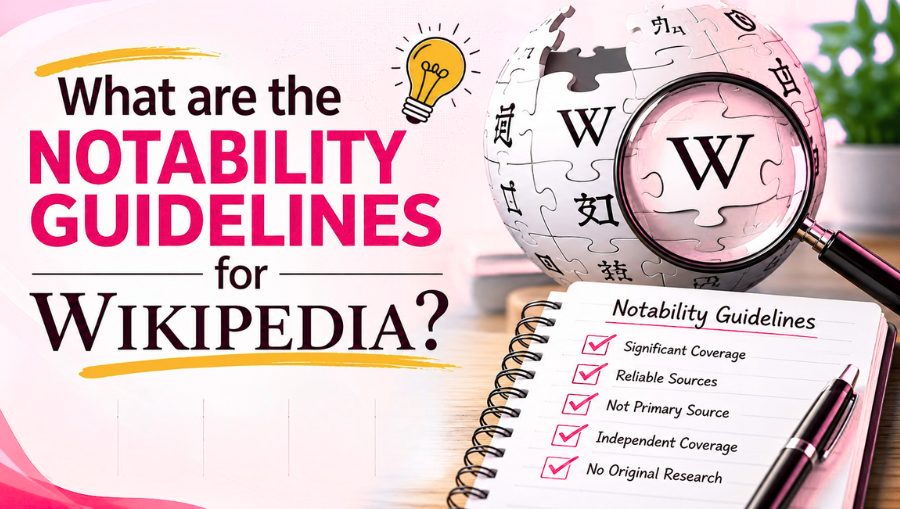
If you’re not following Wikipedia notability guidelines correctly and thoroughly, there are higher chances that your page will get declined, deleted, or never accepted online. Many people think a business, book, person, or brand is important enough for Wikipedia just because it is real or successful. But Wikipedia has its own rules.
Wikipedia is notorious for its subjectivity, independent sources, and notability. It’s not a place that shows ads, self-promote or makes any false claims. And hence, it always requires sources from secondary independent sources. This guide explains the rules in easy language. You’ll learn the complete Wikipedia notability guidelines, what editors look for, which sources count, what does not count, and how to prove notability for Wikipedia in a clean and honest way. We’ll also cover common Wikipedia article rejection reasons so you can avoid them.
What are Wikipedia’s Notability Guidelines?
Wikipedia’s notability guidelines enable the content creators and publishers to follow the standard rules:
A topic should have:
- coverage from sources outside the subject
- coverage that is more than a short mention
- sources with editorial review or fact-checking
- enough information to support a full article
Wikipedia is not asking, “Is this topic good?” It is asking, “Can this topic be verified through strong outside coverage?”
That is a big difference.
For example, a brand can be called notable if it can verify its years of sales, happy customer reviews, and product quality through coverage in news outlets, magazines, or academic sources. If the brand fails to produce or show such evidences that, it fails the notability check. The same goes for authors, podcasts, startups, apps, and even local leaders. Success alone is not enough. Coverage is what matters.
Why Does Notability Matter So Much on Wikipedia?
Wikipedia needs rules so it does not become full of pages about every small business, every new app, or every person with a website. The notability rules help editors keep the site focused on topics with lasting public interest.
This helps in a few ways.
First, it protects quality. If every subject could have a page with no real proof, Wikipedia would be less useful. Second, it helps stop promotion. A page should not read like an ad. Third, it keeps content based on evidence, not opinion. That is why even true facts are not enough on their own. Facts must be backed by accepted sources. And the topic itself must meet the basic test for notability.
The Complete Wikipedia Notability Guidelines in Plain English
The complete Wikipedia notability guidelines can feel hard to read at first. The wording on Wikipedia can be formal. A topic is more likely to be notable when:
It has significant coverage
This means the source talks about the topic in a meaningful way. A passing mention does not help much. A short line in a list like “Top 20 startups to watch” is usually weak. A full article about the company’s growth, impact, or work is much stronger.
The source is independent.
Independent means the source is not controlled by the topic.
Good examples:
- a newspaper writing about a company
- a magazine reviewing a book
- a university press discussing a researcher
- An industry journal covering a product
Weak examples:
- the company website
- the author’s blog
- a press release
- a LinkedIn page
- a self-published interview
The source is reliable
This is where reliable sources Wikipedia editors trust become very important. Reliable sources usually have editors, review steps, and a reason to care about accuracy.
Examples can include:
- major newspapers
- respected magazines
- academic journals
- books from known publishers
- serious trade publications
Not every website counts. A random blog post or paid feature is often too weak.
The topic can support an encyclopedia article
Wikipedia articles need enough information to build a balanced page. That includes history, context, reception, impact, or other well-sourced facts. If the only available content is basic profile info, that is not enough.
Wikipedia Notability Criteria: The Core Ideas to Know
The main Wikipedia notability criteria come down to three simple questions:
1. Has the topic been covered in depth?
Depth matters more than mention count. Ten tiny mentions may be weaker than two strong articles. Editors often look for real discussion, analysis, or reporting. They want proof that the topic matters beyond short notice.
2. Are the sources independent of the topic?
Independence is key. If the subject wrote the source, paid for the source, or closely controls the source, it carries less weight. For example, a founder interview on the company blog does not prove notability. It proves the founder can publish content.
3. Are the sources reliable and published?
Reliable means trusted. Published means the material is available in a real, citable form. Private documents or unpublished claims do not help much. This is why a topic may be real and active but still not be ready for Wikipedia.
Wikipedia Notability Standards for Businesses, People, Books, and More
The Wikipedia notability standards apply across many topics, but the details can look a bit different by subject.
Businesses
A business usually needs more than being registered, operating, or earning money. Editors often want strong third-party coverage from trusted media or industry sources.
Helpful signs include:
- detailed news coverage
- major awards from respected groups
- strong coverage of funding, innovation, or market impact
- independent analysis from trade press
Weak signs include:
- routine directory listings
- basic press release pickup
- product pages
- social media popularity alone
People
A person needs coverage that shows public interest beyond their own bio. A personal website, CV, or profile does not prove notability.
Helpful sources include:
- major interviews by trusted outlets
- features in newspapers or magazines
- academic or professional discussion
- books or journal coverage about the person’s work
Authors and books
Authors usually need more than publishing a book. They need strong, outside coverage of their work or career.
Good support may include:
- reviews in major outlets
- interviews in respected publications
- awards with real standing
- discussion in books, journals, or academic writing
A book itself may also be notable if it has meaningful coverage, impact, or recognition.
Organizations and nonprofits
A nonprofit still needs notability. Good intent alone is not enough. Editors want to see outside coverage about the work, reach, effect, or public role of the group.
Products, apps, and software
Products and apps need more than launch announcements. Editors want evidence that the product has been covered, reviewed, or discussed by independent, trusted sources.
The Wikipedia Notability Test: A Quick Way to Judge Your Topic
You can use this simple Wikipedia notability test before trying to create a Wikipedia page.
Ask these questions:
Can you find at least a few solid, independent sources?
Look for news stories, features, reviews, journal pieces, or books that talk about the topic in real detail.
Do the sources say more than basic facts?
A source should offer more than a name, date, and one quote. It should help a reader understand the topic.
Are the sources separate from your own marketing?
Press pages, brand websites, and self-written bios do not carry the same value.
Would someone outside your circle care about this topic?
Wikipedia is about public, documented significance. It is not a profile site.
Is the topic still too new?
Some topics are real but too early. A startup, book, or person may need more time for outside coverage to build.
If you answer “no” to most of these questions, the topic may not be ready.
Reliable Sources Wikipedia Editors Usually Value
The phrase reliable sources Wikipedia matters because not all sources are equal. A reliable source is one with a process for review, editing, and accuracy. It should have a reason to get facts right.
Strong source types
These are often stronger:
- national or regional newspapers
- established magazines
- books from known publishers
- academic journals
- respected trade publications
- major broadcast media sites
Medium-strength source types
These may help, depending on the case:
- local news coverage
- niche industry sites with clear editorial standards
- expert publications
- professional association publications
Weak source types
These are often weak for proving notability:
- press releases
- sponsored content
- self-published blogs
- company websites
- social media posts
- directory pages
- user-generated databases
Wikipedia editors often care about both reliability and independence. A polished article on a company-owned site may be accurate, but it is not independent.
What Sources Does Wikipedia Usually Reject or Question?
Some sources are not always banned, but they are often questioned.
Press releases
Press releases are written to promote. Even when news websites repost them, the original source is still promotional.
Sponsored articles
If the business paid for placement, the source is weaker because it is not fully independent.
IMDb, Crunchbase, and similar profile sites
These can be useful for leads, but they are usually not enough to prove notability on their own.
Social media
Follower counts, post shares, and comments do not prove encyclopedia value.
Interviews with no outside analysis
An interview can help verify simple facts, but it may not prove notability if it lacks outside reporting or review.
How to Prove Notability for Wikipedia the Right Way
Many people ask how to prove notability for Wikipedia without sounding promotional. The answer is simple: collect and use the strongest independent sources you can find. Here is a smart way to do it.
Step 1: Gather your best third-party coverage
Look for:
- full news stories
- major interviews in trusted outlets
- reviews
- case studies in respected publications
- academic or professional discussion
- books that mention the topic in depth
Try to gather sources from different places, not all from one small circle.
Step 2: Remove weak or self-serving links
Do not build your case around:
- your own website
- your own press page
- affiliate posts
- copied press releases
- low-quality blogs
These can support small facts later, but they should not carry the notability case.
Step 3: Check if the coverage is about the topic, not just a mention
A line in a list is not enough. You want sources where the topic is central.
Step 4: Make sure the topic is described in a neutral way
Wikipedia does not want hype words like:
- leading
- world-class
- award-winning
- best-selling
- innovative
Even if these claims are true, they need strong sourcing and careful wording. Neutral writing is safer.
Step 5: Look for lasting coverage, not just launch buzz
A few launch stories may not be enough. Ongoing coverage over time often helps more.
Common Wikipedia Article Rejection Reasons
Knowing the main Wikipedia article rejection reasons can save you a lot of time.
- Not enough independent coverage
This is the biggest reason. The page may be about a real topic, but there is not enough strong coverage from outside sources.
- The article sounds promotional
Wikipedia is not a sales page. Marketing words, praise, and calls to action make editors suspicious fast.
- Weak sourcing
A page full of press releases, social media, and company links is likely to fail.
- Conflict of interest
If you are writing about yourself, your company, your client, or your book, editors may look more closely. That does not make the topic wrong, but it raises risk.
- No significant coverage
Maybe the topic has many mentions, but not enough real detail.
- The topic is too new
Some topics need time. News needs to grow into coverage.
- Claims are not verified
Facts without sources often get challenged or removed.
- The article copies wording from other sites
Copied text can lead to fast rejection. Wikipedia needs original writing.
How Editors Look at Notability in Real Life
Editors do not always count sources like a math test. They look at the full picture.
They may ask:
- Are these sources truly independent?
- Are they reliable?
- Is the coverage of the topic in depth?
- Can this topic support a neutral article?
- Is this article based on sources or on the subject’s own claims?
This is why one strong newspaper feature may matter more than many weak mentions. Editors also look for balance. If all available sources are positive and come from brand-friendly outlets, that can raise concerns.
A Simple Process to Check Your Topic Before You Draft
Before you write anything, use this process.
Search broadly
Look in:
- news databases
- Google News
- books
- academic search tools
- trade journals
- magazine archives
Do not stop at page one of the search results.
Group your sources
Sort them into:
- strong independent sources
- medium sources
- weak or self-published sources
This helps you see the truth fast.
Ask if the article can be built from strong sources
Can you write the page mostly from strong sources? If not, the topic may not be ready.
Look for depth and spread
You want more than one kind of source. A good mix is often better than many near-duplicate items.
How Many Sources Are Enough?
People often want a magic number. But Wikipedia does not work like that. There is no fixed number that guarantees notability. A topic could fail with ten weak sources and pass with three strong ones.
What matters is:
- source quality
- independence
- depth
- coverage over time
Still, in practice, it often helps to have several strong sources that each discuss the topic in a clear and meaningful way. Think quality first, quantity second.
Can Local News or Niche Media Help?
Yes, sometimes. Local news can help if the story is detailed and the outlet has real editorial review. Niche media can also help, especially for fields like tech, medicine, finance, or publishing. But small sources are not always enough by themselves. Editors often want stronger proof that goes beyond the topic’s own community. A local paper feature plus a few trade articles may help. A town blog and a business directory usually will not.
What Does Notability Look Like for a Business?
Business professionals often ask this because they want a Wikipedia page for a company, founder, or brand.
A business may be notable if it has:
- strong reporting in trusted business media
- meaningful third-party coverage of its growth or impact
- coverage of a major event, such as a large merger or breakthrough
- significant recognition discussed by independent sources
A business may not be ready if it has:
- only press release coverage
- only paid media
- only founder-written thought pieces
- lots of social media buzz but little press depth
Being successful in the market and being notable on Wikipedia are not the same thing.
What Does Notability Look Like for an Author?
Authors often think that having a published book is enough. Usually, it is not. An author becomes more likely to meet the test when there is:
- real review coverage
- profile coverage by trusted media
- awards with outside discussion
- academic or critical attention
- lasting public interest
A self-published book with little outside coverage will usually struggle. A traditionally published book can also struggle if no one talks about it in reliable sources.
What Does Notability Look Like for a Book?
A book may be notable if it has:
- reviews in respected publications
- scholarly discussion
- major awards
- meaningful public or cultural impact
- strong coverage over time
A book is less likely to be notable if it only has:
- retail listings
- blurbs
- launch PR
- the author’s own posts
For books, independent reviews are especially helpful.
Why Press Coverage is Not Always Enough?
Not all press is equal. A short press note, a copied release, or a paid feature may look impressive at first. But Wikipedia editors often examine the source more closely.
They may ask:
- Was this written by the outlet or supplied by the company?
- Is it a true article or sponsored content?
- Does it say anything new and independent?
- Is it mostly praise with no distance?
That is why clean, strong, reported coverage matters more than flashy links.
How to Write a Wikipedia-ready Article in a Neutral Tone
Once your topic seems notable, the next step is tone. Here is what helps.
Use plain facts
Write what the sources support. Skip sales language.
Bad:
XYZ is a leading company changing the future of finance.
Better:
XYZ is a finance company founded in 2021. It has been covered by several business publications for its payment software.
Attribute claims when needed
Instead of stating praise as fact, show where it came from.
Example:
Tech Journal described the product as one of the most discussed tools in its category.
Avoid hype
Words like “best,” “top,” “famous,” and “groundbreaking” are risky unless clearly sourced and necessary.
Keep the structure clean
A simple article often includes:
- intro
- history
- work or products
- reception or impact
- references
Mistakes People Make When Trying to Prove Notability
These mistakes happen a lot.
Counting mentions instead of depth
Many small mentions do not equal strong coverage.
Using your own content as proof
Your site is useful for simple facts, but it does not prove notability.
Relying on awards, no one knows
An award only helps if it comes from a respected body and has outside coverage.
Confusing fame with sourcing
A topic can be popular online and still fail the Wikipedia test.
Writing the page before doing source research
This wastes time. Source review should come first.
A Simple Checklist Before Submitting a Wikipedia Page
Use this checklist before you move forward.
- Do I have several strong, independent sources?
- Do those sources discuss the topic in depth?
- Can I write the page without marketing language?
- Are most claims backed by citations?
- Is the article about public knowledge, not promotion?
- Is the topic ready now, or would more time help?
If you cannot say yes to most of these, pause first.
When a Topic is Real but Not Ready
This happens often, and it is okay. A business may be growing fast. A new book may be good. A founder may be doing strong work. But if outside coverage is still thin, the topic may need more time. That does not mean “never.” It may just mean “not yet.”
Sometimes the best move is to wait until:
- more trusted press covers the topic
- reviews come out
- impact becomes easier to document
- better sources are available
Patience can save effort.
How to Improve Your Chances Without Breaking Rules
You should never try to game Wikipedia. But you can improve your odds in honest ways.
Build real public coverage
Focus on real media relations, thought leadership, awards, and coverage that comes from actual interest, not payment.
Keep your public facts easy to verify
Accurate company pages, author pages, and press materials can help reporters and editors check simple details.
Separate promotion from encyclopedia writing
A sales page and a Wikipedia page have different jobs.
Use independent research first
The strongest pages start with strong source files, not with branding goals.
Should You Write Your Own Page?
You can, but it comes with risk. If you are writing about yourself, your company, or your client, that can create a conflict of interest. Editors may question the page more closely.
A better path is often:
- gather strong sources first
- draft in a neutral tone
- disclose your connection where needed
- avoid editing battles
- let independent editors review the topic
The closer you are to the subject, the more careful you need to be.
How to Use Wikipedia Notability Guidelines Well
The key to understanding Wikipedia notability guidelines is simple: notability is not about how much you care about the topic. It is about whether strong, independent sources have cared enough to cover it in depth. If you remember that, the process gets much easier. Focus on real coverage. Use trusted outside sources. Write in a neutral tone. And learn the common Wikipedia article rejection reasons before you submit anything. That will help you save time, lower risk, and make better choices. If you want expert help turning strong source material into a clear, professional book or author platform, connect with Arkham House Publishers.