
A manuscript can spend years living in private. No one would know anything about it until you decide to share it with someone, anyone. Before the rise of the self-publishing platforms, traditional publishing enjoyed the complete autonomy of the market.
An author could pursue a traditional publishing deal or publish independently. The border between the two was fairly clear. Today, that border has become crowded. Hybrid publishers, assisted publishing companies, freelance production teams, direct sales tools, print-on-demand services, artificial intelligence software, subscription platforms, audiobook companies, and global distribution networks have all entered the same conversation.
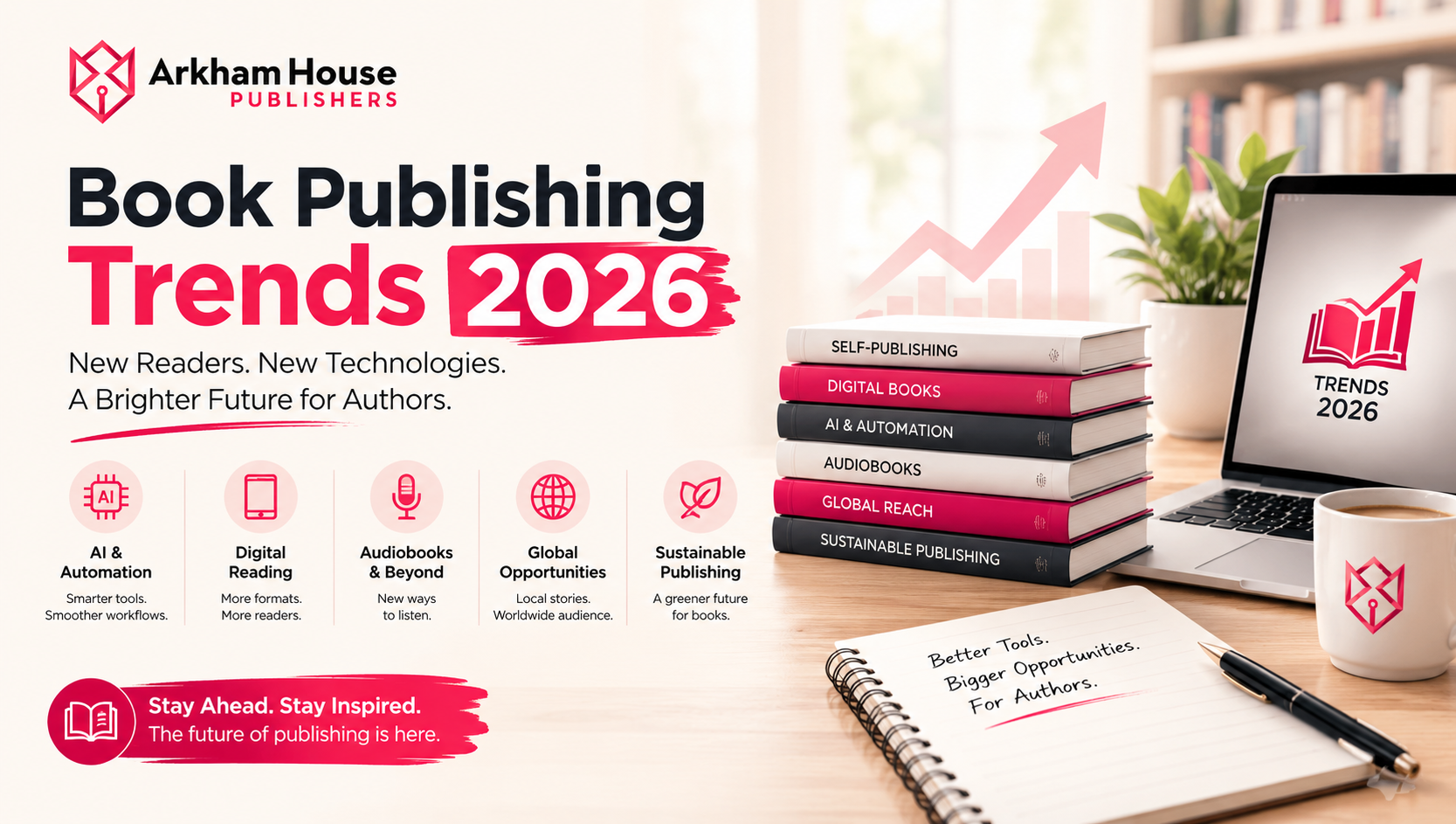
That is why publishing trends 2026 matter. They are not merely predictions about formats or technology. They reveal a deeper change in what authors are being asked to decide. Publishing has become less about choosing one gate and more about choosing a system.
Among different trends, Hybrid Publishing has been the talk of the year. For some authors, it’s the best approach as you don’t have to manage anything on your own. You can take the middle ground between traditional publishing and a DIY approach. However, if the services are weaker or the contracts are vague, then you’ll have problems on your road ahead.
In this blog, we are looking at the publishing industry trends 2026 and finding ways that help maximize benefits for the authors.
The State of Publishing in 2026: A Quick Overview of the Top Publishing Trends
One of the most beneficial changes due to the rise of hybrid publishing platforms is that the access point has become easier for serious authors. The publishing houses that felt difficult to reach are now accessible. There’s no exclusive tag on it anymore.
As an aspiring author, you can hire an editor or a cover designer to work on your book. Through the print-on-demand services, you can have your books printed and distributed in the market. Likewise, the digital storefronts make international sales possible. Audiobooks can be produced outside the largest publishing companies. Authors can build email lists, sell from their websites, develop reader communities, and study sales data that earlier generations of writers rarely saw.
These top publishing trends have created opportunity, but they have also moved more responsibility onto authors. Now the author has to wear many hats at the same time. They have to think like a creative director, an editor, marketers, a publisher, and a brand strategist for long-term brand aura. Some writers enjoy that control. Others find that the work surrounding the manuscript begins to consume the time they wanted to spend writing.
Hybrid publishing exists partly because of that tension. It promises professional help without requiring the author to surrender as much control as a conventional publishing agreement might demand. But the quality, cost, selectivity, contract terms, distribution, and marketing support offered under the word “hybrid” can vary widely.
That variation is one of the defining realities of book publishing industry trends 2026.
What’s Actually Different About 2026 Versus a Few Years Ago?
The biggest difference is not one new invention. It is the accumulation of many smaller changes.
Authors now enter publishing with more tools than they once had, but readers also face more books, more content, and more competing demands on their attention. Producing a book has become easier in certain technical ways. Producing a book that appears professional, reaches the correct audience, earns trust, and continues selling over time remains difficult.
Artificial intelligence has accelerated some production tasks. Direct-to-reader technology has made audience ownership more important. Audiobooks and digital editions have expanded the number of formats an author may need to consider. Social platforms can introduce a book to thousands of readers, yet platform algorithms can also change without warning.
At the same time, authors are becoming more aware of contractual questions. Who owns the files? Who controls the ISBN? What rights are being licensed? How are royalties calculated? Can the author leave? Who owns the audiobook, translation, film, or foreign rights?
The result is a publishing market with fewer simple assumptions for publishing trends 2026.
Trend 1: Hybrid Publishing Has Moved From Niche to Mainstream
Hybrid publishing used to be an unusual option, but now it has become widely accepted and appreciated in conversations. It’s easy to understand why it has gained so much popularity in recent years.
Earlier, traditional publishing dominated the market, but the cost to enter it was much higher than expected. Although all the editorial and design aspects were taken care of by the traditional publishers, the author had to give up their rights and surrender a significant amount of control and rights to the other party.
On the other hand, self-publishing offers another equation. The author can often control nearly every important decision and keep a larger share of revenue per sale. But control also means responsibility. Either they have to take care of all the production, including the proofreading, editing, designing, distribution, marketing and more, or they have to hire someone to do all these for them at a decided price.
Hybrid publishing attempts to occupy the space between those models.
A strong hybrid arrangement can provide a professional publishing structure while allowing authors to retain more influence over their work. The author usually contributes financially, which changes the economics of the relationship and makes careful evaluation essential.
What Changed and Why
Three forces have pushed hybrid publishing closer to the mainstream.
First, professional publishing services have become easier to purchase separately.
Second, more writers view books as long-term intellectual property rather than single products. A consultant may use a book to support speaking work. A novelist may want control over a series. A memoirist may care deeply about publication timing. An entrepreneur may want books available for events, clients, courses, or direct sales.
For such authors, speed and control can have real value.
Third, the traditional route is not equally suited to every project. It can get difficult if you cannot get yourself onto the publishers’ list. This is also one of the reasons why hybrid is in the self-publishing trends 2026.
How to Tell a Reputable Hybrid Publisher From a Vanity Press
A hybrid publisher should have the seal of credibility on their website. This matters a lot, especially in the digital sphere. If you cannot get customers like you or leave a comment on your site, you might be doing something wrong, and that’s how the label is being translated these days.
Secondly, a good publisher will keep the costing transparent, making the authors know what they are paying for. No matter the service, the goal should be measurable, specific, and outcome-driven. Likewise, the contract should be clear in terms of its policies and terminologies. These policies could be about who controls the intellectual property rights, the duration of the agreement, the process of termination, and how the royalties are going to be paid.
Selectivity also matters. If every manuscript is praised as publishable within minutes of submission, the company may be selling packages rather than making meaningful editorial decisions. A useful test is to ignore the sales language and examine the operational details.
Who edits the manuscript? Can the author see examples of published books? Are production standards consistent? Are costs itemized? Who owns the final files? Where will the book be distributed? Who can order and which bookstores will likely list the book?
Among the top publishing trends authors should welcome is a growing insistence on such distinctions.
Trend 2: AI’s Real Role in Publishing and What It Won’t Replace
Few subjects have entered publishing conversations as quickly as artificial intelligence.
It can summarize. It can sort information. It can suggest keywords, identify repeated phrases, compare versions of text, generate rough marketing ideas, assist with metadata research, and reduce some of the mechanical labor involved in managing a book project.
For authors working within tight budgets, that can be useful.
But one of the more important digital publishing trends is the growing distinction between producing material quickly and exercising good judgment.
Publishing is full of decisions for which speed is not the main requirement. For example, how much developmental editing is required, the copyediting shouldn’t change the voice of the author, the cover designs shouldn’t give out mix signals, and more. A publicist must recognize which angle is genuinely newsworthy. A publishing strategist must decide which opportunities are worth pursuing and which merely look impressive.
Where AI Actually Saves Authors Money
Although AI can save a lot of time and reduce repetitive work, it still needs final authority. With the help of AI, you can organize your editorial notes. It can generate preliminary lists of comparable titles for further research. It can suggest alternate metadata phrases. It can help classify content, build checklists, brainstorm promotional angles, or identify obvious inconsistencies that a human can then review.
For independent authors, these efficiencies may reduce the amount of paid professional time needed for basic administrative work.
Nonetheless, it is one of the reasons why AI is tied to the online publishing trends these days. Due to the automation of the process, authors can touch upon many stages in a few days. But efficiency has a ceiling.
An author can save money by automating the wrong task and still lose far more through a weak final product.
Where a Professional Team Still Outperforms AI-Only Workflows
The most important editorial choices are often contextual.
Consider a scene that feels slow. A machine may identify long paragraphs, repeated words, or low variation in sentence length. A skilled editor may recognize something less obvious: the scene contains information but no change. The problem is not sentence length. It is dramatic movement.
The same principle applies elsewhere.
A cover can satisfy technical dimensions while still looking wrong for its audience. A press release can be grammatically clean while containing no story a journalist would care about. A book description can contain the correct keywords while revealing too much of the plot. A marketing plan can include every popular channel and still fail because it does not match how the book’s readers actually discover books.
These are judgment problems.
For that reason, the most sensible role for AI within publishing trends 2026 may be neither rejection nor dependence. It is controlled use. Machines can reduce friction. Experienced people still need to make consequential decisions.
Trend 3: Distribution Is Diversifying Beyond a Single Platform
For years, discussions about independent publishing frequently began and ended with one major online retailer.
This diversification is one of the healthiest digital publishing trends because it forces writers to distinguish between availability and distribution.
A book may technically be available for purchase somewhere without being meaningfully discoverable there.
Uploading a title is not the same as creating demand.
What Should Authors Expect a Publisher to Actually Deliver on Distribution?
The word “distribution” needs interrogation because it can describe several very different services.
At the most basic level, distribution may mean listing a book through systems that allow retailers to order it.
In layman’s terms, distribution is ensuring that your book is listed in the system that allows retailers to make the purchase. However, this does not guarantee that the book will be placed on stores’ shelves.
Physical bookstore has a different set of placement factors. Such as discount offers, return factors, local interests, sales history, and publicity or demand of the book in the market.
The authors who are weighing their options must ask their publishers if their book will be listed; if yes, then on what terms. Likewise, how the ordering system will work, what would be the return policy, what services would be covered, and if sales efforts are included or not.
A publishing company should not need vague language if its distribution process is strong.
The main goal behind these book publishing industry trends 2026 is that the author should do their research first, rather than accepting the face value.
Trend 4: Author Branding and Direct Reader Connection Are Now Expected
The old fantasy of authorship involved retreat. A writer wrote. A publisher published. Readers appeared.
However, now the modern approaches still require the author to make a public appearance in podcasts, interviews and book events. Social media, community building efforts and more. The goal is not always to make the author an online personality, but rather to make them interesting for the audience to find them.
After all, the modern reader now searches for the author’s website, social profile, and other interviews by the author as soon as he finishes the book. If nothing appears, that moment of attention disappears.
This is why author platforms have become intertwined with online publishing trends. The goal is not constant visibility. It is continuity.
How Much Marketing Is the Author Still Responsible for, Even With a Publisher’s Help?
Usually, more than inexperienced authors expect. A publisher may help you attract new opportunities and prepare the marketing material at any campaign stage. However, at the end of the day, the reader is going to meet the author, the person who is real person behind the work.
An author’s existing relationships, expertise, local community, speaking opportunities, newsletter, professional network, or connection to the subject may open doors no outside marketing team can manufacture.
This is especially true for nonfiction, memoir, professional books, regional titles, and works connected to particular communities.
Fiction has its own forms of author participation. Readers may follow a series, attend events, join newsletters, share recommendations, or return because they trust a writer’s voice.
The best publishing relationship therefore does not ask, “Who is responsible for marketing?”
It asks, “Who is responsible for which part?”
A professional publisher or publishing service should be able to answer that before the campaign begins.
Trend 5: Royalties, Rights, and Transparency Are Non-Negotiable in 2026
The least glamorous pages of a publishing agreement may determine more about an author’s future than the cover.
Rights matter because a book is not merely a printed object. It is intellectual property that may exist in multiple editions, formats, territories, and languages.
Print rights are one piece. Ebook rights are another. Audiobook rights, translation rights, foreign rights, adaptation rights, merchandising rights, and other licensing opportunities can become important depending on the work.
Authors do not need to become publishing lawyers. They do need to understand what they are signing.
This concern has become increasingly important within publishing industry trends 2026, particularly as authors gain more ways to exploit their work independently.
A contract that once seemed ordinary may feel restrictive if it prevents an author from pursuing an audiobook, international edition, or future opportunity elsewhere. Royalty language deserves the same attention.
A percentage can sound attractive until the author learns what the percentage is calculated from. Retail price? Net receipts? Money received after certain costs? Different formats may also carry different calculations. Transparency should remove these mysteries.
Which Model Fits Which Type of Author?
There is no publishing model that automatically suits every writer.
A debut novelist with little capital but a highly commercial manuscript may decide that pursuing agents and traditional publishers is worth the time. The possibility of professional investment, trade distribution, and established publishing infrastructure may outweigh the slower process and reduced control.
An experienced author with an established audience may see the calculation differently. If readers are already waiting for the next book, retaining control over pricing, release schedules, and rights may make independent publication attractive.
A budget-conscious author who can manage contractors may prefer self-publishing. Paying separately for editing, design, proofreading, and production can offer excellent results when the author knows how to select and coordinate specialists.
A time-conscious author may prefer hybrid publishing because managing those specialists personally is itself a cost. The author is effectively paying not only for individual services but also for project management and publishing expertise.
Genre matters too.
Commercial fiction authors may care deeply about rapid release schedules, series branding, ebook pricing, and direct reader advertising. Literary writers may place greater importance on editorial development, critical positioning, independent bookstores, awards eligibility, or long-term reputation. Professional nonfiction authors may value speed, bulk ordering, speaking opportunities, and control over how the book supports a larger business.
The correct model is the one whose economics and structure fit the author’s real goals.
Hybrid Publishing vs. Self-Publishing vs. Traditional: A 2026 Cost and Control Comparison
Cost is where many publishing discussions become misleading because different models charge authors in different ways.
Traditional publishing generally does not require the author to pay the ordinary production costs of publishing an acquired manuscript. The publisher assumes financial risk and typically pays the author according to the terms of the contract. In exchange, the publisher receives defined rights and substantial control over how the book enters the market.
The author’s financial cost may therefore be low, but the economic exchange still exists. It takes the form of rights, royalty structure, decision-making authority, and sometimes time.
Self-publishing reverses that arrangement.
The author funds the work, either financially or through personal labor. Professional editing, cover design, proofreading, formatting, advertising, audiobook production, publicity, and other services can each carry separate costs.
The advantage is control. The author can hire the team, set the schedule, choose the cover, control pricing, revise metadata, change marketing direction, and often retain a much larger degree of ownership.
The weakness is management.
A self-published book can be professionally produced, but professionalism does not happen automatically simply because the author controls the project.
Hybrid publishing places the author in a third economic structure. The writer generally contributes financially while the publisher or publishing company provides a coordinated set of services. Depending on the company, these may include editorial work, design, production, distribution, marketing support, project management, and other functions.
The crucial question is value.
Suppose an author spends less through self-publishing but loses months learning production systems, finding freelancers, comparing proofs, managing revisions, fixing technical problems, and coordinating a launch. For that author, a higher-cost hybrid model might make sense.
Another author may already understand publishing, have trusted freelancers, and enjoy controlling every part of production. Paying a hybrid company to manage tasks the author can already manage may offer little advantage.
These differences explain why comparisons built only around price rarely capture the full story behind self-publishing trends in 2026.
The true comparison has at least five parts: money, time, expertise, control, and risk.
An author should know which one is most limited.
The Hidden Cost in Publishing Is Often Coordination
A book appears to be one product. Making one can involve dozens of decisions.
Developmental editing may lead to rewriting. Rewriting changes copy editing. Copy editing changes the page count. Page count can affect spine width. A changed spine width affects the cover file. The new interior needs proofreading. Corrections need to be made without creating fresh errors. Ebook formatting requires separate checks. Metadata must remain consistent. Publication dates affect marketing. Advance copies must arrive early enough to be useful.
None of these jobs is mysterious by itself. The difficulty lies in coordinating them.
This is one of the least discussed top publishing trends because it is not exciting enough to dominate industry conversation. Yet it is a central reason some authors choose publishing support.
A capable hybrid publisher is not valuable simply because it knows how to upload a book. Its value should come from managing dependencies, maintaining standards, identifying problems before they become expensive, and helping an author make decisions in the correct order.
If the company does not provide that expertise, the author may be paying for convenience without receiving genuine professional oversight.
Digital Publishing Trends Are Making the Book More Flexible
The modern book is less fixed than it once was.
An ebook can be updated. Print-on-demand files can be corrected without destroying thousands of printed copies. Online metadata can change. Advertising copy can be tested. A cover can be replaced. Direct storefronts can offer bundles. Audiobooks can introduce a title to readers who rarely buy print editions.
These digital publishing trends give authors room to adapt.
They also create a temptation to publish before a book is ready.
Because files can be changed later, an author may reason that mistakes can simply be corrected after publication. Technically, that may be true. Strategically, it can be costly.
Early reviews, sample pages, retailer previews, reader recommendations, and launch impressions occur in real time. A weak opening, poorly edited text, or amateur cover can shape the book’s reputation before corrections arrive.
Technology has made revision easier. It has not made first impressions irrelevant.
That distinction matters particularly for hybrid publishing. A company that emphasizes speed without protecting editorial standards may be using technology to accelerate production rather than improve publishing.
Online Publishing Trends Are Shifting Attention Toward Audience Ownership
A social media account can reach thousands of people one month and a fraction of them the next.
Algorithms change. Platforms rise and decline. Advertising costs move. Features disappear. Accounts can be limited or lost.
An email list, direct website, reader community, or customer relationship offers something different: continuity that is less dependent on a single outside platform.
For this reason, online publishing trends increasingly favor authors who build assets they control rather than relying entirely on borrowed audiences.
This does not require aggressive self-promotion.
A novelist may send a thoughtful newsletter only when there is something worth saying. A historian might publish essays connected to a research area. A children’s author might create resources for parents or teachers. A memoirist might share interviews, readings, or reflections that extend the book’s central concerns.
The form matters less than the connection.
For authors comparing publishers, marketing support should therefore be judged partly by what remains after a campaign ends.
A week of exposure can be helpful.
A growing body of readers who know where to find the author can be more valuable.
Publishing Industry Trends 2026 Are Making Professional Standards More Important, Not Less
There is a strange effect that occurs whenever production technology becomes easier to access.
More people can create the product, which means quality matters more.
Readers rarely know whether a book was traditionally published, self-published, or produced through a hybrid company when they first encounter its cover online. They see a thumbnail, title, description, reviews, sample, price, and author name.
The book is judged against every other book beside it.
That is why easier publication has not made professional editing and design irrelevant. It has made weak execution more visible.
A confusing cover does not receive sympathy because it was independently produced. A poorly edited opening does not become more enjoyable because the author worked hard. A misleading description does not become effective because the writer lacked marketing experience.
The market sees the result.
Among the most useful publishing trends 2026 can teach authors is that access and readiness are different things. A book can be ready to upload long before it is ready to publish.
Book Publishing Industry Trends 2026 and the Return of the Patient Launch
Digital culture encourages speed, but books often reward patience.
A strong launch is built backward.
The desired publication date determines when final files must be ready. That determines when proofreading must finish. Proofreading depends on formatting. Formatting depends on edited text. Marketing materials depend on stable positioning and cover artwork. Advance outreach may need substantial lead time.
Authors who begin publicity after the book goes live have not necessarily failed, but they have surrendered opportunities that required earlier preparation.
This is one area where professional publishing support can create real value.
A good process gives the author deadlines before the author knows why those deadlines matter.
It protects time for mistakes.
That may sound unromantic, but publishing contains many such truths. The creative act may begin with inspiration. The commercial life of a book depends heavily on preparation.
So, Is Hybrid Publishing Worth It in 2026?
Sometimes.
That answer is less satisfying than a simple yes or no, but it is more useful.
Hybrid publishing is worth considering when an author wants professional publishing support, values control over important decisions, can afford the investment without relying on unrealistic sales expectations, and chooses a company whose quality and contract justify its fees.
It may be especially useful for authors who have strong manuscripts but do not want to manage a fragmented team of independent providers.
It can also make sense when timing matters. A subject expert with an upcoming event, a novelist maintaining a series schedule, or an author building a larger professional platform may value a defined production timeline.
Hybrid publishing may be a poor choice when the author is paying largely for services that can be sourced easily and more effectively elsewhere.
It is also a poor choice when the publisher’s value proposition depends on dreams rather than deliverables.
“We can make your book a bestseller” is not a serious operational plan.
“We will provide developmental editing, copy editing, custom cover design, print and ebook production, defined distribution services, launch assets, and a contract explaining all rights and costs” is at least something an author can evaluate.
The distinction between those statements captures much of what authors need to understand about publishing trends in 2026.
The Better Question Is Not “Which Publishing Model Wins?”
Publishing conversations often turn into identity contests.
Traditional publishing is described as legitimate. Self-publishing is described as freedom. Hybrid publishing is described either as the best of both worlds or the worst of both.
Reality is less neat.
Poor books can emerge from established companies. Exceptional books can be independently published. Hybrid arrangements can deliver real professional value. They can also be overpriced and disappointing.
A publishing model is an economic structure, not a quality guarantee.
The author must still judge the people involved.
Who understands the manuscript? Who knows the intended reader? Who is accountable for quality? Who can explain the distribution strategy? Who controls the rights? Who owns the files? What happens when something goes wrong?
Those questions reveal far more than the label printed on a company’s website.
What This Means for Authors Deciding Right Now
An author standing at the end of a manuscript may feel pressure to move quickly. Finishing creates momentum. After months or years of work, publication feels like the obvious next action.
But the next action should often be evaluation.
The writer should identify the true goal first.
Is the book expected to generate direct revenue? Support a professional career? Reach a specific community? Build a readership for a series? Establish authority? Preserve a family story? Attract traditional media? Create speaking opportunities? Become the beginning of a long writing career?
Different goals require different publishing systems.
Then comes the harder question: What does the author actually need help doing?
Some writers need editorial guidance. Others already have a polished manuscript but do not understand distribution. Some need design and production. Others need project management because they cannot devote six months to learning the business.
A hybrid publisher should solve real problems, not sell an author a feeling.
The same principle applies to self-publishing services, consultants, marketers, and traditional contracts.
The defining lesson of publishing trends 2026 is not that one route has replaced the others. It is that authors have more choices and therefore need better questions.
The modern publishing decision begins when a writer stops asking, “Who will publish this?” and starts asking, “What kind of publishing relationship does this book require?”
Final Words
The image that opened this discussion was a finished manuscript sitting quietly on a computer, waiting for its author to decide what happens next. That moment has become more complicated in 2026, but it has also become more promising. Writers have more tools, more publishing models, more control, and more ways to reach readers than previous generations could easily access. The task is to choose those tools with care.
Authors weighing hybrid publishing, independent publication, or professional publishing support can begin by comparing services, rights, costs, and responsibilities rather than chasing labels.
For writers who want structured help while exploring Affordable Book Publishing Solutions, Arkham House Publishers offers another option to investigate as part of that comparison. The final decision should serve the manuscript, protect the author’s long-term interests, and give the book the professional foundation it needs to meet its readers.