
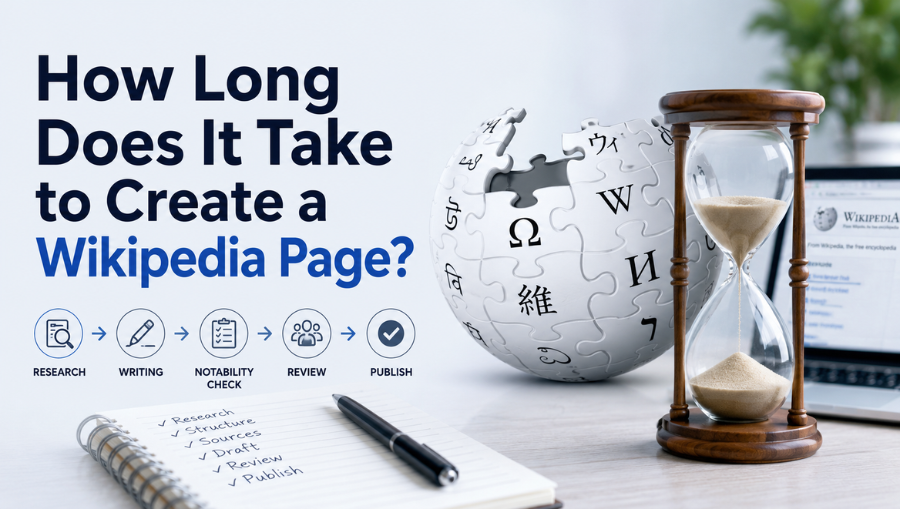
How Long Does It Take to Create a Wikipedia Page?
How long does it take to create a Wikipedia page? For a subject that already meets Wikipedia’s notability rules, the full process can take about one to four months. Research and drafting may take one to four weeks, while the Wikipedia review may take a few days, several weeks, or a few months. A Wikipedia page creator researches independent sources, writes a neutral draft, formats citations, discloses any paid relationship, submits the article, and responds to editor feedback. Understanding this timeline matters because weak sources, promotional writing, or an earlier deletion can turn a simple project into months of revisions. This guide explains the complete process, realistic time ranges, costs, professional services, and the issues that affect approval.
How Long Does Wikipedia Page Approval Take?
A realistic planning range is:
| Situation | Estimated Time |
|---|---|
| Strong sources and a simple subject | 4 to 8 weeks |
| Strong sources with normal review delays | 2 to 4 months |
| Draft requiring one or more revisions | 3 to 6 months |
| Complicated or controversial subject | 4 to 8 months or longer |
| Previous deletion or rejection | Several months or longer |
| Not enough independent coverage | No responsible timeline |
These are planning estimates, not official deadlines.
Wikipedia is maintained by a community of editors. It does not offer a paid priority queue or guaranteed review date. A good draft may be reviewed quickly, while another draft may remain in the queue for months.
The most honest answer is simple:
Creating the draft may take a few weeks. Getting it reviewed and accepted may take several more weeks or months.
What Does Creating a Wikipedia Page Mean?
Creating a Wikipedia page involves more than writing a biography or company profile.
A proper Wikipedia page creation timeline can include:
- Checking whether the subject qualifies
- Finding reliable and independent sources
- Reviewing previous drafts or deletion records
- Planning the article structure
- Writing neutral encyclopedic content
- Adding inline citations
- Formatting the draft
- Disclosing conflicts of interest
- Submitting through Articles for Creation
- Responding to reviewer feedback
- Monitoring the page after publication
Many service providers only discuss the writing stage. That gives readers an incomplete picture.
A 1,000 word draft might be written in a few days. The harder part is proving that the subject deserves a separate Wikipedia article and ensuring every important statement can be supported by acceptable sources.
Does Wikipedia Really “Approve” Pages?
People often ask, “How long does Wikipedia page approval take?” The word approval is useful, but it can be misleading.
Wikipedia does not certify a person, company, product, or organization. It also does not permanently approve an article.
When a draft goes through Articles for Creation, a reviewer may:
- Accept it and move it into article space
- Decline it and request changes
- Reject it because it is unlikely to meet Wikipedia’s requirements
A decline is not always the end. The author can correct the stated problems and resubmit the draft.
A rejection is more serious. It usually means that the draft or subject is not suitable for another review without major new evidence or a material change in circumstances.
Even after an article goes live, other editors can change it, tag it, merge it with another page, or nominate it for deletion. No business, individual, consultant, or Wikipedia page creator owns the finished article.
Wikipedia Page Creation Timeline by Stage
Stage 1: Notability Assessment
Estimated time: 2 days to 2 weeks
The first stage is deciding whether the subject qualifies for a separate article.
Wikipedia notability is based mainly on substantial coverage in reliable sources that are independent of the subject. Fame, followers, revenue, awards, and years in business do not automatically prove notability.
A proper assessment reviews:
- National or established regional newspapers
- Reputable magazines
- Academic journals
- Books from credible publishers
- Independent industry publications
- Major broadcast reports
- Documentaries
- Detailed profiles and critical reviews
The assessment also separates useful background sources from sources that help prove notability.
For example, a company website can confirm an office address. It usually cannot prove that the company deserves its own Wikipedia article.
This stage often saves the most time. A weak subject should not be pushed into drafting simply because someone is willing to pay for the work.
Stage 2: Source Research and Verification
Estimated time: 3 days to 3 weeks
The next step is collecting and checking the sources.
A researcher should ask:
- Does the source discuss the subject in detail?
- Is the publisher known for editorial review?
- Is the writer independent of the subject?
- Is the article a genuine editorial piece or sponsored content?
- Does the source contain enough information to support the claim?
- Are several articles repeating the same press release?
- Can the source be accessed and verified?
This process takes longer when coverage is old, offline, behind a paywall, published in another language, or spread across many databases.
Source quantity alone does not solve the problem. Ten brief mentions can be weaker than three detailed and independent profiles.
Wikipedia does not set a universal rule requiring exactly three, five, or ten sources. Multiple strong sources are normally expected, but the quality and depth of coverage carry more weight.
Stage 3: Article Planning and Drafting
Estimated time: 3 days to 2 weeks
Once the source base is clear, the writer can plan the article.
The structure depends on the subject. A company article may cover its history, operations, notable developments, criticism, and public impact. A biography may include early life, career, major work, reception, and sourced controversies.
The draft should be built from published sources rather than the client’s preferred marketing points.
This distinction matters.
A company may want the article to emphasize customer satisfaction, innovation, leadership, or rapid growth. Those ideas should only appear when reliable sources have discussed them in a meaningful way.
A Wikipedia draft should not read like:
- An About Us page
- A press release
- A sales landing page
- A founder biography written for investors
- A list of every product or award
- A collection of unsupported achievements
The draft should summarize what independent sources have already published.
Stage 4: Citation and Policy Review
Estimated time: 2 days to 1 week
Before submission, the draft should be checked against Wikipedia’s core standards.
These include:
- Neutral point of view
- Verifiability
- No original research
- Reliable sourcing
- Copyright compliance
- Biographies of living persons rules
- Conflict of interest guidance
- Paid contribution disclosure
- Manual of Style requirements
Every important or potentially disputed statement should have a suitable citation.
The writer should also check for close paraphrasing. Replacing a few words from a news article is not enough. The information must be rewritten independently while preserving the original meaning.
This stage may take longer than the first draft because weak citations and promotional phrases are often easier to spot during a separate review.
Stage 5: Client or Subject Fact Check
Estimated time: 1 day to 1 week
When a consultant is working for a client, the client may review the draft for factual errors.
This review should not turn the article into promotional copy.
A responsible fact check focuses on:
- Incorrect dates
- Misspelled names
- Misidentified roles
- Outdated job titles
- Incorrect figures
- Missing context that can be independently sourced
The subject cannot require the removal of properly sourced information simply because it is unflattering.
It is also risky to add claims based only on private documents, personal knowledge, internal presentations, or information supplied in an email.
Stage 6: Articles for Creation Review
Estimated time: A few days to three months or longer
After submission, the draft enters the Articles for Creation queue.
This stage is the least predictable.
On June 24, 2026, the public queue showed thousands of pending drafts. Some had entered the queue that day. Others had been waiting for two or three months.
This does not mean every draft waits three months. It shows that Wikipedia review is not a standard business process with a guaranteed turnaround time.
Reviewers check areas such as:
- Notability
- Source quality
- Source independence
- Neutral tone
- Copyright
- Article scope
- Citation support
- Promotional language
- Conflict of interest concerns
Trying to bypass the queue by copying a draft into article space can create more problems. The page may be returned to draft space, nominated for deletion, or removed.
Stage 7: Revision and Resubmission
Estimated time: 1 to 8 weeks per round
A declined draft usually includes a reason and sometimes additional reviewer comments.
Common requests include:
- Add stronger independent sources
- Remove promotional language
- Rewrite unsupported claims
- Reduce unnecessary detail
- Prove notability more clearly
- Correct citation formatting
- Remove copied or closely paraphrased text
- Address conflict of interest concerns
The writer should respond to the actual review rather than making cosmetic changes.
For example, changing adjectives will not solve a notability problem. Adding ten company press releases will not fix a lack of independent coverage.
After the changes are made, the article must be resubmitted. It may then enter another waiting period.
What Factors Affect the Time to Create a Wikipedia Page?
Strength of Independent Coverage
This is the biggest factor.
A well known person with several detailed newspaper profiles is easier to assess than a founder whose online coverage consists mostly of interviews, press releases, guest articles, and company announcements.
Strong coverage speeds up research and gives the draft a clearer foundation.
Weak coverage creates uncertainty at every stage.
Complexity of the Subject
A short article about a clearly notable book may be easier than a long article about a multinational company with acquisitions, legal disputes, changing ownership, and hundreds of products.
Complex subjects require more research, more source comparison, and more careful wording.
Promotional Source Material
Many clients provide brochures, press releases, executive biographies, award lists, and marketing presentations.
These materials may help identify dates or names. They rarely establish notability.
A Wikipedia consultant may spend considerable time separating usable facts from promotional claims.
Previous Deletions
A prior deletion does not automatically prevent a future article. It does change the process.
The deletion record should be reviewed before a new draft is written.
Important questions include:
- Why was the earlier page removed?
- Was notability the main issue?
- Was the content promotional?
- Were sources unreliable?
- Has meaningful new coverage appeared?
- Was the page repeatedly recreated?
- Is restoration more suitable than starting again?
Submitting the same content under a new title is not a solution.
Conflict of Interest
A person has a conflict of interest when writing about themselves, an employer, a client, a family member, or an organization with which they have a close relationship.
Conflict of interest does not mean every fact is false. It means the writer may find it harder to judge what belongs in an independent encyclopedia article.
Wikipedia strongly discourages direct editing by people with a conflict. New articles connected to a client, employer, or personal relationship should normally go through Articles for Creation.
Paid Editing Disclosure
A paid Wikipedia page creator must disclose the relevant employer, client, intended beneficiary, and affiliation.
Disclosure does not guarantee acceptance. It makes the relationship transparent.
A provider that promises secret editing or claims that disclosure is unnecessary creates serious risk for both the account and the article.
Reviewer Feedback
Some drafts are accepted after the first review. Others require several rounds.
A fast and complete response can reduce avoidable delays. A rushed resubmission that ignores the reviewer’s concern usually leads to another decline.
Can Someone Create a Wikipedia Page for Me?
Yes, someone can research, draft, format, and submit a Wikipedia article for you.
However, hiring a Wikipedia page creator does not mean buying a Wikipedia page.
The person you hire cannot ethically promise:
- Guaranteed acceptance
- Permanent publication
- Control over future edits
- Removal of all negative information
- A private relationship with Wikipedia
- Paid priority review
- Ownership of the page
- Protection from deletion
Paid contributors must follow the same content rules as unpaid contributors. They also have disclosure duties.
A professional can improve preparation and reduce avoidable mistakes. They cannot replace missing notability.
What Does a Wikipedia Page Creator Do?
A competent Wikipedia page creator may handle the practical work required to prepare a draft.
This can include:
- Source research
- Notability assessment
- Deletion history review
- Article planning
- Neutral writing
- Citation formatting
- Wiki markup
- Conflict disclosure
- Draft submission
- Reviewer responses
- Post-publication monitoring
The title “Wikipedia page creator” is not an official Wikipedia certification. Anyone can use the term.
Clients should judge providers by their process, transparency, sourcing standards, and refusal to make unrealistic promises.
Wikipedia Page Creator vs. Wikipedia Consultant
The terms are often used together, but they can describe different roles.
| Role | Main Focus |
|---|---|
| Wikipedia page creator | Researches, writes, formats, and submits a draft |
| Wikipedia consultant | Assesses eligibility, risk, policy, deletion history, and strategy |
| Wikipedia editor | Makes or proposes changes to Wikipedia content |
| Wikipedia researcher | Finds and evaluates reliable sources |
| Wikipedia monitoring provider | Watches an existing page for changes or disputes |
One person or agency may provide all these services.
A consultant is most valuable before writing begins. An honest consultation may result in a recommendation not to create a page yet.
That advice can be more useful than a polished draft that has little chance of surviving review.
How Much Does It Cost to Create a Wikipedia Page?
Wikipedia does not charge a fee to create or publish an article.
The direct cost of doing it yourself is zero. The real cost is the time needed to learn the rules, research sources, write the draft, format citations, and respond to reviewers.
Professional service prices vary widely. Current commercial pages advertise prices ranging from a few hundred dollars to five figures. These numbers are vendor prices, not official Wikipedia rates or reliable industry standards.
The cost to create a Wikipedia page may depend on:
| Cost Factor | Why It Matters |
|---|---|
| Source assessment | Weak or unclear coverage requires more research |
| Subject complexity | Large companies and public figures need deeper fact checking |
| Draft length | Longer articles require more source mapping and review |
| Previous deletion | The provider must study past decisions and identify material changes |
| Controversial history | Sensitive claims need careful sourcing and wording |
| Citation condition | Broken, archived, offline, or foreign language sources take more time |
| Revision support | Some packages include only one draft, while others include reviewer responses |
| Monitoring | Post-publication monitoring is usually a separate service |
| Translation | Each language edition has its own community and standards |
Before paying, request a written scope.
It should explain what happens if the source assessment finds that the subject does not qualify.
How to Choose the Best Wikipedia Page Creation Service
The best Wikipedia page creation service is not the one promising the fastest publication.
Look for a provider that:
- Assesses notability before accepting the project
- Explains which sources qualify and which do not
- Reviews earlier deletion records
- Uses neutral language
- Follows paid editing disclosure rules
- Submits through the proper process
- Explains the difference between decline and rejection
- Does not promise control over the article
- Provides a clear revision policy
- Separates page creation from public relations services
- States that Wikipedia decisions are made by independent editors
Ask to see a sample source assessment rather than screenshots of live pages.
A live article does not prove that the provider created it, followed the rules, or can keep another page online.
Warning Signs
Avoid providers that claim:
- “Guaranteed Wikipedia page”
- “Approval in 24 hours”
- “Permanent publication”
- “Direct access to Wikipedia administrators”
- “No disclosure required”
- “We can remove anything you dislike”
- “Pay only after approval” without explaining their methods
- “We create notability with paid news articles”
Notability cannot be purchased through a package of sponsored articles that only appear independent.
How Can You Shorten the Wikipedia Page Creation Timeline?
You cannot control the review queue, but you can reduce avoidable delays.
Confirm Eligibility Before Writing
Do not start with the question, “What should the page say?”
Start with, “What independent sources have already written about the subject?”
Build a Source Matrix
Create a table containing:
- Source title
- Publisher
- Author
- Publication date
- Link or archive
- Type of source
- Independence
- Depth of coverage
- Claims the source can support
This makes weak coverage easier to detect before drafting begins.
Use the Best Sources First
Lead with detailed independent coverage.
Do not bury the strongest sources below dozens of press releases, social profiles, database entries, and routine announcements.
Remove Sales Language
Words such as leading, trusted, innovative, respected, successful, unique, and world class should only appear when they are part of a relevant attributed statement from a strong source.
Most drafts do not need them.
Disclose Paid Relationships
Transparency protects the process. Hiding a client relationship can create more serious problems than the original draft had.
Address Every Review Point
When a draft is declined, create a checklist from the reviewer’s comments.
Do not resubmit until each point has been handled or clearly explained.
Do Not Create Duplicate Drafts
Submitting several versions of the same article does not create several chances for approval. It creates confusion and may appear disruptive.
Three Realistic Wikipedia Page Creation Scenarios
The following examples are composite scenarios. They show how the starting evidence changes the timeline.
Scenario 1: An Executive With Strong Coverage
An executive has detailed profiles in several recognized business publications. The sources were written by independent journalists over a number of years.
Possible timeline:
- Source review: 4 days
- Research and draft: 10 days
- Policy review: 3 days
- Client fact check: 2 days
- Wikipedia review: 4 to 8 weeks
- Minor revision: 1 week
Likely total: 6 to 12 weeks
The process is still not guaranteed, but the source foundation is clear.
Scenario 2: A Startup With Press Releases
A startup has a company website, social media pages, press releases, founder interviews, product announcements, and brief mentions in industry news.
The company is visible online, but the available sources do not discuss it independently and in enough depth.
Responsible timeline: Not ready for submission
A professional should explain the gap rather than promise a page in 30 days.
The company may become notable later if independent publications choose to cover its work in detail. Paid placements should not be treated as a substitute.
Scenario 3: An Author With a Previous Decline
An author’s first draft was declined because it relied on the author’s website, book listings, interviews, and promotional profiles.
A later source review finds several independent book reviews and a detailed newspaper feature.
Possible timeline:
- Review old draft and feedback: 3 days
- New source assessment: 5 days
- Rewrite from the beginning: 10 days
- Submission wait: 1 to 3 months
- Reviewer changes and resubmission: 2 to 6 weeks
Likely total: 3 to 5 months
The longer timeline comes from rebuilding the article and waiting through another review cycle.
Is Hiring Wikipedia Consultants Worth It?
Wikipedia consultants can be useful when the subject is notable but the process is unfamiliar, sensitive, or complicated.
Professional help may be worthwhile when:
- The subject has extensive media coverage
- An earlier page was deleted
- The article involves a living person
- Sources are spread across several languages
- The topic includes criticism or legal issues
- The company has a clear conflict of interest
- Internal staff do not understand Wikipedia policy
- The draft has already been declined
Hiring a consultant is less useful when the main problem is missing independent coverage.
A consultant can identify that problem. They cannot ethically manufacture an encyclopedia worthy history.
How Much Time Should You Plan?
For a notable subject with strong sources, plan about one to four months from the first source assessment to a possible live article.
A straightforward page may be completed faster. A long review queue, weak citations, reviewer revisions, controversy, or prior deletion may extend the Wikipedia page creation timeline to three to six months or longer.
If the subject does not yet have significant independent coverage, there is no honest approval timeline.
The safest order is:
- Assess notability
- Verify the sources
- Review deletion history
- Write a neutral draft
- Disclose conflicts
- Submit through the correct process
- Respond fully to reviewers
- Monitor the published article
A fast draft is not the same as a stable Wikipedia article. The strongest process is built around source quality, transparency, and realistic expectations.