
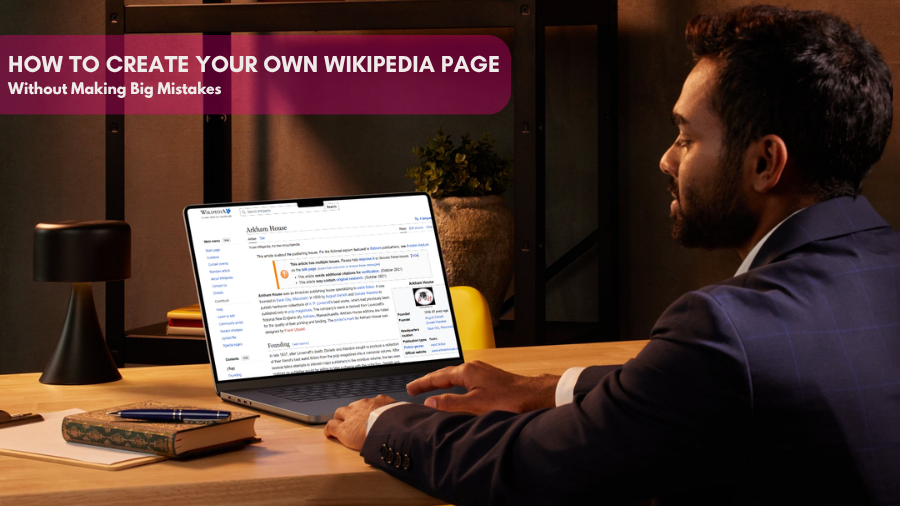
Often, you have heard as a company owner and business executive to create your own Wikipedia page or for your company. People say you just sign up, copy your bio, paste in some links, and wait. A friend insists there are shortcuts. Nevertheless, every time you try to make a wiki page, you won’t be able to do so.
A Wikipedia page is a public record written, in theory, by strangers. To create your own Wikipedia page is to try to sound like one of those strangers while writing about yourself. That is an odd writing problem, and also a cultural one.
Why this Matters Now
This article looks at that problem from two sides. It is a clear, step-by-step guide to create a Wikipedia page profile or to make your own Wikipedia page without breaking the rules. But it is also a lesson in a useful writing technique: how to speak in a neutral, verifiable voice when your instinct is to pitch, perform, or defend.
In an age where an online search often stands in for an introduction, the urge to create your own Wikipedia page has become almost mundane. Business owners and startup founders, along with musicians, academics, podcasters, and even local activists, all want it. To create a Wikipedia page, you need to prepare a proper, well-structured write-up or consider getting help from a Wikipedia writing service to ensure it meets the platform’s guidelines. At the same time, Wikipedia’s volunteer editors remain highly vigilant about promotion, bias, and puffery cracking down on paid page creation offers, flagging conflict-of-interest edits, and removing pages that read like marketing copy.
This tension between self-promotion and public record is where the real story sits. To make a wiki page, you need to learn how to write like someone else, and this blog teaches you particularly that.
A Simple New Technique: The Third-voice Method
Before any how-to, a writing trick.
Most people write in one of two voices:
- The Me Voice – warm, close, full of “I” and “we,” shaped by what they want to show.
- The Sales Voice – Third person but with big adjectives, big claims, and quiet facts.
However, the objective third voice is all about creating objectivity and sounding less personal. It’s distant but not cold.
To learn this objective third voice, you can use one or more of the following methods:
- Column One: What You’d Say to a Friend
On paper or screen, write a short paragraph as if you were telling a close friend why you or your company deserves a page. Use “I,” “we,” and any tone you like. - Column Two: What a Skeptical Reporter Would Say
Next to it, write a second paragraph as if you are a reporter at a serious paper. Use only facts that another person could verify without calling you. Lose every adjective that cannot be backed by a source. - Column Three: What a Neutral Stranger Would Write
Now merge the two into a third paragraph. Keep only claims you can support with reliable sources. Remove yourself from the sentence where you can. Replace “I” and “we” with the name of the person or organization.
When you create your own Wikipedia page, you will spend most of your time writing in that third voice. It is not natural. It is, however, learnable. The rest of this guide shows how that voice works inside Wikipedia’s actual process.
Step-by-Step Guide to Creating a Wikipedia Page
Here are some of the steps to create your own Wikipedia page:
- Check if a page already exists.
- Create an account and build a small edit history.
- Confirm that the subject is notable enough.
- Draft your article in the sandbox, using neutral language and sources.
- Structure it clearly, with sections, references, and internal link paths.
- Move the draft into “mainspace” or submit it for review.
- Watch for feedback, edit, and let the page grow beyond you.
That is the map. Now, in more detail.
Preparations
The preparations are the quiet part of Wikipedia page creation, the part that feels almost boring. It is also where most attempts fail, sometimes before the first word is written.
Why you should not just “make your own Wikipedia page” overnight
The truth is uncomfortable: Wikipedia does not actually like it when people make their own Wikipedia page about themselves or their business. Its official line is that topics should be written about by independent editors. In reality, many people do write about themselves. Some of those pages survive. Many do not.
The key is to behave more like a volunteer editor than a subject. This means starting small:
- Fix a typo on an unrelated page.
- Add a citation to a page you know well.
- Learn how edit summaries work.
Create an Account
The first and foremost important step to make a wiki page is to set up your account. A username (which can be a pseudonym; using your real name is not required).
- A user talk page where others can leave you messages.
- Access to a personal sandbox for drafts.
When you are creating a page, think carefully about what name you would give it. Transparency is not only ethical; it builds trust when you later work on a Wikipedia article submission for a topic connected to you.
Verify Notability
Before anyone creates a new Wikipedia page, the subject has to pass a basic test: would an independent reader, with no stake in your success, care enough to look this up? On Wikipedia, that idea becomes “notability.”
In practice, that means:
- Multiple significant articles in reliable, independent sources.
- Coverage that goes beyond a passing mention or a press listing.
- For businesses, reports or analyses in real media, not just your own blog or social feed.
If your only coverage is a few small blog posts you wrote yourself, it is too soon to create your own Wikipedia page. If you run a local bakery with one glowing write-up in a hometown paper but nothing else, it may also be too soon to create a company Wikipedia page.
This is the hardest step because it forces you to see your own work through someone else’s lens. A quiet rule: if you have to argue that the coverage “should” count, it probably does not.
Search Existing Content
Once you decide the subject may be notable, search again. Is there a misspelled page that already exists? Is your band buried in a list page? Has someone created a draft that was never finished?
Learning to make your own Wikipedia page sometimes means learning to improve an existing one instead. If a stub article already exists about your company or career, the ethical path is to edit that page with care, not start over.
Search for:
- Alternate spellings and old names.
- Translations in other languages.
- Mentions in broader pages (for example, a business noted inside an article about a local scene).
If you find a seed, water it. If you do not, you can move on to drafting.
Drafting the Page
Drafting is where writing craft and Wikipedia culture meet. It is also where The Third-Voice Method becomes less theory and more habit.
Use the Sandbox
Every account has a personal sandbox. Think of it as the rehearsal stage of Wikipedia page creation. To create your Wikipedia page safely, start here:
- Copy the basic layout of a similar article that seems well-written and well-sourced.
- Replace that subject’s name and details with your own.
- Keep the same section order at first: lead section, early life or background, career, notable works, references.
In addition, there are several advantages of using Sandbox. One of the benefits is that you can protect your privacy and write without any fear of judgment or deletion.
Writing with Neutral Point of View (NPOV)
Wikipedia is built on “Neutral Point of View,” almost always shortened to NPOV. It sounds like legal jargon, but it is just the Third Voice made into a rule.
To write with NPOV when you create your own Wikipedia page, follow these four simple habits:
- State, don’t sell.
“The novel received a national award” is a fact. “The novel was groundbreaking” is a claim that needs wide support.
- Attribute opinions.
Instead of “Her work is brilliant,” write, “Critic X called her work ‘brilliant’ in [publication].”
- Balance coverage.
If negative reviews or controversies exist in reliable sources, they should appear, in proportion, alongside the positive.
- Use the Third-Voice Method for every paragraph.
Draft in your own words, then rewrite as if you are a distant observer, keeping only what can be checked.
This is not only about avoiding deletion. It is also a solid writing technique outside Wikipedia.
Cite Sources
What makes Wikipedia credible and authentic is the usage of references and citations. A good article is one that holds the public’s attention and has enough credible sources to back its claim or story.
It’s of the utmost importance when you create a new Wikipedia page. Good sources for Wikipedia article submission include:
- Major newspapers and magazines.
- Reputable trade press in your field.
- Books from established publishers.
- Academic journals and respected research.
Weak sources include:
- Your own website, except for simple factual details.
- Press releases.
- Social media posts.
- One-line mentions in passing.
Each major claim should rest on a citation. You’ll also have to ensure that the citations you’re adding are properly formatted as per the standard. Yes, gathering all the sources and citing them with proper formatting sounds tedious and utterly boring, but it’s one of the essential steps of Wikipedia profile creation that you cannot skip.
Outline the Structure
There are numerous benefits of creating an outline before you create your own Wikipedia page.
A basic outline would look something like this:
- The lead section: This offers a summary of the whole event, biography, or occurrence, and why this topic/person matters.
- Early life and education.
- Career (sometimes broken into stages).
- Major works, awards, or contributions.
- Personal life, if it has been covered in reliable sources.
- References and external links.
If you are writing a business article, then you need to create a company Wikipedia page or make a business Wikipedia page. This type of structure requires the following format:
- Lead section –Answering all the Ws nd Hs of the topic in a concise manner.
- History and founding.
- Products or services.
- Growth, funding, or key milestones.
- Criticism or notable controversies, if covered.
- References and external links.
When you create an outline, you’re able to deliver an objective and neutral point of view to the readers. An impartial view makes your information credible and trustworthy.
A note for Companies and Brands
Business owners often want to make business Wikipedia page entries that read like polished brochures. Those rarely last. The most stable articles about companies usually:
- Acknowledge competition and market context.
- Include both praise and criticism from independent sources.
- Focus on verifiable impact, not slogans.
Moving Towards Publishing
At some point, the draft feels done. The citations are in place. The tone is more reporter than press agent. Now comes the part that feels most like a test: getting the draft out of the sandbox and into public view.
Submit for Review
The first method is to use Wikipedia Articles for the creation process. Here, you submit your article draft for reviewing purposes.
A volunteer reviewer will look at it and either accept it (moving it into mainspace), return it with comments, or decline it with an explanation.
For many people who create their own Wikipedia page for the first time, this path offers two benefits:
- A second pair of eyes that may catch problems in tone or sourcing.
- A clear “yes” or “no” signal before the page appears live.
Alternatively, Use “Move”
The other path is to use the “Move” function to move your sandbox draft straight into mainspace under the article title you want. This is a bolder move, often taken by more experienced editors.
If you go this route:
- Make sure the title follows Wikipedia’s naming conventions.
- Ensure that your draft is properly edited and proofread, and that the title is not duplicated or copied. Or no other similar title exists.
- Be prepared for other editors to tag, tweak, or even nominate the article for deletion if they see problems.
When you create your own Wikipedia page and move it yourself, you are essentially saying, “I believe this meets the site’s standards.” That confidence should be backed by solid sources and clear neutrality.
Internal Link
Once your article is live, its connections matter. Wikipedia is built on internal link paths. Articles link out to related topics and, in turn, are linked back from those topics.
To help your new article stand on steady ground:
- Add relevant internal links in the text to places, people, movements, and ideas that already have articles.
- Look for related articles that might mention your subject in a natural, sourced way, and (with care) propose or add those links.
This is not about spamming the site with references to yourself. It is about weaving your subject into the web of knowledge in a way that reflects how it shows up in the wider world.
The “Wikipedia Page Creation Service” offers
At this stage, many people are tempted to outsource the whole thing. Search engines are thick with companies promising Wikipedia page creation service offerings, complete with “guaranteed approval” and slick testimonials.
Wikipedia’s own policies are wary of these services. You can pay for the Wikipedia editing services, as editing is not forbidden. However, any promotional or sales-oriented content quickly moves to the trash. More importantly, you can also outsource the writing, but keep in mind that writing must be grounded in reality and what you desire.
Learning to create your own Wikipedia page with your own hands, or in open dialogue with volunteer editors, is slower. It is also far more sustainable. You learn the rules rather than renting them.
Key Tips for Success
The mechanics of Wikipedia article submission are only part of the story. A few broader habits can make the difference between a fragile page and one that grows stronger over time.
Avoid Conflicts of Interest
Conflict of interest, or COI, sounds like legal jargon, but in practice, it is simple: if you have a strong tie to a topic because it is you, your company, or someone close to you, you have a conflict.
Wikipedia does not ban COI editors from editing. It does, however, ask them to be extremely careful. When you make your own Wikipedia page, think of yourself as the least neutral person in the room.
Practical steps:
- Be open on your user page about who you are and why you care about the subject.
- Consider proposing changes on the article’s talk page rather than editing directly, especially on controversial points.
- Invite other editors to review your work and be ready to let go of control.
There is an emotional shift here. You stop seeing the page as your property. You start seeing it as a shared resource that might one day say things you do not love, as long as reliable sources support them.
Review Guidelines
Before, during, and after you create your own Wikipedia page, spend time with the site’s core guidelines. They are written in a dense, sometimes fussy style, but they exist for a reason.
Focus on:
- Notability guidelines for biographies or organizations.
- The Neutral Point of View policy.
- Verifiability and reliable sources guidelines.
- Conflict of interest and paid editing rules.
Reading these is not just compliance work. It is also a quiet course in how to write for an audience that does not know you and does not owe you their attention. You learn, in effect, a new genre.
Use Existing Articles for Inspiration
One of the most helpful habits when you create your own Wikipedia page is to read three or four existing articles of the same type:
- If you are writing about an author, read pages about authors at a similar level of fame.
- If you want to create a company Wikipedia page, read articles about similar-sized firms in your industry.
- If you plan to make a business Wikipedia page content for a startup, compare how long-standing companies are described.
Ask:
- How long are their lead sections?
- How many sources back each claim?
- Where did editors draw the line between noteworthy detail and trivia?
Do not copy the language, of course. But do let the structure and restraint shape your own draft. Think of it as apprenticing yourself to the crowd.