
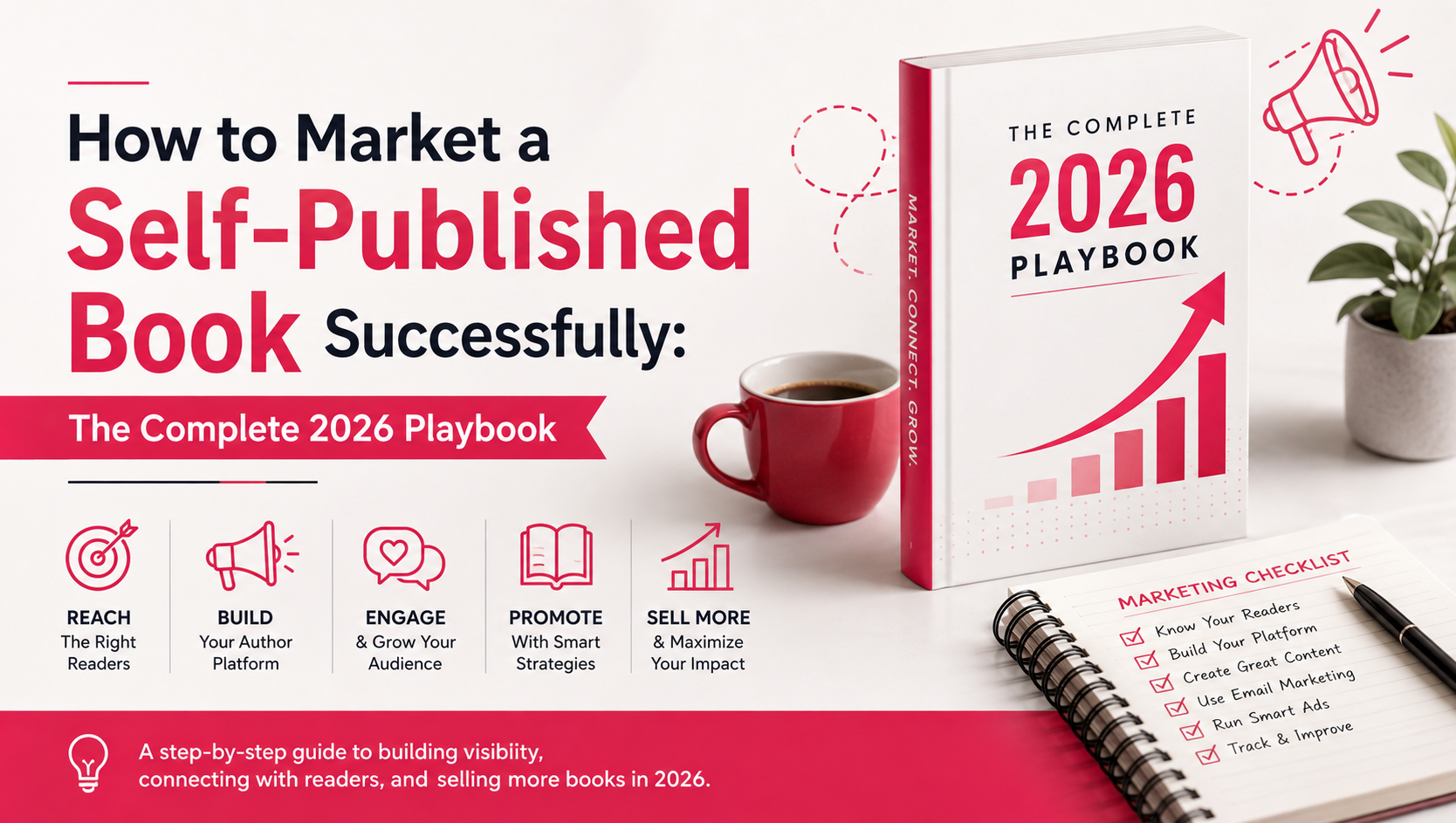
The book publishing industry has become saturated. Especially after the advancement of AI, everyone is now in a rush to become an author. And among this, if you have not marketed your book correctly, your book can disappear fast.
For Indie and self-published authors, publishing a manuscript is one thing, and marketing is another. No one can guarantee your book will sell just because its title exists.
This is exactly why marketing a self publishing book in 2026 has become more important than ever. This blog guide is written to help you market your book with a strategic plan if you want to take the DIY approach.
Before You Market: Know Your Reader and Your Comps
First things first, you need to know that book marketing for self-published authors begins with the readers. You need to ask the right questions when you’re starting out. Questions such as who is going to read my book, or which target audience this book speaks to instead of how I can get more attention online.
That difference sounds small. It changes nearly everything.
A broad description such as “women who enjoy fiction” is not a useful audience, nor is “readers interested in self-help.” such broad categorization is often looked down upon, as there are millions of readers with different literary preferences.
A useful reader description is narrower. Comparable books should not be treated as books to imitate. They are evidence. They show where readers are already spending attention and money.
An author can study comparable titles and ask several questions. What promises appear in their subtitles? What ideas repeat in reader reviews? What complaints do readers make? What visual patterns appear on covers? What words appear in book descriptions? Which emotional need seems to bring readers to the category?
This research can reveal a gap between what the author thinks is interesting about the book and what readers are likely to find interesting.
That gap matters. Marketing cannot repair weak positioning forever. It can amplify a clear promise. It cannot create one.
Marketing Your Self Published Book Starts With a Reader Profile
Before building campaigns, the author should be able to answer a few plain questions.
- Who is most likely to finish this book?
- What problem, emotion, curiosity, or desire brings that person to it?
- What books has that reader probably enjoyed before?
- What would make the reader think twice before buying?
When you answer these, it can become foundation for the book cover, book description, and all the other marketing and promotional materials. You can use these even for social media posts, interviews, emails, and all the promotional content.
How Amazon’s Algorithm Actually Works
Amazon is often spoken about as though there were a secret code hidden behind its bookstore.
Authors hear claims about magic keyword combinations, perfect launch hours, mysterious ranking tricks, or a precise number of sales needed to trigger permanent visibility. That is the wrong way to think about the platform. Amazon’s algorithm is designed to satisfy the users’ intent. It is designed to fulfill the commercial needs: which products make the shoppers buy?
What does this imply for you? It means visibility grows when the readers get the signal of relevance. Shopping behavior, sales activity, and the search term, along with ad performance, all influence the algorithm. The truth is, no author controls all of those signals.
But authors can influence many of them. When marketing a self-published book, the Amazon product page should therefore be treated as a sales page, not merely a listing.
The cover has to communicate genre and quality quickly. Same with the title and subtitle. You need to ensure that your message communicates with the audience at a glance. The book description should be enticing enough to draw their attention, without spilling the extra details. The categories and keywords should help the book appear in relevant contexts. Reviews provide social proof. The sample must persuade a curious shopper to continue. A marketing campaign that drives traffic to a weak product page can waste money.
Traffic is not the final objective. Conversion is. If one hundred well-matched readers visit a book page and very few purchase, sending another thousand people to the same page may simply create a larger version of the same problem. The first response should not always be, “Advertise more.” It may be, “Find out why qualified readers are not buying.”
Search Visibility Is Built on Relevance
Authors sometimes chase large search terms because the words appear popular. Popularity alone is not enough. A narrow phrase that describes the reader’s real intent may be more valuable than a broad phrase with heavy competition.
A practical guide for newly divorced fathers, for example, has little reason to compete first for a giant term such as “self-help.” A more specific phrase connected to the book’s actual promise can attract fewer people but more suitable ones. This principle applies beyond Amazon. As an author, your goal shouldn’t be to draw the largest audience to your book. Rather, your goal should be to draw the relevant audience to your book by removing the distance.
Build Your Foundation: Book Marketing for Self Publishers Before Launch
A book launch should begin before publication. You need to generate enough hype so that the words get out about your book. Authors who start book marketing after the book launch often find themselves in a pit of confusion and piles of things to do. They get tasked with audience building, learning all about advertisement, amazon optimization, and requesting reviews for the book.
That is too many jobs for one week. A better approach is to separate preparation from promotion.
At least two months before release, the book should begin acquiring the assets needed to travel through the market. That includes a professional cover, polished description, author biography, retail metadata, website or landing page, email signup, advance reader plan, social graphics, sample material, and a short description that another person can easily repeat.
The author should also decide where marketing effort will be concentrated. Being active on five social platforms is not automatically better than being useful on one. If your readers are on Facebook, then following a strict posting schedule on Tiktok won’t benefit you. The same goes for business authors whose main audience is on LinkedIn will not benefit from Facebook groups. As an author, you need to identify where your audience is, and direct your energy towards that platform. The platform should follow the reader. The reader should not be invented to justify the platform.
Build an Email List Before You Need One
Algorithms decide who sees most social media posts. An email list creates a more direct relationship. That does not mean email guarantees sales. It means an author has permission to contact readers who have already expressed interest.
The simplest list may begin with a small offer connected to the book. The offer should attract the same kind of person who would want the book. A giant list filled with people who only wanted a giveaway is less useful than a modest list built around genuine interest.
This distinction becomes especially important when the book launches. Your engaged list can help with early purchases, reader reviews, recommendations, and word-of-mouth marketing. And the best it can do for the book is to build the foundation for your next book. An engaged list can produce early purchases, reviews, recommendations, event attendance, and word of mouth. More importantly, it gives the author a foundation for the next book.
The 90-Day Pre-Launch to Launch Timeline
If you’re looking for the best way to market a self published book, here’s our ninety-day timeline plan.
Day -90 to -60: Build the Positioning
At this stage, the book should still be approached like a product entering a market. The author identifies the core reader, studies comparable books, reviews the cover and subtitle, improves the retail description, selects relevant categories, and builds the central message around the book.
For nonfiction, this may mean identifying the clearest reader problem.
For fiction, it may mean defining the emotional promise without revealing the plot.
This is also the time to prepare an author website or focused landing page. At this stage, your website content doesn’t have to be detailed. But it should be able to tell the readers who the author is, what their book offers, and what should be their next step. You can also share an advance copy of the manuscript with early readers, reviewers, bloggers, and industry experts who are appropriate. Your goal is not to generate praise at this stage, but to gather enough readership.
Day -60 to -30: Build Recognition
A month or two before publication, marketing can become more visible. Rather than repeating “my book is coming” every day, authors can publish material connected to the questions, themes, tensions, or interests that led to the book.
A financial writer can explain one common money mistake. A thriller author can discuss research into surveillance, cold cases, or remote landscapes. A parenting author can answer a question families frequently ask.
This kind of content has value even before the reader purchases anything. That matters because useful attention is stronger than forced attention. This is also a good period for podcast outreach, guest articles, newsletter partnerships, local media pitches, bookstore conversations, library contacts, and relevant community relationships. These opportunities often require lead time. Waiting until launch morning may be too late.
Day -30 to -7: Make the Book Easy to Notice
The final month is when recognition can become intent. Now, you can reveal the packaging, short excerpts, and sneak peek. You can also discuss the book’s theme and the reason for writing the book. You can also ask the reads to join your email list.
An author does not need to gamble a large budget on an advertisement that has never proved it can attract qualified readers. Start small and study the response. Improve the copy, image, targeting, or product page. Increase spending only when the campaign shows evidence that the economics make sense.
Launch Week: Concentrate Attention Without Exhausting Readers
Launch week matters, but it should not feel like seven days of begging. The strongest launch content gives readers different reasons to care.
One message might announce publication. Another might share what inspired the work. A third could feature an early reader response. Another might teach something useful related to the subject. The book remains central, but the message changes.
Email subscribers should receive a clear announcement with a direct purchase link. Advance readers who have completed the book can be reminded that honest reviews are welcome. Media appearances and guest content can be shared while they are fresh.
The author should also watch the retail page carefully.
- Are shoppers clicking but not buying?
- Are certain ads performing better than others?
- Is one format outselling another?
- Are readers responding to one message more strongly?
Launch week is not merely a celebration. It is a research period.
Day +7 to +30: Keep Going After the Announcement
Many book campaigns collapse one week after release. That is often when the useful work is beginning. The book now has real readers. Those readers create questions, reviews, quotes, conversations, and patterns that were not available before publication. Authors can use those signals to improve marketing.
If several readers mention the same emotional element in a novel, that may reveal stronger language for future promotion. If readers have praised a certain chapter, then divert your attention towards it more, and advertise it more. This would signal to potential readers that the book may solve their problem.
Day +30 to +90: Turn a Launch Into a System
The third month is where book marketing for self publishers becomes sustainable or disappears.
At this stage, as an author, you’d know a lot more than you knew before. Now, you know which channel helped you gain more traction, what message resonated with the potential readers more, what was the CTR rate, and more. Knowing these elements also helps you reduce any weak tactics that do not produce results. Strong tactics can be expanded.
An author might discover that Instagram creates attention, but email creates sales. Another might learn that podcast interviews outperform paid social ads. A novelist may find that one Amazon ad campaign produces steady purchases while broader ads burn money.
Marketing becomes easier when evidence replaces assumptions. The objective after ninety days is not constant promotion. It is a repeatable system.
Paid Advertising, With Real Numbers
With paid advertisement, you can improve the chances of discovery; however, you still have to keep the economics of publishing in view.
For example, you’re selling a paperback for $17.99; you won’t receive the full $17.99. You need to add the cost of printing, distribution, retailer share, and other costs in order to claim the profit. Now suppose you’re earning $5 on a sale, and paying $8 for advertisement; you’re going in the loss on the first purchase. That does not always mean the advertisement is useless.
An author with several books may accept a smaller first-sale profit because one reader could later purchase additional titles. A nonfiction author may use a book to support speaking, consulting, courses, or other legitimate services. But those decisions require a model. For an author with one book and no additional revenue path, the math is stricter.
Imagine a campaign spends $100. It produces 100 clicks at an average cost of $1 per click. Ten people purchase, the advertising cost per sale is $10.
If the author earns $5 from each purchase, the direct result is a $50 royalty against $100 in ad spend. That campaign is not profitable on immediate book sales.
Now suppose changes to the cover, targeting, ad copy, or description raise the conversion rate from 10 percent to 20 percent. The same $100 generates 20 sales. The cost per sale becomes $5. That is a very different campaign. This is why paid advertising should be treated as a measurement system, not a slot machine.
Amazon Advertising
Amazon ads can be useful because they reach readers who are already shopping for books.
That is a meaningful advantage. The reader does not need to be convinced to visit a bookstore. The reader is already inside one.
Authors can generally think in terms of targeting related keywords, categories, products, and audiences supported by the platform. The exact options available may vary by marketplace and campaign type, so authors should work from the current advertising interface rather than old screenshots or fixed formulas.
The goal is relevance. A mystery novel displayed beside books for readers who love similar mysteries has a clearer path to purchase than the same novel placed before an unrelated general audience.
Meta and Social Advertising
Social advertising works differently. Readers are usually not browsing Facebook or Instagram because they intend to buy a book at that moment. The advertisement interrupts another activity.
That means the creative needs to earn attention first. Strong social ads often begin with a problem, question, visual, emotional tension, or idea that makes the intended reader stop.
For nonfiction, that might be a specific pain point. For fiction, it may be atmosphere, conflict, character tension, or a compelling premise. Authors should be careful with large budgets until a creative approach shows evidence of working. A $10 experiment that teaches something useful can be more valuable than a $500 campaign based on confidence alone.
Organic & Community Marketing
Organic marketing has one major advantage over advertising. It can create trust before the sale. Its disadvantage is time.
A meaningful community is built slowly, which is why organic promotion works best when the author stops viewing every interaction as a chance to post a purchase link. Readers notice when a person joins a group only to advertise. They also notice when someone consistently contributes something worth reading.
For nonfiction authors, useful organic content may include explanations, practical tips, thoughtful opinions, case examples, short lessons, or answers to recurring questions. For novelists, the approach can be broader. Authors can discuss genre, themes, research, writing choices, books they admire, settings, history, character questions, or cultural subjects connected to the work.
The purpose is not to give the book away in pieces. It is to create a reason for the right reader to become curious about the person and the work.
Book Clubs, Libraries, Bookstores, and Local Communities
Digital marketing receives most of the attention because it is easy to measure. Local relationships are often underestimated.
A bookstore event attended by fifteen people may sound less impressive than a post viewed by 10,000. But those fifteen people chose to enter a room because of books. The value of attention is not measured only by volume.
Libraries can connect authors with readers, community events, talks, and local networks. Book clubs can generate long conversations around a title. Independent bookstores may offer events, consignment arrangements, local-author programs, or other opportunities depending on their policies.
Schools, professional groups, nonprofits, conferences, churches, associations, and community organizations may also be relevant depending on the subject and audience. The principle is simple. Go where the book has a legitimate reason to belong.
Genre-Specific Playbooks for Marketing Your Self Published Book
No universal marketing strategy works equally well for every genre. Readers discover romance differently from business books. Parents choose children’s books differently from fantasy readers choosing a new series. A strategy should reflect those differences.
Fiction
Fiction marketing sells an experience. Readers need enough information to sense the world, conflict, mood, and emotional stakes without being told everything that happens.
Visual identity matters. So do genre expectations. A thriller should look and sound recognizably different from a gentle small-town romance. Readers use those cues to decide whether a book belongs to the reading experience they want.
Useful fiction marketing may include atmospheric excerpts, character-centered teasers, book-club questions, genre communities, reader newsletters, review outreach, author interviews, short videos, series promotions, and targeted retail advertising.
The central question is not, “What happens in the book?” It is, “What will it feel like to spend time inside this story?”
Nonfiction
Nonfiction marketing usually begins with a problem. The reader wants to understand something, change something, avoid something, or become better at something. Promotion should therefore demonstrate the author’s ability to clarify the problem before asking the reader to purchase the full solution.
Articles, podcasts, webinars, workshops, newsletters, checklists, professional networks, LinkedIn content, speaking opportunities, and search-focused website content can all support nonfiction titles. The book should feel like the deeper destination for a conversation that has already become useful.
Memoir
Memoir requires particular care. A memoir is not merely “a true story.” Readers need to understand why this particular life invites attention beyond personal history.
The strongest memoir positioning often connects an individual experience to a larger human question: grief, migration, identity, family, addiction, faith, illness, ambition, loss, survival, belonging, or social change.
Promotion should not reduce difficult experiences to sensational hooks. It should reveal the broader meaning without exploiting the pain.
Children’s Books
In children’s publishing, the reader and buyer are often different people. A child may love the story, but a parent, teacher, librarian, or grandparent makes the purchase. Marketing therefore has to speak to both. The child-facing promise may involve humor, wonder, adventure, comfort, curiosity, or imagination.
The adult-facing promise may involve reading level, emotional learning, family discussion, education, bedtime use, classroom relevance, or simple enjoyment.
Schools, libraries, parent communities, educator resources, read-aloud videos, local events, and seasonal opportunities can be particularly useful.
Tracking What’s Working: The KPI Dashboard
An author does not need a complicated analytics department. A simple spreadsheet can prevent months of wasted work. Every month, the author can track a small group of key performance indicators, or KPIs.
These may include units sold, revenue, estimated royalties, advertising spend, cost per click, advertising cost per sale, email subscriber growth, email open and click rates, website visits, retail page traffic where available, reviews gained, and sales by format. Not every metric deserves equal weight. Follower count can look impressive without producing book sales.
Website traffic can grow while conversions stay flat. An ad may generate inexpensive clicks from people who never buy. The metrics closest to meaningful reader behavior deserve the most attention.
Measure Conversion, Not Just Attention
Suppose two advertisements are running. Ad A receives 5,000 views and 200 clicks. Ad B receives only 2,000 views and 80 clicks. Ad A appears stronger.
But if Ad A produces two sales while Ad B produces ten, the smaller campaign may be far more valuable. Attention is useful only when it moves the right reader closer to the book.
This is where marketing a self published book becomes less emotional. Instead of asking, “Did people like the post?” the author can ask, “Did this activity create the behavior it was designed to create?”
Not every piece of content must sell a book directly. Some content builds trust. Some grows the email list. Some earns media attention. Some creates reviews. But every marketing activity should have a purpose.
Common Mistakes That Kill Momentum
- The first mistake is waiting until publication to begin marketing.
- The second is trying to market everywhere.
- The third is treating every reader as the same reader.
- The fourth is buying ads before the book page is ready to convert.
- The fifth is abandoning marketing because the first campaign fails.
- The sixth is changing too many things at once.
- If an author changes the cover, description, price, audience, keywords, and advertising creative on the same day, it becomes difficult to understand what caused the next result.
- Testing works best when variables can be isolated.
- Another common mistake is confusing activity with progress.
- Posting three times a day may create activity, sending twenty generic media pitches may create activity, running five ads without tracking them creates activity. None of those actions necessarily creates useful momentum.
- Marketing should produce information as well as exposure.
- Each effort should make the next decision smarter.
Do Not Buy Empty Visibility
Authors are frequently offered services promising thousands of impressions, large follower counts, guaranteed exposure, bestseller placement, mass social posting, or access to huge audiences.
The important question is not how many people might see the book. It is who those people are and what evidence exists that the audience is relevant.
Ten thousand random views have little value if the viewers do not read books in the category. A hundred serious readers can be more important. Good marketing is not the purchase of numbers. It is the creation of meaningful contact between a book and its potential reader.
The Best Way to Market a Self Published Book Is to Build More Than a Launch
A launch has an ending. A publishing career does not. That distinction becomes especially important for authors who plan to publish more than one book. The first book may need to work harder to find readers because the author begins with little recognition. The second book can benefit from the readers, subscribers, reviews, data, media contacts, and lessons created by the first.
By the fifth book, a well-managed author is no longer beginning at zero. That is why one of the most valuable results of marketing your self published book is not today’s sale. It is tomorrow’s reader. A person who genuinely likes one book may read the next one, recommend the author, join a mailing list, attend an event, leave a review, or give the book to someone else.
Marketing becomes more durable when it creates relationships rather than isolated transactions. The quiet books that continue selling years after publication often have something beneath them: a backlist, a community, useful search visibility, steady advertising, word of mouth, an author’s reputation, or some combination of these. They are not being relaunched every morning. They have become discoverable.
Conclusion: Marketing a Self Published Book in 2026 Means Creating a Path to Discovery
The image that haunts many independent authors is the silent book page: a finished work sitting online while the world moves past it. But silence is not necessarily rejection. Often, it is simply absence. The right reader has not yet found the path.
The work of marketing a self published book is to build that path carefully. It begins with knowing the reader, continues through strong positioning and a credible retail page, grows through useful content and community, and becomes more precise through data. Advertising can widen the path. Reviews can strengthen it. Email can keep readers connected to it. A second book can make the entire system more valuable.
None of this requires an author to become a full-time online personality. It requires choices. A few suitable channels used consistently are more useful than constant promotion everywhere. A hundred engaged readers can matter more than thousands of empty impressions. A well-measured campaign can teach more than a large campaign built on hope.
The book may have begun alone at a desk, but successful publishing ends in a relationship between writer and reader. Authors who need help turning that finished manuscript into a book that is professionally positioned, published, and prepared for the market can explore affordable book marketing solutions from Arkham House Publishers. The strongest next step is not simply to put another book online. It is to give the right book a clear route to the people who have been waiting to discover it.