
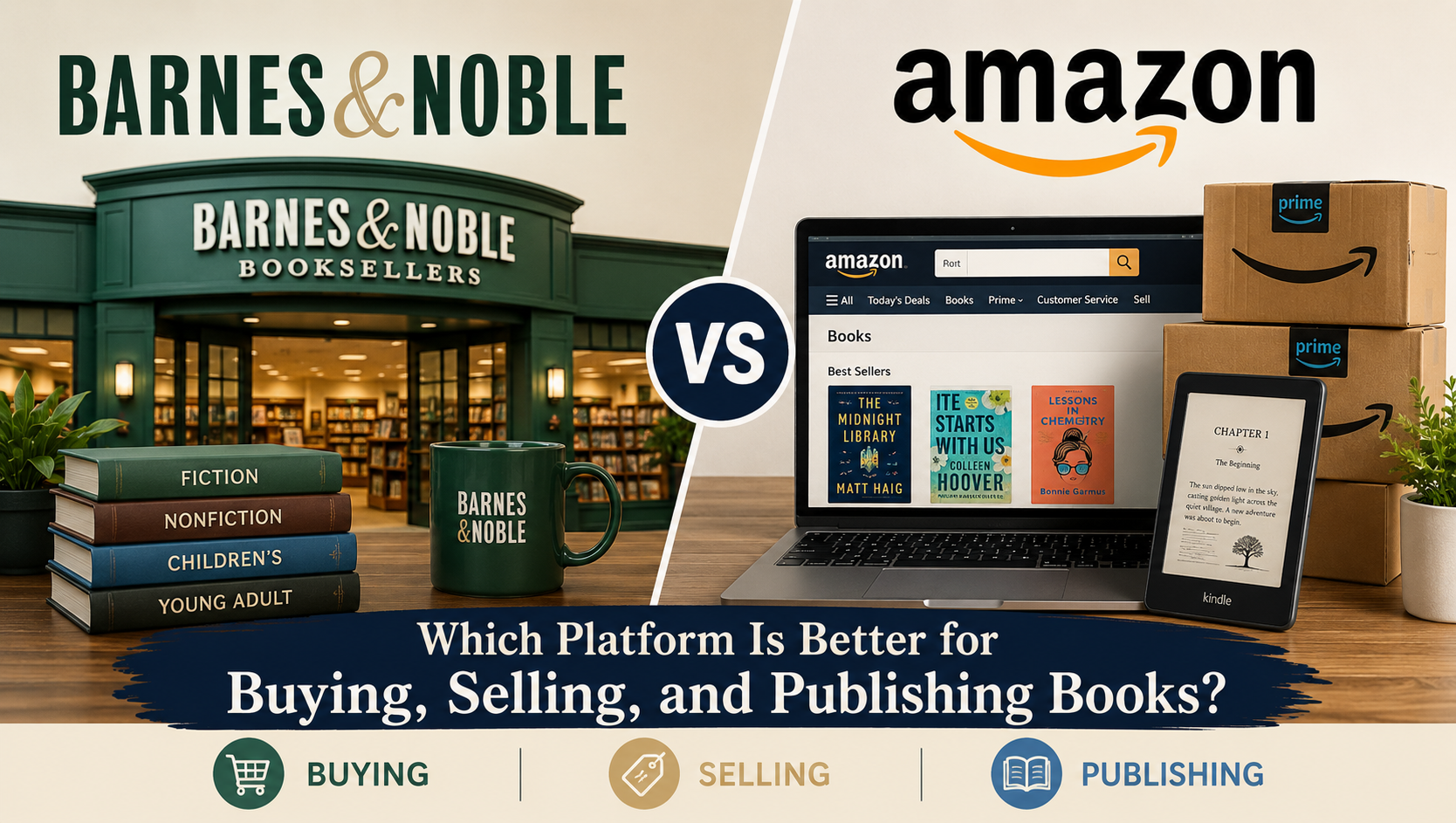
Amazon and Barnes & Noble both sell books, but they do not solve the same problem.
Amazon is built for speed, scale, search, discounts, Kindle, Prime, marketplace sellers, and self-publishing volume. Barnes & Noble is built around bookstore discovery, physical browsing, bookseller curation, NOOK, BN.com, B&N membership, and a publishing route that gives indie authors another direct retailer outside Amazon.
So the better choice depends on what you are trying to do.
For book buyers, Amazon usually wins on price, delivery speed, inventory depth, and Kindle convenience. Barnes & Noble wins when the experience matters: browsing shelves, finding staff picks, buying special editions, attending events, supporting physical bookstores, or discovering books through human curation.
For book sellers, Amazon has the stronger marketplace engine, but it is fee-heavy and competitive. Barnes & Noble has a marketplace and bookstore infrastructure, but it is less open, less algorithm-driven, and more selective.
For authors and publishers, Amazon KDP offers the largest self-publishing reach, Kindle Unlimited access, Amazon Ads, and strong paperback distribution on Amazon. Barnes & Noble Press offers a useful non-exclusive publishing channel, a direct path to BN.com and NOOK readers, and a flat 70% eBook royalty, but publishing through B&N Press does not automatically put your book in Barnes & Noble stores. Barnes & Noble’s own help documentation says B&N Press print books sell on BN.com and the Barnes & Noble app, not automatically in physical bookstores.
Barnes & Noble vs Amazon: Quick Overview
| Use case | Better platform | Why |
|---|---|---|
| Cheapest everyday book buying | Amazon | Frequent discounts, huge inventory, fast Prime shipping |
| In-store browsing | Barnes & Noble | Physical shelves, local bookseller picks, cafés, events |
| Buying eBooks | Amazon | Kindle ecosystem is larger and more mature |
| Buying from NOOK | Barnes & Noble | Best for readers already using NOOK or BN.com |
| Selling used books online | Amazon | Bigger marketplace and stronger buyer traffic |
| Selling books into physical retail | Barnes & Noble / Ingram route | Bookstores care about distribution, returnability, demand, and salability |
| Self-publishing eBooks | Amazon KDP for reach; B&N Press for wide strategy | KDP has Kindle scale; B&N Press is non-exclusive |
| Kindle Unlimited authors | Amazon KDP Select | KU requires KDP Select enrollment and digital exclusivity |
| Authors avoiding exclusivity | Barnes & Noble Press | B&N Press allows publishing elsewhere |
| Long-term author brand building | Both | Amazon for demand capture, B&N for reader trust and wide retail presence |
The smartest answer is often not “Amazon or Barnes & Noble.” For buyers, use both depending on the book. For authors, publish on Amazon KDP and Barnes & Noble Press unless Kindle Unlimited exclusivity is central to your launch strategy.
Why People Search “Barnes and Noble vs Amazon”?
People searching for barnes and noble vs amazon, amazon vs barnes and noble, or amazon books vs barnes and noble are usually asking one of four questions:
- Where should I buy books?
They want price, shipping, selection, returns, editions, and reading experience. - Which company is better for the book industry?
They are comparing Amazon’s efficiency against Barnes & Noble’s role as a physical bookseller. - Where should I sell books?
Used-book sellers, small publishers, and authors want fees, visibility, and distribution details. - Should I self-publish through Amazon KDP or Barnes & Noble Press?
This is where the comparison gets serious, because Amazon KDP and Barnes & Noble publishing services have very different trade-offs.
This article answers all four, then gives a practical decision framework.
Barnes & Noble vs Amazon: The Big Difference
Amazon is not just a bookstore. It is a search engine, marketplace, logistics network, ad platform, eBook ecosystem, and subscription engine.
Barnes & Noble is still, at heart, a bookseller.
That difference shapes everything.
Amazon’s book business is built around:
- Amazon.com search
- Kindle eBooks
- Kindle Direct Publishing
- Kindle Unlimited
- Prime shipping
- Amazon Ads
- third-party marketplace sellers
- customer reviews
- algorithmic recommendations
- fast checkout and fulfillment
Barnes & Noble’s book business is built around:
- physical stores
- BN.com
- NOOK eBooks
- B&N Press
- bookseller recommendations
- store events
- local merchandising
- membership rewards
- giftable books, special editions, toys, games, cafés, and browsing
This is why Amazon often feels more efficient, while Barnes & Noble often feels more bookish.
That difference has become even clearer since Amazon closed its physical bookstores in 2022, while Barnes & Noble has been opening new stores again. Reuters reported that Amazon planned to close all 68 of its Amazon Books, 4-star, and pop-up shops in the U.S. and U.K. in 2022. By contrast, Publishers Weekly reported that Barnes & Noble ended 2025 with 702 outlets after a multi-year store-opening campaign.
Buying Books: Amazon Books vs Barnes & Noble
Selection and Availability
Amazon has the advantage on sheer selection. It carries new books, used books, imports, textbooks, Kindle editions, audiobooks, marketplace listings, out-of-print copies, and print-on-demand titles. If a book exists and has an ISBN, Amazon is often the fastest place to find it.
Barnes & Noble also has a strong online catalog, but its real advantage is not infinite inventory. Its advantage is edited discovery. Walk into a good Barnes & Noble and you are not seeing every possible book. You are seeing what the store believes is worth shelf space.
That sounds limiting until you are overwhelmed by thousands of similar Amazon results.
Amazon is better when you already know what you want. Barnes & Noble is better when you want to discover what to read next.
Price and Discounts
Amazon usually wins on price, especially for popular hardcovers, paperbacks, used copies, and marketplace listings. Its pricing can move constantly, and Prime members may get fast delivery without thinking about shipping costs.
Barnes & Noble can still be competitive, especially during preorder promotions, hardcover sales, membership offers, and special-edition campaigns. Its Premium Membership costs $39.99 per year and includes a 10% everyday discount on eligible purchases in stores and online, free standard shipping, café drink upgrades, and rewards benefits. The free Rewards Membership gives one stamp per $10 spent, with 10 stamps converting into a $5 reward.
For non-members, Barnes & Noble’s free standard shipping threshold on eligible BN.com orders is $60 within the U.S. Amazon Prime costs $14.99 per month or $139 per year in the U.S., with fast delivery and many non-book benefits included.
Reading Experience
If you read eBooks, Amazon has the stronger ecosystem. Kindle devices, Kindle apps, Whispersync, Kindle Unlimited, Prime Reading, Goodreads integration, and Amazon’s review base make it hard to beat.
Barnes & Noble has NOOK, but NOOK no longer has the same cultural weight Kindle has. It still works for dedicated B&N readers, people who prefer BN.com, and readers who want to keep their digital purchases away from Amazon.
For print books, the experience flips. Barnes & Noble gives you physical browsing, staff displays, signed copies, sprayed-edge editions, local events, and the pleasure of leaving with a book you did not plan to buy.
Amazon is excellent at fulfilling intent. Barnes & Noble is better at creating intent.
Shipping, Pickup, and Returns
Amazon wins on delivery speed for Prime members. It is hard to compete with one-day, two-day, or same-day shipping in eligible areas.
Barnes & Noble gives buyers a different kind of convenience: order online, pick up in store, browse while you are there, and handle some issues with a human being. For parents, students, gift buyers, and book-club shoppers, that can matter.
Best Platform for Buyers
| Buyer type | Best choice |
| “I want the lowest price and fast delivery.” | Amazon |
| “I want to browse and enjoy the bookstore experience.” | Barnes & Noble |
| “I read mostly Kindle books.” | Amazon |
| “I collect editions, signed copies, and gift books.” | Barnes & Noble |
| “I buy many used books.” | Amazon |
| “I want human recommendations.” | Barnes & Noble |
| “I want one account for books, household items, and media.” | Amazon |
| “I want to support physical bookstores.” | Barnes & Noble |
Practical buying tip: Search Amazon first for price and availability, then check Barnes & Noble for special editions, preorder campaigns, signed copies, and local pickup. The better deal is not always the cheaper listing. For gifts and collectible editions, condition and packaging matter.
Selling Books: Amazon vs Barnes & Noble
Selling books is different from buying books. Here, the question is not just “Where are the customers?” It is “Where can I profit after fees, shipping, returns, competition, and discoverability?”
Selling Books on Amazon
Amazon is the stronger platform for independent book sellers, used-book sellers, textbook resellers, collectors, and small inventory businesses. It has massive buyer intent. People search Amazon when they are ready to buy.
That traffic comes at a cost.
Amazon sellers in media categories such as books generally deal with referral fees and a closing fee. Amazon Seller Central search snippets show a $1.80 closing fee per unit sold for products in Books and other media categories, and Amazon’s fee schedule commonly shows a 15% referral fee structure for many categories.
For a $7 used paperback, those fees can hurt. For a rare, collectible, signed, academic, or out-of-print book, Amazon can still work well because buyer demand is high.
Amazon is strongest for:
- used books
- textbooks
- rare and collectible books
- fast-moving nonfiction
- book arbitrage
- FBA sellers with volume
- publishers with optimized listings
- authors who can drive traffic to Amazon
Amazon is weaker for:
- low-priced used books with thin margins
- sellers who cannot manage returns and condition grading
- books with many competing listings
- inventory that depends on careful packaging or collectible condition
Selling Books Through Barnes & Noble
Barnes & Noble is more selective.
BN.com has a marketplace with new, used, rare, collectible, signed, first-edition, and out-of-print books from trusted sellers. Barnes & Noble describes its marketplace as offering millions of new and used items from trusted sellers, including rare and collectible books.
For publishers and authors, Barnes & Noble’s store-placement process is not the same as uploading a book to a marketplace. Barnes & Noble says books are considered for store placement based on subject matter and salability.
That word — salability — is the key.
Barnes & Noble is not asking, “Does this book exist?” It is asking, “Will this book sell in our environment?”
That means a book has a better shot if it has:
- professional cover design
- clean interior formatting
- strong metadata
- real reviews
- clear category fit
- competitive retail price
- wholesale availability
- returnability
- local demand
- media attention
- author platform
- event potential
A self-published book can be sold through Barnes & Noble online via B&N Press, but store placement is a separate challenge.
Best Platform for Book Sellers
| Seller type | Better option | Reason |
| Used-book reseller | Amazon | Larger buyer traffic and existing used-book marketplace |
| Rare-book seller | Both | Amazon has demand; B&N marketplace has book-focused buyers |
| Small publisher | Both | Amazon for volume, B&N for retail legitimacy |
| Local author | Barnes & Noble + local pitch | Store events and regional appeal matter |
| Low-price book flipper | Neither is easy | Fees and shipping can destroy margin |
| High-volume online seller | Amazon | Better infrastructure and demand capture |
| Author selling own book | Amazon KDP + B&N Press | Different readers, different discovery paths |
Real-world scenario: A seller with 300 used mass-market paperbacks may struggle on Amazon after fees and shipping. A seller with 40 clean academic books, collectible hardcovers, or niche nonfiction titles has a better chance because buyers are searching by title, author, ISBN, and edition.
Publishing Books: Amazon KDP vs Barnes & Noble Press
This is the part most authors care about.
Amazon KDP and Barnes & Noble Press both let authors self-publish. Both support eBooks and print books. Both are free to use upfront. Both pay royalties. But the platforms serve different strategies.
Amazon KDP is built for maximum reach inside Amazon.
Barnes & Noble Press is built for reaching Barnes & Noble and NOOK readers without requiring exclusivity.
Amazon KDP: Strengths and Trade-Offs
Amazon KDP is the dominant self-publishing platform because it connects authors directly to Amazon’s book-buying audience. It supports Kindle eBooks, paperbacks, hardcovers, print-on-demand, global marketplaces, Amazon author pages, Amazon Ads, and KDP Select.
Amazon’s official KDP documentation says eBook authors can choose between 35% and 70% royalty options. The 70% option is available only in eligible territories and includes delivery-cost deductions for many sales.
For paperbacks, KDP now offers 50% or 60% royalty rates on Amazon marketplaces depending on list price and marketplace, minus printing costs. Amazon’s paperback royalty example shows a $15 paperback with $5 printing cost earning $4 at a 60% royalty calculation. Expanded Distribution uses a 40% royalty rate minus printing costs.
KDP is strongest when:
- your readers already buy on Amazon
- you write genre fiction with Kindle demand
- you want Kindle Unlimited page-read income
- you plan to run Amazon Ads
- you want print-on-demand paperbacks on Amazon
- you need fast listing updates
- reviews and algorithmic visibility matter to your launch
But KDP has trade-offs.
KDP Select gives you access to Kindle Unlimited, but it requires digital exclusivity for the Kindle eBook during each 90-day enrollment period. Amazon’s help page says the Kindle eBook must be exclusive to the Kindle Store during the KDP Select enrollment period, while print, audio, video, and other formats can be distributed elsewhere.
That matters. If you enroll in KDP Select, you cannot sell the same eBook through Barnes & Noble Press, Apple Books, Kobo, Google Play Books, your website, or most other digital retailers during that term.
Barnes & Noble Press: Strengths and Trade-Offs
Barnes & Noble Press is B&N’s self-publishing platform for print books and eBooks.
B&N Press allows authors to publish eBooks and print books, including paperbacks and hardcovers with printed case or dust jacket options. It supports black-and-white, standard color, and premium color interiors, with a page range of 18 to 800 pages. It does not support audiobooks.
B&N Press eBooks are sold on BN.com, the Barnes & Noble app, NOOK devices, and the NOOK app. B&N Press print books are sold on BN.com and the Barnes & Noble app. Again, publishing through B&N Press does not automatically place the book inside Barnes & Noble bookstores.
B&N Press is non-exclusive. Barnes & Noble says authors may publish a project with B&N Press even if it has been published elsewhere, though a unique, never-used ISBN is required for B&N Press print publishing.
B&N Press pays a flat 70% royalty on eBooks and a 55% author royalty rate on print books, minus printing costs, according to its royalty terms and self-publishing materials.
Barnes & Noble also updated B&N Press policies in 2026. Print books must have a retail price of $14.99 or more, accounts are limited to 100 individual titles unless authors contact B&N for more options, and public-domain titles are no longer allowed on the platform.
B&N Press is strongest when:
- you want to go wide beyond Amazon
- you want NOOK and BN.com visibility
- you want non-exclusive publishing
- you want to reach readers who prefer Barnes & Noble
- you want another retailer link for your website and email list
- you publish giftable print books, hardcovers, children’s books, local nonfiction, or reader-friendly genre fiction
- you want to reduce dependence on Amazon
B&N Press is weaker when:
- Kindle Unlimited is central to your strategy
- you need the biggest eBook audience immediately
- you rely heavily on paid ads inside the retailer ecosystem
- your print book must be priced below $14.99
- you expect automatic physical store placement
Amazon KDP vs Barnes & Noble Press Comparison Table
| Feature | Amazon KDP | Barnes & Noble Press |
| eBook store | Kindle Store | BN.com, NOOK, B&N app |
| Print formats | Paperback and hardcover | Paperback, hardcover |
| Audiobooks | Through ACX/Audible, separate from KDP | Not supported by B&N Press |
| eBook royalty | 35% or 70%, depending on eligibility | Flat 70% |
| Print royalty | 50% or 60% on Amazon, minus print cost; 40% for Expanded Distribution | 55% of list price minus print cost |
| Exclusivity | Optional through KDP Select | Non-exclusive |
| Kindle Unlimited | Yes, via KDP Select | No |
| NOOK access | No | Yes |
| Paid ads | Amazon Ads | Limited compared with Amazon |
| Physical bookstore placement | Not through KDP alone | Not guaranteed through B&N Press |
| Wide publishing fit | Good if not in KDP Select | Strong |
| Best for | Amazon-first authors | Wide authors and B&N/NOOK reach |
Barnes & Noble Publishing Services vs Amazon KDP: Which Should Authors Choose?
The phrase Barnes & Noble publishing services usually refers to B&N Press. It is not a traditional publisher. It does not acquire your book, pay an advance, edit your manuscript, design your cover, or guarantee store placement.
It is a self-publishing platform.
Amazon KDP is also a self-publishing platform, not a traditional publisher.
The difference is reach and strategy.
Choose Amazon KDP first if:
- most of your readers buy from Amazon
- you write in Kindle-heavy genres such as romance, fantasy, thriller, LitRPG, mystery, or rapid-release fiction
- Kindle Unlimited is part of your revenue plan
- you want Amazon Ads and search visibility
- you want fast print-on-demand availability through Amazon
Choose Barnes & Noble Press if:
- you want a wide publishing strategy
- you do not want eBook exclusivity
- you want NOOK and BN.com distribution
- your audience includes bookstore shoppers
- you want to offer a Barnes & Noble buy link
- you publish hardcovers, gift books, children’s books, nonfiction, or regional titles
Choose both if:
- you are not enrolling the eBook in KDP Select
- you want Amazon and B&N readers
- you want to protect your author business from overdependence on one retailer
- you use your own email list, website, BookBub, Goodreads, TikTok, Instagram, podcast interviews, or media coverage to send readers to multiple buying options
A clean wide strategy might look like this:
- Publish Kindle eBook and print through Amazon KDP.
- Publish eBook and print through Barnes & Noble Press.
- Use Kobo Writing Life, Apple Books for Authors, Google Play Books, Draft2Digital, or IngramSpark depending on your goals.
- Use IngramSpark for bookstore-friendly print distribution if physical retail is a serious target.
- Keep KDP Select off unless Kindle Unlimited is the core sales engine.
Amazon vs Barnes & Noble Case Study: Why Both Models Still Matter
The amazon vs barnes and noble case study is really a study in two business models.
Amazon won online book buying by reducing friction. Search the title, compare formats, read reviews, click buy, get it fast. For self-publishing, Amazon gave authors a direct route to readers without waiting for agents, publishers, distributors, or bookstore buyers.
Barnes & Noble survived by remembering that a bookstore is not only a warehouse. Under CEO James Daunt, B&N has leaned back into local store identity, bookseller judgment, and physical discovery. Publishers Weekly reported that B&N ended 2025 with 702 outlets, had an 18 million-member list, and saw better online performance alongside solid book sales.
The wider book market supports both stories.
Print is not dead. Publishers Weekly reported that U.S. print book unit sales at Circana BookScan-reporting outlets reached 762.4 million in 2025, a slight 0.3% increase over 2024.
Online sales are powerful, too. AAP data reported by Publishers Weekly showed that e-tailers, led by Amazon, accounted for 52% of trade sales in 2024, while physical retailers represented 22% of trade revenue.
Self-publishing is no longer a fringe path. Bowker data reported by Publishers Weekly found that self-published titles with ISBNs rose 7.2% in 2023 over 2022, topping 2.6 million titles. The same report noted that Amazon said KDP authors had earned more than $3.5 billion from Kindle Unlimited over 10 years, with more than $650 million in the most recent 12-month period at the time.
The lesson is simple: Amazon owns the scale advantage. Barnes & Noble owns the bookstore experience advantage. Authors and publishers who understand both can make better decisions.
Practical Examples
Example 1: The Everyday Reader
A reader wants the new Rebecca Yarros hardcover, a backlist thriller, and a discounted Kindle romance.
Amazon is probably better for the Kindle title and maybe the backlist thriller. Barnes & Noble may be better for the hardcover if there is an exclusive edition, sprayed edge, signed copy, preorder bonus, or local pickup.
Best move: compare both before buying. Use Amazon for convenience, Barnes & Noble for editions and experience.
Example 2: The Used-Book Seller
A seller has 200 used books from estate sales.
Amazon is the better first platform because buyers search there by ISBN and title. But the seller must calculate referral fees, closing fees, shipping, condition grading, storage, and return risk. Low-value paperbacks may not be worth listing.
Best move: sell higher-value books individually, bundle low-value books locally, and avoid competing on $3 listings with thin margins.
Example 3: The Indie Romance Author
An indie romance author is launching book one in a series.
If the subgenre performs well in Kindle Unlimited, Amazon KDP Select may make sense for the first 90 days. The trade-off is that the eBook cannot be sold through Barnes & Noble Press during that period.
Best move: test KDP Select for one enrollment term only if KU page reads are likely. If KU does not perform, go wide with B&N Press, Apple Books, Kobo, and other channels.
Example 4: The Local Nonfiction Author
A local historian writes a book about a city, neighborhood, or regional event.
Amazon is useful for online sales, but Barnes & Noble may matter more for credibility, events, and local discovery. The book should have a professional cover, ISBN, clear metadata, local press outreach, and a bookstore-friendly pitch.
Best move: publish on Amazon and Barnes & Noble Press, then pitch local B&N stores with a sell sheet, event angle, and proof of local demand.
Example 5: The Children’s Book Author
A children’s book author wants hardcover copies and bookstore credibility.
Barnes & Noble Press can be attractive because it supports print and hardcover options, but the author should not assume store placement. Amazon KDP can handle Amazon demand, but children’s books often need schools, libraries, gift buyers, events, and physical presentation.
Best move: use both platforms, invest in professional illustration and design, and consider IngramSpark for bookstore and library distribution.
Hidden Factors Most Comparisons Miss
1. Amazon is better at demand capture. Barnes & Noble is better at demand creation.
If someone searches “atomic habits paperback,” Amazon is extremely good at converting that intent into a sale.
If someone walks into Barnes & Noble with no plan and leaves with three books, that is a different kind of value.
2. Kindle Unlimited can help or trap authors.
KU can be powerful for genre fiction, especially series. But KDP Select exclusivity means your eBook cannot build readership on Barnes & Noble, Kobo, Apple Books, Google Play, or your own store during the enrollment term.
3. Physical bookstore placement is not the same as online listing.
Many authors think publishing on B&N Press means their book will appear on Barnes & Noble shelves. It does not. B&N Press listings are online and app-based unless the book earns separate store consideration.
4. “Wide” publishing is slower but safer.
Amazon-first publishing can bring faster sales. Wide publishing can build a more durable author business because no single retailer controls all your eBook revenue.
5. Book format changes the winner.
For Kindle eBooks, Amazon usually wins.
For NOOK readers, Barnes & Noble wins.
For collectible hardcovers, Barnes & Noble often wins.
For used books, Amazon usually wins.
For bookstore credibility, Barnes & Noble matters more.
For algorithmic self-publishing, Amazon KDP matters more.
Is Barnes & Noble Better Than Amazon?
Barnes & Noble is better than Amazon for readers who value browsing, physical stores, human recommendations, events, special editions, and bookstore culture.
Amazon is better than Barnes & Noble for readers who value price, speed, massive selection, Kindle, used-book availability, and one-click convenience.
For authors, Amazon KDP is better for reach, Kindle sales, Kindle Unlimited, Amazon Ads, and Amazon-first launches. Barnes & Noble Press is better for non-exclusive publishing, NOOK readers, BN.com visibility, and building a wide author platform.
For sellers, Amazon is better for marketplace scale. Barnes & Noble is better for book-focused credibility, but it is more selective and less accessible for casual sellers.
The strongest strategy is not loyalty to one platform. It is using the right platform for the job.