
There might be some books that have become a part of your identity. They play or have played a crucial role in your life that you cannot forget at any cost. This happens because those books have shaped your life in one way or another. Whether it’s a poem or a self-help book, or just a tagline, those books’ authors hit different.
A reader can forget a book title faster than most writers would like to admit. A cover flashes past on a phone. A name appears in a review. A sentence from an interview sounds interesting, then disappears into the long stream of things competing for attention.
That is the real work of author branding. The phrase can make serious writers uneasy. “Brand” sounds commercial. It can suggest logos, slogans, sales language, and the strange pressure to become a public personality when the writer would rather be writing. That suspicion is understandable. A weak approach to branding can make an author seem flatter, louder, and less human.
Good author branding does the opposite. It creates clarity.
It helps a reader connect an author’s name with a recognizable body of thought, feeling, style, and purpose. It does not ask a writer to invent a false identity. It asks the writer to notice what is already present and make it easier for others to see.
That task matters more now because publishing happens in public. Before the reader decides to buy your book, they may read a description online, watch an interview, or go through social media asking who this author is and what I can expect from his work as a reader.
The writers who answer that question clearly have an advantage. Not because they are popular or louder on social media, but because they are memorable.
What Author Branding Really Means, and What It Isn’t
At its simplest, author branding is the pattern of meaning that forms around an author’s name.
That pattern is built from many parts. It includes the subjects a writer returns to, the tone of the work, the emotional experience offered to readers, the visual presentation of the books, the author’s public language, and the way each part connects with the others.
This is why branding for authors cannot be reduced to a logo.
A logo can be useful. So can a color palette, a website design, or a carefully made photograph. But none of these can carry an author brand by themselves. Readers do not develop loyalty to a typeface. They develop loyalty to an experience.
A crime writer may become known for moral tension rather than violence. A children’s author may be remembered for warm humor and emotional honesty. A historian may build a following because difficult ideas become clear without being made simple. A memoirist may earn trust through unusual candor and restraint.
These are brand qualities even when nobody has formally named them.
Author branding, then, is not the invention of a costume. It is an act of selection. A writer decides which parts of a much larger creative identity should remain most visible and consistent.
This distinction matters.
A person is always more complex than a public brand. An author may love gardening, old detective films, jazz records, long walks, political history, bread making, and science fiction. Not all of those interests need equal space on an author website. Branding is not a complete record of a human being. It is a useful frame through which readers can understand the work.
The danger appears when the frame becomes a cage.
Some writers become so anxious about maintaining a brand that every sentence begins to sound managed. Every photograph uses the same pose. Every post points toward a book. Personality is replaced by positioning.
Readers can often feel the difference.
A strong author brand creates recognition without making the author seem rehearsed. It leaves room for growth. The aim is not to produce perfect sameness. It is to create enough continuity that change still feels connected to the writer readers already know.
Why a Recognizable Brand Matters for Book Sales
Books are unusual products because the buying decision is often emotional before it becomes practical.
A reader rarely examines a novel the way a customer might compare two kitchen appliances. There is no simple chart showing which story performs better. A reader makes a series of judgments based on interest, trust, mood, curiosity, recommendation, and memory.
Recognition helps those judgments happen faster. Imagine two writers with equally thoughtful books. One has a website that feels unrelated to the book cover, a social feed that changes tone each week, an author biography filled with vague claims, and no clear reason explaining what the writer cares about.
The other presents a more connected picture. The books look as if they belong to the same creative world. The author’s biography contains specific interests. Interviews and essays return to a clear set of concerns. The website feels like an extension of the books rather than a separate business card.
Nothing guarantees that the second writer will sell more copies. Publishing has too many variables for such promises.
But that writer has made recognition easier. This is one reason a thoughtful branding strategy for authors can support book sales without becoming aggressive salesmanship. The brand lowers the amount of work a reader must do to understand the writer.
A recognizable author brand can also help between launches. A single book has a publishing cycle. Attention rises, reaches a peak, and often fades. An author identity can last longer. Readers who remember what a writer represents may remain interested even when there is no new book to buy.
That long memory matters.
A book asks, “Will someone read this?”
An author brand asks a larger question: “Will someone want to hear from this writer again?”
The second question is where a career begins to form.
The 5 Core Elements of an Author Brand
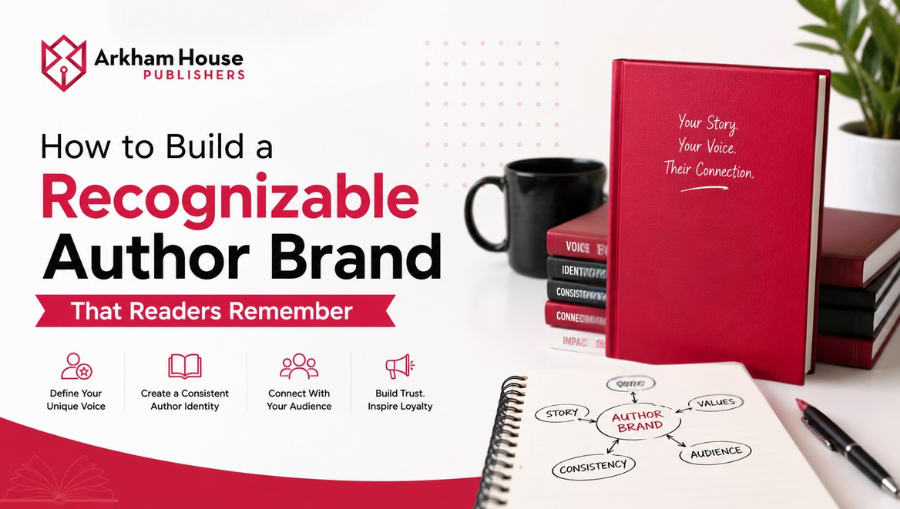
The most useful way to think about authors’ brand-building is not as a marketing campaign but as a system of recognition. Five elements do most of the work: voice, visual identity, story, reader promise, and consistency.
None requires a large audience. None depends on fame.
They can be built from the first book onward.
Your Author Voice and Positioning: The Foundation of Branding for Authors
Every writer has a subject. Strong author positioning goes deeper and asks how that writer approaches the subject differently.
Two novelists may both write family dramas. One may focus on secrets passed from one generation to another. The other may be interested in small acts of forgiveness. Two business writers may both discuss leadership. One may use research and case studies. The other may rely on personal experience and plainspoken lessons.
The category may be similar. The lens is different.
That lens should shape an author’s public voice.
Writers can uncover it by asking several plain questions. What ideas keep returning in the work? What emotions matter most? What does the author notice that others often miss? What kinds of readers tend to connect with those concerns?
The answers do not need to sound grand.
“My work explores courage” is broad enough to belong to thousands of authors.
“My work looks at the small decisions people make when fear has already entered the room” is more useful. It gives the reader something to picture.
Positioning becomes stronger as language becomes more exact.
There is a simple technique authors can use here: the recognition sentence.
Instead of writing a slogan, the author writes one private sentence that completes this thought:
Readers come to this author when they want…
The answer may be “quiet mysteries where character matters more than spectacle.” It may be “clear guidance for parents who feel overwhelmed by conflicting advice.” It may be “historical fiction that places ordinary people inside large political change.”
The sentence may never appear publicly.
Its purpose is to guide decisions. A new website page, cover concept, interview topic, article, or newsletter can be tested against it. Does the new material deepen the reader’s understanding of the author’s work, or does it create noise?
That is positioning in practice.
Visual Identity: Covers, Website, and Social Templates
Books are read in words, but authors are often encountered first through images. A visual identity creates a family resemblance among those encounters.
This does not mean every cover should look identical. In fact, forcing unrelated books into the same design can weaken them. Genre expectations matter, and each book needs its own character. What matters is coherence.
You don’t want to confuse your readers. Every reader should know what they are getting themselves into. They shouldn’t wonder if they are opening a correct link. Social media present a single unified messaging and graphics, rather than failed attempts at new design every week. The photographs, typography, the cover designing, colors, layout, etc should be consistent through the materials.
When you have unified author branding materials, your readers find you original, consistent, and someone worth following.
A literary novelist whose work is restrained and intimate may benefit from a clean, quiet website. An energetic children’s author may have more room for color and movement. A writer of serious history may favor strong typography and clear organization over dramatic effects.
The question is not “What looks impressive?”
The better question is “What looks true to the reading experience?”
That difference can save writers from expensive mistakes.
Trends move quickly. A website designed only to look fashionable may feel old within a few years. A visual identity rooted in the author’s work has a better chance of lasting.
Your Author Brand Story: The “Why I Write” Question
Most writers eventually face a version of the same interview question: Why did you write this book?
The weak answer often becomes a summary of the book.
The stronger answer reveals the writer.
An author brand story explains the relationship between the author’s life, curiosity, values, and body of work without turning the biography into a dramatic performance.
- It does not require hardship.
- It does not require a life-changing event.
- It requires specificity.
For example, a mystery writer may begin writing the mystery book after observing crime stories around him. A teacher may want to write a children’s book because she’s writing on a topic of her interest that she cannot discuss in her classroom. A business author may have watched smart teams fail because nobody knew how to speak plainly about conflict.
The useful story is not simply what happened. It is what the writer learned to notice because it happened.
That shift keeps the author’s brand story from sounding like an advertisement. It also gives readers a reason to care about the person behind the work.
The best “why I write” statements are usually modest. They reveal an enduring question rather than claiming a mission to transform the world.
A writer may not know the final answer to that question. That uncertainty can be part of the appeal.
Reader Promise: What Readers Can Always Expect
A brand becomes meaningful when it contains a promise.
The word “promise” should not be taken literally. Authors cannot guarantee that every reader will love every book. They cannot promise bestseller status, emotional transformation, or perfect satisfaction.
The promise is about intention.
It describes the kind of experience the author repeatedly tries to create.
A thriller writer may promise moral complexity and mounting tension. A romance author may promise emotional warmth and earned intimacy. A nonfiction writer may promise practical clarity without talking down to the reader.
This element of author branding is often overlooked because it cannot be photographed.
Yet it may be the most important part.
Readers return to authors because something familiar awaits them, even when the story, setting, or argument changes.
The strongest brands therefore create a useful balance between surprise and trust.
The new book must contain discovery. Otherwise there is little reason to read it.
But beneath the discovery should be something recognizable.
That recognizable quality is the reader promise.
Consistency Across Platforms
Consistency is one of the least glamorous ideas in publishing and one of the most useful.
It does not mean posting every day.
It does not mean repeating the same sentence across a website, newsletter, social page, and interview.
It means those places should feel as if the same thoughtful person is speaking through them.
If an author’s website presents a careful literary voice while social accounts use a completely unrelated public persona, readers receive mixed signals. If a writer is positioned as an expert on a focused subject but publishes random commentary on every passing issue, the central identity becomes harder to see.
Consistency is partly editorial discipline.
The writer decides what belongs.
That may require saying no to content that could gain attention but does little for the larger body of work.
Attention and recognition are not the same thing.
Attention asks whether people looked.
Author branding asks what they remembered after looking.
How to Build Your Author Brand Step by Step
A recognizable brand rarely arrives in one inspired afternoon. It develops through choices repeated over time. The process becomes easier when a writer stops trying to “create a brand” in the abstract and begins making specific decisions.
Step 1: Define Your Reader and Genre Promise
The first step is not choosing colors. It is understanding the reader. An author does not need a detailed fictional profile with a name, salary, favorite coffee order, and complete personal history. That exercise can become distracting.
Instead, the author should know three things.
- What kind of books does this reader already value?
- What does the reader hope to feel, understand, escape, question, or learn?
- Why might this author’s work become part of that reading life?
These questions help define the genre promise. Genre provides expectations. Branding adds distinction.
A fantasy writer cannot simply decide that the work should be sold as business advice because a branding exercise suggests that business readers spend more money. The books must lead the strategy. When you’re focusing on author branding for self-published authors, you have the authority on your author packaging and how you position yourself in the market. This is really important because you don’t want your readers to get confused.
Since you’re not working with a traditional publisher, you have to make every decision carefully. You have to consider the pricing strategy, the publishing discipline, website content, ad copy, and more. With every marketing material, you are revealing all about yourself and your brand authority. Clarity begins with that reader, not with the author.
Step 2: Audit Your Current Presence
Before building something new, an author should look at what already exists.
Read the biography as if it belongs to a stranger. Look at book covers side by side. Scan recent public posts. Read the description attached to an interview or podcast appearance. Examine the newsletter signup page. This audit often reveals small contradictions.
Step 3: Create a Simple Style Guide for Your Branding Strategy for Authors
Large companies may have long brand manuals. Most authors do not need one. A useful style guide can fit on a few pages.
It should record the author’s preferred name presentation, short and long biography, core topics, audience, tone, key visual choices, approved photographs, website language, and a few sentences describing the reader promise. Writers change. Books change. The document should be reviewed as the body of work develops.
Step 4: Align Your Website, Socials, and Newsletter
The author website is the one place where the writer should be able to explain the work without competing with an outside platform’s format. That makes it central to branding for authors.
A useful author site should quickly answer basic questions. Who is the writer? What books are available? What kind of work does the author create? Where can readers learn more? How can interested readers remain connected? Anything beyond that should earn its place.
Unlike the quick movement of social media, email allows a writer to build a slower relationship. It can contain reflections, reading notes, research discoveries, behind-the-scenes observations, publication news, or personal essays.
Step 5: Maintain Consistency Through Every Launch
Book launches tempt authors to abandon their own identity. Suddenly every post becomes a countdown. Every email asks readers to buy. Every page is covered in promotional language. The person readers followed seems to disappear beneath the campaign.
The author who usually writes thoughtful essays can explore the questions behind the new book. Promotion becomes more effective when it belongs to the author’s normal voice.
This is where a long-term branding strategy for authors becomes useful. It prevents each publication from feeling like an unrelated event.
Author Branding for Self-Published Authors: Turning Independence Into Coherence
Independent publishing gives an author unusual control. That control can be powerful. It can also produce fragmentation. Without a shared creative direction, each contractor may solve only the task in front of them. The cover designer makes an attractive cover. The website designer builds a polished site. The social media specialist creates bright templates. The editor sharpens the manuscript.
That is why author branding for self-published authors should begin before individual assets are commissioned.
The author should be able to explain the body of work in clear language. What does it explore? Who is it for? What tone fits? What should a reader feel when moving from the book to the website?
An author who knows the central identity can also make better hiring decisions. The right question becomes less about whether a designer’s portfolio is beautiful in general and more about whether that designer understands the specific reading experience the books need to signal.
Independent publishing works best when freedom is matched by editorial discipline.
Branding provides some of that discipline.
Authors’ Brand-Building and the Value of Repetition
A reader may need to encounter the same central idea many times before it becomes associated with an author. This does not mean repeating identical copy. It means returning to a recognizable territory.
A writer who cares about grief, family memory, and the stories people inherit may explore those ideas in fiction, interviews, essays, newsletters, and public talks. Each version can be fresh. The underlying territory remains familiar. This is how association forms.
Good authors’ brand-building therefore requires patience. The brand is not created when an author publishes a new website. It is created when the reader has seen enough connected evidence to form an expectation.
The Author Branding Quick Checklist
A useful Author Branding Quick Checklist should be short enough to return to before any major publishing decision.
An author should be able to answer these questions without reaching for marketing language:
Does the public description of the work sound like the work itself?
- Can a new reader understand what kind of writer this is within a few minutes?
- Do the book covers, website, biography, newsletter, and social presence feel connected?
- Is the author’s central voice recognizable even when the subject changes?
- Does the author brand story explain a real source of curiosity rather than manufacture drama?
- Is there a clear reader promise?
- Does each new project deepen the brand rather than confuse it?
- Are visual choices serving the books rather than following trends?
- Is the author’s public presence sustainable?
- Most important, does the brand leave enough room for the writer to grow?
If several answers are no, the solution is rarely to become louder.
It is usually to become clearer.
DIY vs. Hiring a Professional: How to Decide
Many authors can build the first version of a brand themselves. In fact, some parts should begin with the author.
No outside consultant can decide why a writer writes, what subjects matter most, what emotional experience the books should create, or what kind of relationship the writer wants with readers.
Professional help becomes valuable when those ideas need to be translated into systems and materials.
The decision should depend on need, budget, skill, and time. Authors who enjoy design and have strong visual judgment may handle more themselves. Writers who dislike technology may find a professional website worth the cost. A new author with a limited budget may begin with a clean template and invest later.
Professional support should solve a real problem. Hiring experts simply to make an author “look bigger” often leads to expensive surfaces without a strong center.
Common Author Branding Mistakes to Avoid
- The first common mistake is trying to appeal to everyone.
- Another mistake is copying a successful author too closely.
- A third mistake is confusing visibility with identity.
- A fourth mistake is over-design.
- A fifth mistake is changing direction too quickly.
But strong author branding requires enough stability for memory to form. Perhaps the most serious mistake is building an identity that the author cannot sustain.
A writer who hates daily social media should not create a brand dependent on daily social performance. An introverted author does not need to imitate an online entertainer. A serious historian does not need to become a comedian because short humorous videos are popular.
Sustainable branding respects temperament.
The best system is one the author can still live with after the excitement of the first launch is gone.
Real Examples of Strong Author Brands
Strong author brands existed long before the phrase became common.
Agatha Christie offers one clear example. Her name became closely linked with carefully structured mystery fiction, ingenious puzzles, and a particular tradition of crime storytelling. The association is strong enough that her name signals a reading experience before a specific plot is known.
Stephen King’s name has long carried another kind of recognition. Horror is central to his public identity, but the deeper association includes ordinary people confronting fear, danger, memory, and forces larger than they expected. The brand is broader than a single monster or setting, which has allowed the work to range widely without losing recognition.
Judy Blume built a different form of trust. Her books became associated with candid treatment of childhood and adolescence, including feelings young readers often found difficult to discuss openly. The recognizable quality was not a visual device. It was the willingness to take young emotions seriously.
In nonfiction, writers can create similar recognition through method.
These examples matter because they show what a strong author brand is not.
The name itself begins to carry an expectation because the work has repeated and deepened a recognizable promise.
Modern authors can use websites, newsletters, visual design, and social platforms to make that process easier.
The Brand Readers Carry With Them
The most revealing test of author branding happens when the author is not in the room.
There is no website open. No advertisement is running. No social post is asking for attention.
One reader is simply telling another about a writer.
What does that reader say?
Not the official biography. Not the tagline. Not the carefully chosen color palette.
For that reason, the strongest author branding is rarely the loudest. It is patient enough to build association. Precise enough to create distinction. Flexible enough to survive a new book. Honest enough to remain believable.
The work begins with a question that looks simple but is not: What should remain in a reader’s mind after the book is closed?
An author who can answer that question has something more useful than a slogan. The writer has a direction.
And for authors ready to turn that direction into a coherent publishing presence, Arkham House Publishers offers Affordable Book Publishing Solutions that can help connect the manuscript, presentation, author identity, and path to readers. The aim should not be to make a writer look like somebody else. It should be to make the writer’s own work easier to recognize, from the first passing glimpse of a name to the moment a reader remembers it and decides to return.