
Writing a book about your life starts with one important decision: choosing which part of your story you want to tell.
You do not need to record every event from childhood to the present day. Instead, choose a central theme, life-changing experience, relationship, struggle, or period that shaped who you became. Then identify the key moments connected to that theme and organize them into a clear narrative.
A practical process looks like this:
- Decide why you are writing.
- Identify the intended reader.
- Choose a central theme.
- Select the period you want to cover.
- Create a timeline of important memories.
- Identify the central conflict.
- Choose a structure.
- Outline the chapters.
- Write important moments as scenes.
- Revise for clarity, accuracy, and emotional depth.
This guide explains each step and shows how to turn personal memories into a focused and engaging book.
How Do You Start Writing Your Life Story?
Start by writing down the experiences that still feel important to you.
These may include major turning points, difficult decisions, meaningful relationships, losses, achievements, failures, moves, career changes, family events, or moments when your view of life changed.
Do not worry about putting everything in order at first. Your first goal is to collect the raw material.
Create a simple memory list using questions such as:
- Which experiences changed the direction of my life?
- What challenge affected me most deeply?
- Which relationship shaped my identity?
- What period of my life do I understand differently now?
- What have I learned that could help another person?
- Which memories do I keep returning to?
- What did I once believe that I no longer believe?
Once you have a list, look for connections. Several memories may relate to the same theme, such as grief, survival, family, ambition, identity, migration, faith, addiction, parenthood, business, or personal growth.
That shared theme can become the foundation of your book.
Should You Write a Memoir or an Autobiography?
A memoir and an autobiography are both based on the author’s real life, but they usually have different scopes.
A memoir commonly focuses on a particular experience, period, relationship, or theme. An autobiography generally gives a broader and more chronological account of the writer’s life.
| Memoir |
Autobiography |
| Focuses on a selected part of life | Covers most or all of a life |
| Organized around a theme or experience | Often organized chronologically |
| Gives more space to reflection | Gives more space to historical detail |
| Explores what events meant to the author | Records what happened across a lifetime |
| May move between different periods | Usually follows a clearer timeline |
A private family history can be different from both. Its purpose may be to preserve memories, traditions, photographs, family records, and personal stories for future generations rather than reach a commercial audience.
Choose a memoir when one period or subject contains your strongest story. Choose an autobiography when your complete life journey is important to the book’s purpose.
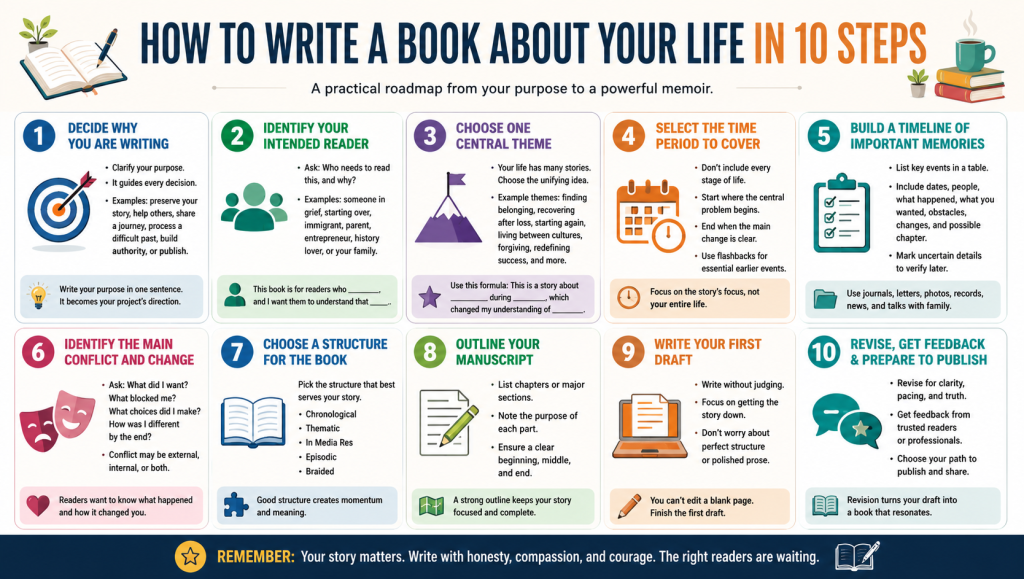
How to Write a Book About Your Life in 10 Steps
-
Decide Why You Are Writing
Your reason for writing affects every later decision.
You may want to:
- Preserve your story for your family
- Help readers facing a similar struggle
- Share a professional or personal journey
- Explore a difficult period in your past
- Record an unusual experience
- Build authority around your work
- Publish a commercially appealing memoir
Write your purpose in one sentence.
For example:
I want to show how rebuilding my life after losing my business changed my understanding of success.
This statement gives your project direction. It tells you which memories belong in the book and which ones may distract from it.
A book written for children and grandchildren may include more family background. A memoir intended for general readers needs a stronger narrative, clear conflict, and a reason for strangers to care.
-
Identify Your Intended Reader
Many people begin a life story by asking, “What do I want to say?”
A stronger question is, “Who needs to read this, and why?”
Your intended reader may be:
- Someone experiencing grief
- A person starting over after failure
- A first-generation immigrant
- A parent facing a family crisis
- An entrepreneur building a company
- A reader interested in a particular time or place
- Members of your family
Knowing the reader helps you choose the right background information, tone, pace, and level of detail.
A stranger will not understand family references or private jokes without explanation. A family member may already know the people involved but value details about places, traditions, and earlier generations.
Try completing this sentence:
This book is for readers who ________, and I want them to understand that ________.
Your answer becomes a filter for the entire manuscript.
-
Choose One Central Theme
Your life contains many stories, but your book needs a unifying idea.
A theme is not simply a topic. “My career” is a topic. “Learning that professional success could not replace personal purpose” is a theme.
Other possible themes include:
- Finding belonging
- Recovering after loss
- Breaking a family pattern
- Learning to forgive
- Starting again
- Living between two cultures
- Redefining success
- Surviving an abusive environment
- Building a family
- Accepting change
- Discovering independence
Your theme does not need to be stated directly in every chapter. It should work quietly beneath the events and connect them.
Use this formula:
This is a story about ________ during ________, which changed my understanding of ________.
Example:
This is a story about caring for my mother during the final two years of her life, which changed my understanding of love, responsibility, and grief.
That is more focused than saying, “This is a book about my family.”
-
Select the Time Period to Cover
A common mistake is trying to include every stage of life.
A strong memoir usually begins where the central problem starts to develop and ends when the main emotional change becomes clear.
Ask:
- What event begins the real story?
- When does the main conflict appear?
- Which earlier events must the reader understand?
- At what point has the narrator changed?
- Where does the central question reach an answer?
You can include earlier memories through short flashbacks when they help explain a decision, relationship, fear, or belief.
Avoid adding childhood stories simply because they happened first. Include them when they serve the central narrative.
Writers and editors commonly advise memoirists to identify the story’s focus rather than starting automatically at birth or following every year in order.
-
Build a Timeline of Important Memories
Now collect the events that may belong in your book.
Create a document or spreadsheet with these columns:
- Approximate date
- Your age
- Location
- People involved
- What happened
- What you wanted
- What stood in your way
- What changed afterward
- Possible chapter
- Evidence or records available
You do not need perfect dates during the first draft. Mark uncertain details so you can verify them later.
Useful sources may include:
- Journals
- Letters
- Emails
- Photographs
- Calendars
- Medical or school records
- News reports
- Legal documents
- Travel records
- Conversations with relatives
- Social media posts
Memories can be emotionally accurate while still being incomplete. Comparing your recollection with records and other people’s accounts can help you identify missing details.
Other people may remember the same event differently. You do not have to adopt their interpretation, but knowing that different versions exist can help you write more carefully.
-
Identify the Main Conflict and Change
A collection of memories is not automatically a story.
A story needs movement. The main character wants something, faces resistance, makes decisions, and changes.
In a memoir, the main character is a younger version of you. The narrator is the present-day version looking back.
Ask four questions:
- What did I want at the beginning?
- What prevented me from getting it?
- What choices did I make?
- How was I different by the end?
The conflict may be external, such as illness, discrimination, poverty, war, divorce, or business failure.
It may also be internal, such as shame, fear, denial, pride, grief, or the need for approval.
Many effective memoirs contain both. The external events create pressure, while the internal conflict gives those events meaning.
For example, a memoir about moving to another country may involve language barriers, financial problems, and cultural differences. Its deeper conflict may concern identity and belonging.
The reader continues because they want to know both what happened and how the experience changed you.
-
Choose a Structure for the Book
Your structure determines how the reader experiences your story.
Chronological structure
The events appear mainly in the order they occurred.
This approach works well when one event naturally leads to another and the transformation develops over time.
Thematic structure
The chapters are grouped by subjects, relationships, values, places, or lessons.
This may work for family histories, essay collections, travel memoirs, or books covering a long period.
Braided structure
Two or more timelines or themes alternate throughout the book.
For example, one timeline may follow your childhood while another follows your present-day attempt to understand it.
Framed structure
The book begins with a major present-day event. Earlier chapters then explain how you reached that point before returning to the opening situation.
Quest structure
The story follows a clear pursuit, such as finding a relative, recovering from illness, completing a journey, building a company, or seeking an answer.
Whichever structure you select, the reader should be able to recognize a beginning, middle, and end. A memoir outline often becomes clearer when the writer identifies important scenes and arranges them around the main narrative movement.
-
Outline the Chapters
An outline prevents the manuscript from becoming a collection of loosely connected memories.
Start with the major stages of the story:
Beginning: Introduce the central situation, desire, or problem.
Middle: Show the complications, mistakes, discoveries, and increasing pressure.
End: Show the decisive moment, consequences, and change in understanding.
Next, turn those stages into chapters.
For every chapter, write:
- What happens?
- What does the main character want?
- What creates conflict?
- What new information appears?
- What decision is made?
- What changes before the chapter ends?
- Why does this chapter belong in the book?
A chapter should perform a clear job. It may reveal a relationship, raise the stakes, change the direction of the story, explain an important belief, or move the main character closer to a decision.
If removing a chapter does not affect the story, that chapter may need to be cut, combined, or rewritten.
-
Write in Scenes, Not Only Summaries
Summary tells the reader what happened over time.
Scene places the reader inside a specific moment.
Compare these examples.
Summary:
My father and I often argued about my career. He wanted me to join the family business, but I wanted to become a teacher.
Scene:
My father pushed the application across the kitchen table.
“The position is ready,” he said. “You can start Monday.”
I kept my hands under the table. The acceptance letter from the teaching program was folded inside my pocket.
The scene gives the reader a location, action, tension, and unanswered question.
Build important scenes using:
- A specific place and time
- Sensory details
- Action
- Dialogue
- Conflict
- A clear point of view
- A change by the end of the scene
Use reflection after or within the scene to explain what you understand now.
For example:
At twenty-three, I thought the argument was about employment. Years later, I understood that my father heard my decision as a rejection of everything he had built.
That difference between the younger self and the present narrator creates depth.
Do not invent precise dialogue and present it as certain when you cannot reasonably remember it. You can reconstruct the substance of a conversation carefully, avoid quotation marks, or explain in an author’s note that some dialogue has been reconstructed from memory.
-
Revise for Clarity and Emotional Truth
Finishing the first draft is not the end of the process. It gives you material to shape.
Begin revision with the story rather than individual sentences.
Ask:
- Is the main theme clear?
- Does the book begin in the right place?
- Is the central conflict introduced early enough?
- Does each chapter move the story forward?
- Have I included too much background?
- Are important emotional changes visible?
- Have I portrayed myself honestly?
- Does the ending answer the question raised at the beginning?
- Are any events repeated?
- Does the reader understand why the story matters?
Then review the writing at the sentence level.
Look for:
- Long explanations
- Repeated ideas
- Unnecessary names
- Vague descriptions
- Slow openings
- Excessive backstory
- Unclear timelines
- Unsupported factual claims
- Dialogue that sounds unnatural
- Reflection that explains too much
Give the manuscript time to rest before revising. Distance can help you see what is actually on the page rather than what you intended to write.
After your own revisions, consider using beta readers, a developmental editor, a copy editor, and a proofreader. Each role serves a different purpose.
A developmental editor focuses on structure, content, pacing, character development, and the reader’s experience. A copy editor addresses clarity, consistency, grammar, and style. A proofreader checks the final version for remaining errors.
What Should You Leave Out of a Life Story?
You are not required to include something simply because it happened.
Leave out material that:
- Does not support the central theme
- Repeats a point already established
- Adds names without adding meaning
- Requires too much explanation for too little value
- Slows the main story
- Exists only to settle a personal score
- Exposes private information without a clear purpose
- Cannot be presented responsibly
- Belongs in a different book
You may have vivid memories that matter deeply to you but do not belong in this particular manuscript.
Save them in a separate document. Cutting them from one book does not erase them.
Also distinguish between honesty and total disclosure. Honest writing does not require publishing every private detail. It requires avoiding deliberate deception about the events you choose to include.
How Should You Write About Real People?
Writing about real people requires care, especially when the story includes accusations, private information, medical details, criminal conduct, abuse, professional misconduct, or identifiable individuals.
Changing a person’s name does not always make them unrecognizable. Details involving location, profession, family relationships, timing, and specific events may still reveal their identity.
Before publication:
- Verify factual statements where possible.
- Separate your observations from assumptions.
- Avoid stating rumors as facts.
- Keep records supporting serious claims.
- Consider whether private details are necessary.
- Request permission before reproducing letters, emails, photographs, lyrics, or other copyrighted material that you do not own.
- Consider an experienced publishing attorney’s review when the manuscript creates meaningful legal risk.
Writers covering real people may face concerns involving defamation, privacy, publicity rights, and copyright. The exact rules vary by jurisdiction and by the facts of the case.
Copyright protection for your own original writing generally begins when the work is fixed in a tangible form. In the United States, registration creates a public record and provides additional legal benefits.
This section provides general publishing information, not legal advice.
Example of a Memoir Chapter Outline
Suppose the memoir is about rebuilding a life after a failed family business.
Chapter 1: The Locked Door
The narrator arrives at the business and discovers that the landlord has changed the locks. The immediate crisis introduces the central question: What remains when the work that defined you disappears?
Chapter 2: The Family Name
The story moves back to childhood and explains how the business became tied to family identity, loyalty, and personal worth.
Chapter 3: Taking Control
The narrator joins the company as a young adult and believes hard work will solve its financial problems.
Chapter 4: Warning Signs
Unpaid invoices, staff departures, and family disagreements reveal that the company is in deeper trouble.
Chapter 5: The Decision
The narrator takes on debt to protect the business. This choice increases both financial and emotional pressure.
Chapter 6: The Collapse
The company closes. Relationships break down, and the narrator loses a sense of purpose.
Chapter 7: The Quiet Months
Without the business, the narrator struggles with shame and isolation while beginning to examine the beliefs that shaped earlier choices.
Chapter 8: Starting Again
A smaller opportunity appears. The narrator must decide whether rebuilding means recreating the past or choosing a different life.
Chapter 9: A New Definition of Success
The narrator begins work on different terms and repairs selected family relationships.
Chapter 10: The Unlocked Door
The ending returns to an image from the opening chapter. The narrator understands that losing the company ended one identity but made another possible.
This outline does not contain every event in the person’s life. It selects the moments that develop one central transformation.
How Long Should a Book About Your Life Be?
There is no universal length for a life story.
A private family history may be short and highly visual. A focused personal essay may contain only a few thousand words. A full commercial memoir usually needs enough space to develop scenes, relationships, conflict, and reflection.
Publishing guidance frequently places commercial memoirs around 80,000 to 90,000 words, although shorter and longer books are published. Manuscripts well above 100,000 words may be more difficult for a new author to submit unless the length is clearly justified.
Treat these figures as market guidance, not a rule.
The right length depends on:
- The story’s scope
- The intended audience
- The publishing route
- The number of timelines
- The amount of historical context
- Whether photographs or documents are included
- Whether the manuscript is a memoir, autobiography, or family history
Focus on completing the story without unnecessary repetition. Word count can be refined during revision.
How to Edit and Publish Your Life Story
Once the manuscript is complete, decide how you want to publish it.
Traditional publishing
In traditional publishing, an author usually approaches literary agents or publishers with a query letter, proposal, sample chapters, or complete manuscript, depending on the submission requirements.
A publisher normally manages editing, design, printing, and distribution. However, acceptance is competitive, and the process can take considerable time.
Memoir proposals often need to explain:
- The central idea
- Intended audience
- Comparable titles
- Author background
- Marketing platform
- Chapter outline
- Sample chapters
- Why the book is different
Self-publishing
Self-publishing gives the author more control over the schedule, editing, design, pricing, and distribution.
It also makes the author responsible for managing or hiring professionals for:
- Developmental editing
- Copy editing
- Proofreading
- Interior formatting
- Cover design
- Metadata
- Distribution
- Marketing
Amazon KDP currently allows authors to publish eBooks, paperbacks, and hardcovers. It also offers free ISBNs for eligible paperback and hardcover editions, although those free ISBNs are limited to KDP. Authors who want greater imprint and distribution flexibility may purchase their own ISBN through the relevant ISBN agency.
Assisted or hybrid publishing
Some companies provide paid publishing packages that may include editing, design, printing, distribution, or marketing support.
Services and contracts vary greatly. Before signing, examine:
- Who owns the files and rights
- Which services are included
- Total costs
- Royalty terms
- Distribution details
- Revision limits
- Cancellation clauses
- Sales claims
- Marketing responsibilities
A professional publisher should explain its process clearly and provide a written agreement before work begins.
Start With the Story That Matters Most
Writing a book about your life is not the same as recording everything that has ever happened to you.
Your task is to identify the experience that carries the greatest meaning, understand how it changed you, and present it through carefully chosen scenes.
Begin with one memory. Describe where you were, what you wanted, who was present, what stood in your way, and what changed afterward.
Then write the next important moment.
A complete life story is built one focused scene at a time.