

Print on demand is a craft, a choice that makes a Lulu book look, feel, and read like am expert.
A book is born twice. The first time, it is written in private, whether quiet pages, private doubt, or the glow of a screen at midnight. The second time, it is manufactured. It must fit a trim size. It must survive a spine. It must arrive in a stranger’s hands without looking like a rushed homework packet.
That second birth is where many first-time authors stall. Not because they lack talent, but because publishing asks new questions. What paper? What margins? What price? What happens if the proof looks wrong?
This blog explains self-publishing on Lulu with steady, practical steps and a simple technique to keep you sane while you do it. Lulu can be a strong tool for authors right now because print-on-demand has turned “book production” into a set of clicks. But the culture around books has also gotten louder and faster. The writers who do well are not always the ones who rush. They are the ones who learn the process, make clean choices, and ship a book they’re proud to stand behind.
Understanding Lulu Book Publishing
Lulu sits in a modern, crowded middle space: not a traditional publisher, not a private print shop, but a platform that helps authors print and sell books without paying for a huge inventory up front. That difference matters. Traditional publishing often asks for patience and permission. Lulu book publishing asks for preparation and responsibility.
Print-on-demand is the key idea here. In a print-on-demand model, books can be printed as orders come in. That helps authors avoid the classic beginner disaster: ordering a thousand copies and storing them under a bed, where they gather dust and guilt. It also changes the rhythm of publishing. Instead of thinking, “How many do I print?” the author thinks, “How do I make one copy look great, every time it prints?”
This is why Lulu self publishing can feel empowering. It puts the author in control of the schedule, the revisions, the format, and the pricing. But it also means the author becomes the quality department. The platform will not write your back cover copy. It will not fix a crooked spine file. You will not notice that your chapter titles look tiny on paper. The author must look.
Here is the small truth that makes the whole process easier: Lulu is less like a gate and more like a mirror. It reflects your file choices back to you. If you feed it clean files and clear decisions, you often get a clean book. If you feed it messy files and fuzzy decisions, you often get a messy surprise.
What Is Lulu Publishing?
Lulu Publishing is a self-service publishing approach built around printing and, depending on the author’s choices, selling. It can support paperbacks, hardcovers, and other formats that fit within the platform’s options. Many authors use Lulu for novels, memoirs, poetry, journals, workbooks, and short nonfiction.
It helps to be clear about what Lulu is not. Lulu is not a traditional publisher that selects a manuscript, edits it, designs it, and then places it in stores with a dedicated sales force. Lulu is a toolset. It can print your book. It can help you sell copies in certain ways. But it does not replace the work of editing, design, or marketing. That distinction is not an insult. It is the point. For an author who wants control and speed and who is willing to learn basic production skills, Lulu can be a practical route to publication.
So, before the steps begin, here is the technique that makes everything smoother.
The Proof-First Technique (the calm way to publish on Lulu)
Treat the first upload as a draft, not a finish line. Build your Lulu project early, upload your current files, and order a proof copy as soon as the platform allows. Then make revisions based on what the paper shows you. This technique does two important things:
- It turns anxiety into evidence. You stop guessing how the book will look. You see it.
- It prevents expensive mistakes. Fixing a file before wide distribution is far easier than fixing it after readers have bought a flawed version.
Authors who publish well often do not “get it right” on the first proof. They get it right on the second proof because they used the first proof to learn.
How Do I Get My Book Published Through Lulu?
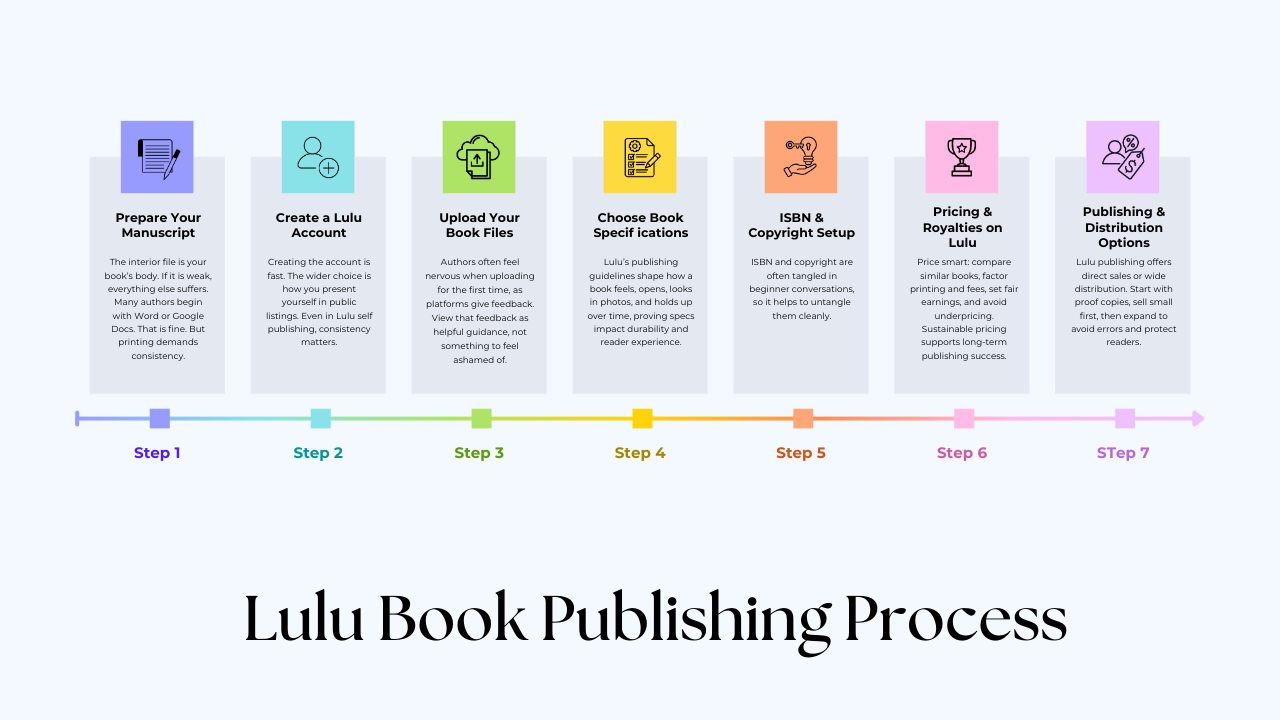
If you’re wondering how to get my book published through Lulu, then below is a publish on Lulu step by step walkthrough that matches the usual Lulu publishing process and keeps the focus on what first-time authors most often miss.
Step 1: Prepare Your Manuscript
The interior file is your book’s body. If it is weak, everything else suffers. Many authors begin with Word or Google Docs. That is fine. But printing demands consistency.
Before you format, decide the book’s shape. Choose a trim size early because trim size affects margins, page flow, and page count. Then format with print in mind:
- Use real paragraph styles for headings and body text (not manual bolding everywhere).
- Keep margins generous. Print needs space for fingers, binding, and comfort.
- Use page breaks to control chapter starts.
- Avoid tiny fonts. What looks “normal” on a screen can look cramped on paper.
- If you include images, use high-quality originals. Low-resolution images can look harsh when printed.
Most Lulu workflows end with an exported PDF for the interior. A good interior PDF is predictable: consistent fonts, clean spacing, and correct page size.
A simple proofing habit helps here. Do a “three-pass read” before you export:
- Structure pass: Chapter order, headings, page breaks, table of contents (if used).
- Typography pass: Font size, line spacing, widows/orphans, weird indenting, spacing errors.
- Detail pass: Spelling, punctuation, missing words, repeated lines.
This is the core of a practical Lulu publishing guide: clean files first, fancy decisions later.
Step 2: Create a Lulu Account
Creating the account is fast. The wider choice is how you present yourself in public listings. Even in Lulu self publishing, consistency matters. Decide:
- Author name (and whether it matches your website/social profiles)
- Book title and subtitle (exact spelling and capitalization)
- A short description that matches your tone
- Your “publisher” name or imprint name (optional, but useful if you plan multiple books)
These details become part of your metadata footprint. Readers may not think about metadata, but they feel its effects. Clean metadata makes a book easier to find and easier to trust.
One small warning: avoid changing your title and author name repeatedly once you publish widely. It can create confusion for listings and readers. If you are uncertain, test your description and cover concept before you lock them in.
Step 3: Upload Your Book Files
Uploading is where authors often feel the most nervous, because it’s the first time the platform gives feedback. The key is to treat feedback as information, not as shame.
When you upload, you are usually handling two files:
- Interior file (often PDF)
- Cover file (often PDF, built to a template)
If the platform flags errors, the most common causes are simple:
- Wrong page size (interior does not match chosen trim size)
- Missing bleed on the cover
- Text placed too close to the trim edge
- Low image quality in the cover
- Fonts not embedded properly
The practical move is to keep your working files organized. Name versions clearly. Save export settings. Track what you changed between uploads. This turns a stressful process into a repeatable one.
In a true publish on Lulu step by step mindset, Step 3 is not “upload once and pray.” It is “upload, test, revise.”
Step 4: Choose Book Specifications
This is where Lulu’s book publishing guidelines quietly shape the reader’s experience. Book specs are not cosmetic. They determine how the book feels in the hand, how it opens, how it photographs, and how it survives use.
Typical spec choices include:
- Trim size
- Binding type (paperback or hardcover)
- Interior color option (black-and-white vs color)
- Paper type (if multiple options exist)
- Cover finish (often glossy or matte, where available)
A helpful approach is to choose specs based on the book’s job:
- A novel should be comfortable to hold for long reading sessions.
- A workbook should have margins and paper that welcomes writing.
- A photo-heavy book needs paper choices that respect images.
- A poetry book may benefit from more whitespace and a quieter finish.
Step 5: ISBN & Copyright Setup
ISBN and copyright are often tangled in beginner conversations, so it helps to untangle them cleanly.
- Copyright protects original expression. In many places, copyright exists when a work is created and fixed in a tangible form. Registration rules vary, and authors should research what applies to them and their goals.
- ISBN is an identifier used in retail and library systems to track editions and formats.
Whether you need an ISBN depends on where you want the book to travel. If you want the book easily ordered through certain channels, an ISBN can help. If you plan to sell mostly direct, you may decide it is not essential for your first run.
Because platform options and requirements can change, authors should rely on Lulu’s current in-platform guidance for ISBN choices and distribution settings. The best practice is simple: choose the ISBN path that matches your distribution plan, not the one that sounds most “official.”
This step is part of the Lulu publishing process that often feels intimidating. It becomes easier when you treat it as a routing choice: where do you want the book to be found?
Step 6: Pricing & Royalties on Lulu
Pricing is where the dream touches math. In print-on-demand, the author’s earnings usually come down to a basic structure:
List price – printing cost – channel-related fees/discounts = earnings
The exact details depend on format and distribution choices. The important thing is not to memorize a percentage. It is to understand the forces that shape your price.
Here is a calm pricing method:
- Look at similar books in your genre and format.
- Check your printing cost for your chosen specs.
- Decide what minimum earnings per copy feel fair to you.
- Set a list price that can survive discounts in wider channels, if you enable them.
A common mistake is pricing too low out of fear. That often leads to disappointment later when earnings are tiny. Another mistake is pricing too high without offering a clear reason (format, length, special design). Readers can accept many prices when the value feels honest.
If your goal is to Publish Your Book on Lulu and keep publishing, price it in a way that lets you afford future proofs, future edits, and future covers. A book is not only a product. It is also a bridge to the next book.
Step 7: Publishing & Distribution Options
“Publishing” on Lulu can mean different release shapes. The author might:
- Sell copies directly through tools connected to Lulu
- Order author copies for events, classrooms, or direct shipping
- Enable broader distribution options where available
Each choice has tradeoffs.
Direct sales can offer more control and better margins, but the author must bring the readers. Wider distribution can offer reach, but it often includes retailer discounts and can reduce earnings per copy. A thoughtful launch often starts smaller and grows:
- Publish and proof the product
- Sell direct or in a limited way first
- Expand distribution after you trust the files and the physical quality
This is not caution for its own sake. It is respect for readers. The author who uses the Proof-First Technique prevents the worst scenario: a flawed edition circulating widely before it is fixed.
How Long Does It Take to Publish a Book on Lulu?
The platform steps can move quickly. The slower part is the part that matters: making the files and the physical book good.
A realistic first-time timeline often looks like this:
- Manuscript formatting: a few days to a few weeks, depending on complexity
- Cover design and setup: a few days to a few weeks, depending on design skill and revisions
- Upload and checks: often same day, sometimes multiple rounds
- Proof copy shipping: varies by location and shipping option
- Proof review and revisions: a few days (if minor) to a few weeks (if major)
- Final publish settings: usually quick once files are stable
If you have a launch date, build a buffer. Not because you expect failure, but because you respect physics: printing and shipping take time.
A useful rule: if the book matters to you, plan for at least one full proof-and-revise cycle. Authors who rush past proofing often end up doing a worse kind of waiting later, waiting while they fix problems in public.
Pros and Cons of Publishing Through Lulu
Lulu is not a miracle and not a trap. It is a tool. Tools are judged by fit.
Pros
- Print-on-demand reduces inventory risk
- Good for testing editions and making updates
- Useful for author copies and small-batch needs
- Gives authors control over schedule and creative choices
- Can be a practical entry into self-publishing without large upfront printing runs
Cons
- File preparation requires care and patience
- Per-copy costs can limit how low you can price
- Some distribution options (if enabled) may reduce margins
- Quality depends heavily on specs, files, and proofing discipline
- The author must handle or hire editing and design for a polished result
The honest critical point is this: Lulu rewards authors who like the process. If an author hates the process, Lulu can feel frustrated. If an author can treat the process as a craft, Lulu can feel freeing.
Is Lulu Worth It for First-Time Authors in 2026?
For many first-time authors, Lulu can be worth it because it lowers the cost of entry and encourages learning through proofreading. A first book is often a learning book, even when it is also a beautiful one. Lulu’s workflow makes that learning visible: upload, proof, revise, publish.
But it’s not automatically the best choice for every debut. A children’s picture book with strict color needs may require more testing. A heavily designed coffee-table book may demand a level of paper and color control that takes time and careful selection. A writer who wants a hands-off service might prefer a different path or might need professional help to make Lulu work smoothly.
Still, Lulu’s value for beginners is real when authors approach it with the Proof-First Technique and a clear goal. The goal is not to “get published” as fast as possible. The goal is to publish a book that looks intentional and to learn a process you can repeat.
Many careers are built this way: one clean first edition, then a better second book, then a third that feels effortless because the author now understands production.
Is Lulu Good for Self-publishing?
Lulu is often a good fit when:
- You want print-on-demand flexibility
- You want to avoid ordering a large inventory
- You plan to sell direct, at events, or in controlled channels
- You want the ability to revise and re-upload files for new editions
- You are willing to learn basic production steps or hire help
It may be less ideal when:
- Your book needs a complex layout, and you have no design support
- You need strict, consistent color accuracy and cannot tolerate iteration
- You want a fully managed publishing experience without learning tools
- Your distribution goals require a different platform’s specific strengths
A simple decision test can help:
- What format does the book want to be? (paperback, hardcover, workbook, journal)
- Where will most sales come from? (direct, events, online listings, bookstores)
- How comfortable are you with proofing and revising files?
- Do you have a budget for editing and design if you need it?
If the answers point toward control, flexibility, and careful proofing, Lulu is often a reasonable choice. If the answers point toward hands-off service, the author may still use Lulu but with professional support.
How Arkham House Help Authors Publish a Book on Lulu?
Lulu makes publishing accessible, but it does not make it effortless. It assumes the author can format an interior file cleanly, build a correct cover, interpret file-check errors, and make smart choices about specs and pricing. Many writers can learn that. Many others would rather spend their time writing the next book.
Arkham House Publishers helps authors Publish Your Book on Lulu by handling the parts that most often slow a release: interior formatting that meets platform requirements, cover setup aligned to Lulu templates, proof review support, and practical guidance on book specifications so the final copy looks intentional in a reader’s hands. For authors who want a steadier path without guesswork, Arkham House Publishers offers affordable and professional book publishing services, so the manuscript’s second birth, the one made of paper and margins and proofs, is as thoughtful as the first.